




dn16:5.1.0 26. The Pair of Sal Trees
BAGIAN 5
dn16:5.1.1 Then the Buddha said to Ānanda,
dn16:5.1.2 “Come, Ānanda, let’s go to the far shore of the Golden River, and on to the sal forest of the Mallas at Upavattana near Kusinārā.”
dn16:5.1.3 “Yes, sir,” Ānanda replied.
dn16:5.1.4 And that’s where they went. Then the Buddha addressed Ānanda,
dn16:5.1.5 “Go on then, Ānanda, set up a cot for me between the twin sal trees, with my head to the north. I am tired and will lie down.”
dn16:5.1.6 “Yes, sir,” replied Ānanda, and did as he was asked.
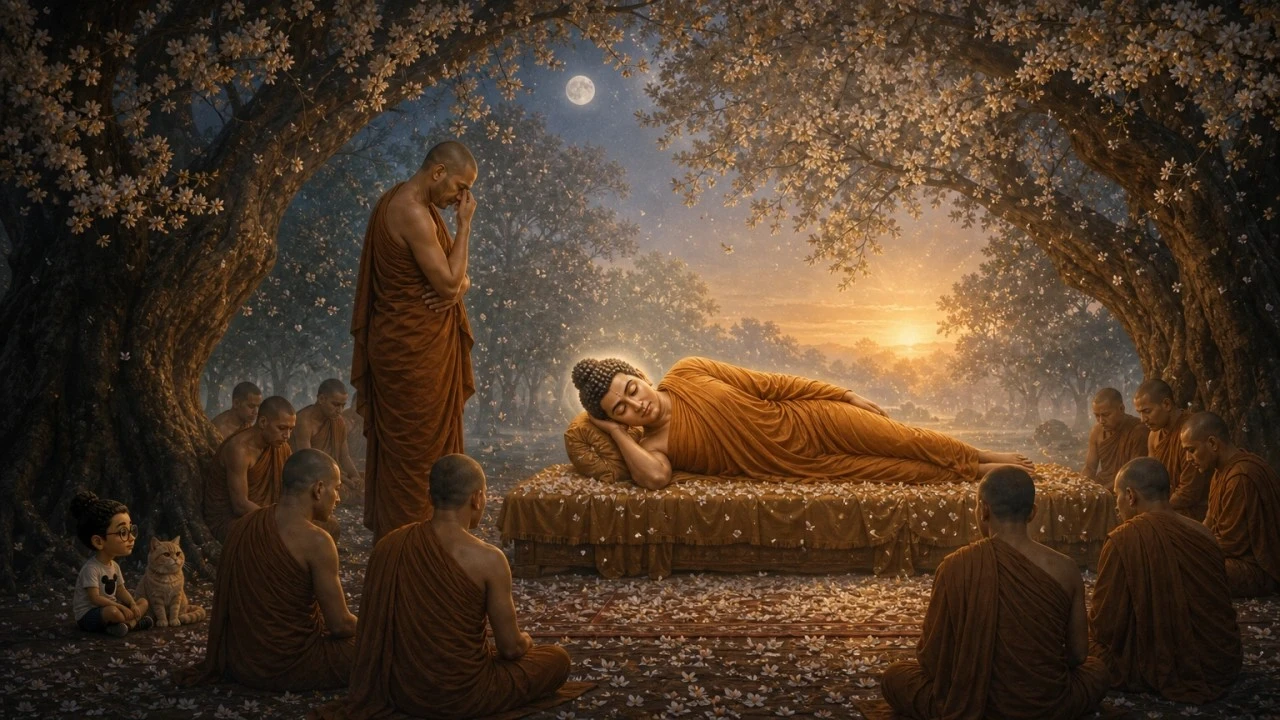
dn16:5.1.7 And then the Buddha laid down in the lion’s posture—on the right side, placing one foot on top of the other—mindful and aware.
dn16:5.2.1 Now at that time the twin sal trees were in full blossom with flowers out of season.
dn16:5.2.2 They sprinkled and bestrewed the Realized One’s body in honor of the Realized One.
dn16:5.2.3 And the flowers of the heavenly Flame Tree fell from the sky, and they too sprinkled and bestrewed the Realized One’s body in honor of the Realized One.
dn16:5.2.4 And heavenly sandalwood powder fell from the sky, and it too sprinkled and bestrewed the Realized One’s body in honor of the Realized One.
dn16:5.2.5 And heavenly music played in midair in honor of the Realized One.
dn16:5.2.6 And heavenly choirs sang in midair in honor of the Realized One.
dn16:5.3.1 Then the Buddha pointed out to Ānanda what was happening, adding:
dn16:5.3.8 “That’s not the full extent of how the Realized One is honored, respected, revered, venerated, and esteemed.
dn16:5.3.9 Any monk or nun or male or female lay follower who practices in line with the teaching, practicing properly, living in line with the teaching—they honor, respect, revere, venerate, and esteem the Realized One with the highest honor.
dn16:5.3.10 So Ānanda, you should train like this: ‘We shall practice in line with the teaching, practicing properly, living in line with the teaching.’”
dn16:5.4.0 27. The Monk Upavāṇa
dn16:5.4.1 Now at that time Venerable Upavāṇa was standing in front of the Buddha fanning him.
dn16:5.4.2 Then the Buddha made him move,
dn16:5.4.3 “Move over, mendicant, don’t stand in front of me.”
dn16:5.4.4 Ānanda thought,
dn16:5.4.5 “This Venerable Upavāṇa has been the Buddha’s attendant for a long time, close to him, living in his presence.
dn16:5.4.6 Yet in his final hour the Buddha makes him move, saying:
dn16:5.4.7 ‘Move over, mendicant, don’t stand in front of me.’
dn16:5.4.8 What is the cause, what is the reason for this?”
dn16:5.5.1 Then Ānanda said to the Buddha,
dn16:5.5.2 “This Venerable Upavāṇa has been the Buddha’s attendant for a long time, close to him, living in his presence.
dn16:5.5.3 Yet in his final hour the Buddha makes him move, saying:
dn16:5.5.4 ‘Move over, mendicant, don’t stand in front of me.’
dn16:5.5.5 What is the cause, sir, what is the reason for this?”
dn16:5.5.7 “Most of the deities from ten solar systems have gathered to see the Realized One.
dn16:5.5.8 For twelve leagues all around this sal grove there’s no spot, not even a fraction of a hair’s tip, that’s not crowded full of illustrious deities.
dn16:5.5.9 The deities are complaining:
dn16:5.5.10 ‘We’ve come such a long way to see the Realized One!
dn16:5.5.11 Only rarely do Realized Ones arise in the world, perfected ones, fully awakened Buddhas.
dn16:5.5.12 This very day, in the last watch of the night, the Realized One will be fully extinguished.
dn16:5.5.13 And this illustrious mendicant is standing in front of the Buddha blocking the view. We won’t get to see the Realized One in his final hour!’”
dn16:5.6.1 “But sir, what kind of deities are you thinking of?”
dn16:5.6.2 “There are, Ānanda, deities—both in space and on the earth—who are aware of the earth. With hair disheveled and arms raised, they fall down like their feet were chopped off, rolling back and forth, lamenting:
dn16:5.6.3 ‘Too soon the Blessed One will be fully extinguished! Too soon the Holy One will be fully extinguished! Too soon the Eye of the World will vanish!’
dn16:5.6.6 But the deities who are free of desire endure, mindful and aware, thinking:
dn16:5.6.7 ‘Conditions are impermanent. How could it possibly be otherwise?’”
dn16:5.7.0 28. The Four Inspiring Places
dn16:5.7.1 “Previously, sir, when mendicants had completed the rainy season residence in various districts they came to see the Realized One.
dn16:5.7.2 We got to see the esteemed mendicants, and to pay homage to them.
dn16:5.7.3 But when the Buddha has passed, we won’t get to see the esteemed mendicants or to pay homage to them.”
dn16:5.8.1 “Ānanda, a faithful gentleman should go to see these four inspiring places.
dn16:5.8.2 What four?
dn16:5.8.3 Thinking: ‘Here the Realized One was born!’—that is an inspiring place.
dn16:5.8.4 Thinking: ‘Here the Realized One became awakened as a supreme fully awakened Buddha!’—that is an inspiring place.
dn16:5.8.5 Thinking: ‘Here the supreme Wheel of Dhamma was rolled forth by the Realized One!’—that is an inspiring place.
dn16:5.8.6 Thinking: ‘Here the Realized One was fully quenched in the element of extinguishment with no residue!’—that is an inspiring place.
dn16:5.8.7 These are the four inspiring places that a faithful gentleman should go to see.
dn16:5.8.8 Faithful monks, nuns, laymen, and laywomen will come, and think:
dn16:5.8.9 ‘Here the Realized One was born!’ and ‘Here the Realized One became awakened as a supreme fully awakened Buddha!’ and ‘Here the supreme Wheel of Dhamma was rolled forth by the Realized One!’ and ‘Here the Realized One was fully quenched in the element of extinguishment with no residue!’
dn16:5.8.10 Anyone who passes away while on pilgrimage to these shrines will, when their body breaks up, after death, be reborn in a good place, a heavenly realm.”
dn16:5.9.0 29. Ānanda’s Questions
dn16:5.9.1 “Sir, how do we proceed when it comes to ladies?”
dn16:5.9.2 “Without looking, Ānanda.”
dn16:5.9.3 “But when looking, how to proceed?”
dn16:5.9.4 “Without chatting, Ānanda.”
dn16:5.9.5 “But when chatting, how to proceed?”
dn16:5.9.6 “Be mindful, Ānanda.”
dn16:5.10.1 “Sir, how do we proceed when it comes to the Realized One’s corpse?”
dn16:5.10.2 “Don’t get involved in the rites for venerating the Realized One’s corpse, Ānanda.
dn16:5.10.3 Please, Ānanda, you must all strive and practice for your heart’s goal! Meditate diligent, keen, and resolute for your heart’s goal!
dn16:5.10.4 There are astute aristocrats, brahmins, and householders who are devoted to the Realized One. They will perform the rites for venerating the Realized One’s corpse.”
dn16:5.11.1 “But sir, how to proceed when it comes to the Realized One’s corpse?”
dn16:5.11.2 “Proceed in the same way as they do for the corpse of a wheel-turning monarch.”
dn16:5.11.3 “But how do they proceed with a wheel-turning monarch’s corpse?”
dn16:5.11.4 “They wrap a wheel-turning monarch’s corpse with unworn cloth, then with uncarded cotton, then again with unworn cloth.
dn16:5.11.5 In this way they wrap the corpse with five hundred double-layers. Then they place it in an iron casket filled with oil and close it up with another casket. Then, having built a funeral pyre out of all kinds of aromatics, they cremate the corpse.
dn16:5.11.6 They build a monument for the wheel-turning monarch at the crossroads.
dn16:5.11.7 That’s how they proceed with a wheel-turning monarch’s corpse.
dn16:5.11.8 Proceed in the same way with the Realized One’s corpse.
dn16:5.11.9 A monument for the Realized One is to be built at the crossroads.
dn16:5.11.10 When someone there lifts up garlands or fragrance or powder, or bows, or inspires confidence in their heart, that will be for their lasting welfare and happiness.
dn16:5.12.0 30. Individuals Worthy of a Monument
dn16:5.12.1 Ānanda, these four are worthy of a monument.
dn16:5.12.2 What four?
dn16:5.12.3 A Realized One, a perfected one, a fully awakened Buddha; an independent Buddha; a disciple of a Realized One; and a wheel-turning monarch.
dn16:5.12.4 And for what reason is a Realized One worthy of a monument?
dn16:5.12.5 So that many people will inspire confidence in their hearts, thinking: ‘This is the monument for that Blessed One, perfected and fully awakened!’
dn16:5.12.6 And having done so, when their body breaks up, after death, they are reborn in a good place, a heavenly realm.
dn16:5.12.7 It is for this reason that a Realized One is worthy of a monument.
dn16:5.12.8 And for what reason is an independent Buddha worthy of a monument?
dn16:5.12.9 So that many people will inspire confidence in their hearts, thinking: ‘This is the monument for that independent Buddha!’
dn16:5.12.10 And having done so, when their body breaks up, after death, they are reborn in a good place, a heavenly realm.
dn16:5.12.11 It is for this reason that an independent Buddha is worthy of a monument.
dn16:5.12.12 And for what reason is a Realized One’s disciple worthy of a monument?
dn16:5.12.13 So that many people will inspire confidence in their hearts, thinking: ‘This is the monument for that Blessed One’s disciple!’
dn16:5.12.14 And having done so, when their body breaks up, after death, they are reborn in a good place, a heavenly realm.
dn16:5.12.15 It is for this reason that a Realized One’s disciple is worthy of a monument.
dn16:5.12.16 And for what reason is a wheel-turning monarch worthy of a monument?
dn16:5.12.17 So that many people will inspire confidence in their hearts, thinking: ‘This is the monument for that just and principled king!’
dn16:5.12.18 And having done so, when their body breaks up, after death, they are reborn in a good place, a heavenly realm.
dn16:5.12.19 It is for this reason that a wheel-turning monarch is worthy of a monument.
dn16:5.12.20 These four are worthy of a monument.”
dn16:5.13.0 31. Ānanda’s Incredible Qualities
dn16:5.13.1 Then Venerable Ānanda entered a building, and stood there leaning against the door-jamb and crying,
dn16:5.13.2 “Oh! I’m still only a trainee with work left to do; and my Teacher is about to be fully extinguished, he who is so kind to me!”
dn16:5.13.3 Then the Buddha said to the mendicants,
dn16:5.13.4 “Mendicants, where is Ānanda?”
dn16:5.13.5 “Sir, Ānanda has entered a dwelling, and stands there leaning against the door-jamb and crying:
dn16:5.13.6 ‘Oh! I’m still only a trainee with work left to do; and my Teacher is about to be fully extinguished, he who is so kind to me!’”
dn16:5.13.7 So the Buddha addressed one of the monks,
dn16:5.13.8 “Please, monk, in my name tell Ānanda that
dn16:5.13.9 the Teacher summons him.”
dn16:5.13.10 “Yes, sir,” that monk replied. He went to Ānanda and said to him,
dn16:5.13.11 “Reverend Ānanda, the Teacher summons you.”
dn16:5.14.1 “Yes, reverend,” Ānanda replied. He went to the Buddha, bowed, and sat down to one side. The Buddha said to him:
dn16:5.14.2 “Enough, Ānanda! Do not grieve, do not lament. Did I not prepare for this when I explained that
dn16:5.14.3 we must be parted and separated from all we hold dear and beloved?
dn16:5.14.4 How could it possibly be so that what is born, created, conditioned, and liable to wear out should not wear out, even the Realized One’s body?
dn16:5.14.5 For a long time, Ānanda, you’ve treated the Realized One with deeds of body, speech, and mind that are loving, beneficial, pleasant, undivided, and limitless.
dn16:5.14.6 You have done good deeds, Ānanda. Devote yourself to meditation, and you will soon be free of defilements.”
dn16:5.15.1 Then the Buddha said to the mendicants:
dn16:5.15.2 “Those who were perfected ones, fully awakened Buddhas in the past also had attendants, who at best were like Ānanda is for me.
dn16:5.15.3 Those who will be perfected ones, fully awakened Buddhas in the future will also have attendants, who at best will be like Ānanda is for me.
dn16:5.15.4 Ānanda is astute,
dn16:5.15.5 he is intelligent.
dn16:5.15.6 He knows the time for monks, nuns, laymen, laywomen, royal ministers, monastics of other religions and their disciples to visit the Realized One.
dn16:5.16.1 There are these four incredible and amazing things about Ānanda.
dn16:5.16.2 What four?
dn16:5.16.3 If an assembly of monks goes to see Ānanda, they’re uplifted by seeing him
dn16:5.16.4 and uplifted by hearing him speak.
dn16:5.16.5 And when he falls silent, they’ve never had enough.
dn16:5.16.6 If an assembly of nuns …
dn16:5.16.9 laymen …
dn16:5.16.12 or laywomen goes to see Ānanda, they’re uplifted by seeing him
dn16:5.16.13 and uplifted by hearing him speak.
dn16:5.16.14 And when he falls silent, they’ve never had enough.
dn16:5.16.15 These are the four incredible and amazing things about Ānanda.
dn16:5.16.16 There are these four incredible and amazing things about a wheel-turning monarch.
dn16:5.16.17 What four?
dn16:5.16.18 If an assembly of aristocrats goes to see a wheel-turning monarch, they’re uplifted by seeing him
dn16:5.16.19 and uplifted by hearing him speak.
dn16:5.16.20 And when he falls silent, they’ve never had enough.
dn16:5.16.21 If an assembly of brahmins …
dn16:5.16.22 householders …
dn16:5.16.23 or ascetics goes to see a wheel-turning monarch, they’re uplifted by seeing him
dn16:5.16.24 and uplifted by hearing him speak.
dn16:5.16.25 And when he falls silent, they’ve never had enough.
dn16:5.16.26 In the same way, there are those four incredible and amazing things about Ānanda.”
dn16:5.17.0 32. Teaching the Discourse on Mahāsudassana
dn16:5.17.1 When he said this, Venerable Ānanda said to the Buddha:
dn16:5.17.2 “Sir, please don’t be fully extinguished in this little hamlet, this jungle hamlet, this branch hamlet.
dn16:5.17.3 There are other great cities such as
dn16:5.17.4 Campā, Rājagaha, Sāvatthī, Sāketa, Kosambī, and Varanasi.
dn16:5.17.5 Let the Buddha be fully extinguished there.
dn16:5.17.6 There are many well-to-do aristocrats, brahmins, and householders there who are devoted to the Buddha.
dn16:5.17.7 They will perform the rites of venerating the Realized One’s corpse.”
dn16:5.17.8 “Don’t say that Ānanda! Don’t say that
dn16:5.17.9 this is a little hamlet, a jungle hamlet, a branch hamlet.
dn16:5.18.1 Once upon a time, there was a king named Mahāsudassana who was a wheel-turning monarch, a just and principled king. His dominion extended to all four sides, he achieved stability in the country, and he possessed the seven treasures.
dn16:5.18.2 His capital was this Kusinārā, which at the time was named Kusāvatī.
dn16:5.18.3 It stretched for twelve leagues from east to west, and seven leagues from north to south.
dn16:5.18.4 The royal capital of Kusāvatī was successful and prosperous, populous and full of people, with plenty of food.
dn16:5.18.5 It was just like Āḷakamandā, the royal capital of the gods, which is successful and prosperous, populous and full of spirits, with plenty of food.
dn16:5.18.7 Kusāvatī was never free of ten sounds by day or night, namely:
dn16:5.18.8 the sound of elephants, horses, chariots, drums, clay drums, arched harps, singing, horns, gongs, and handbells; and the cry: ‘Eat, drink, be merry!’ as the tenth.
dn16:5.19.1 Go, Ānanda, into Kusinārā and inform the Mallas:
dn16:5.19.2 ‘This very day, Vāseṭṭhas, in the last watch of the night, the Realized One will be fully extinguished.
dn16:5.19.3 Come forth, Vāseṭṭhas! Come forth, Vāseṭṭhas!
dn16:5.19.4 Don’t regret it later, thinking:
dn16:5.19.5 “The Realized One became fully extinguished in our own village district, but we didn’t get a chance to see him in his final hour.”’”
dn16:5.19.6 “Yes, sir,” replied Ānanda. Then he robed up and, taking his bowl and robe, entered Kusinārā with a companion.
dn16:5.20.0 33. The Mallas Pay Homage
dn16:5.20.1 Now at that time the Mallas of Kusinārā were sitting together at the town hall on some business.
dn16:5.20.2 Ānanda went up to them, and announced:
dn16:5.20.3 “This very day, Vāseṭṭhas, in the last watch of the night, the Realized One will be fully extinguished.
dn16:5.20.4 Come forth, Vāseṭṭhas! Come forth, Vāseṭṭhas!
dn16:5.20.5 Don’t regret it later, thinking:
dn16:5.20.6 ‘The Realized One became fully extinguished in our own village district, but we didn’t get a chance to see him in his final hour.’”
dn16:5.21.1 When they heard what Ānanda had to say, the Mallas, their sons, daughters-in-law, and wives became distraught, saddened, and grief-stricken. And some, with hair disheveled and arms raised, falling down like their feet were chopped off, rolling back and forth, lamented,
dn16:5.21.2 “Too soon the Blessed One will be fully extinguished! Too soon the Holy One will be fully extinguished! Too soon the Eye of the World will vanish!”
dn16:5.21.3 Then the Mallas, their sons, daughters-in-law, and wives, distraught, saddened, and grief-stricken went to the Mallian sal grove at Upavattana and approached Ānanda.
dn16:5.22.1 Then Ānanda thought,
dn16:5.22.2 “If I have the Mallas pay homage to the Buddha one by one, they won’t be finished before first light.
dn16:5.22.3 I’d better separate them family by family and then have them pay homage, saying:
dn16:5.22.4 ‘Sir, the Malla named so-and-so with children, wives, retinue, and ministers bows with his head to your feet.’”
dn16:5.22.5 And so that’s what he did.
dn16:5.22.7 So by this means Ānanda got the Mallas to finish paying homage to the Buddha in the first watch of the night.
dn16:5.23.0 34. On Subhadda the Wanderer
dn16:5.23.1 Now at that time a wanderer named Subhadda was residing near Kusinārā.
dn16:5.23.2 He heard that
dn16:5.23.3 on that very day, in the last watch of the night, will be the full extinguishment of the ascetic Gotama.
dn16:5.23.4 He thought:
dn16:5.23.5 “I have heard that brahmins of the past who were elderly and senior, the tutors of tutors, said:
dn16:5.23.6 ‘Only rarely do Realized Ones arise in the world, perfected ones, fully awakened Buddhas.’
dn16:5.23.7 And this very day, in the last watch of the night, will be the full extinguishment of the ascetic Gotama.
dn16:5.23.8 This state of uncertainty has come up in me.
dn16:5.23.9 I am quite confident that the Buddha is capable of teaching me so that I can give up this state of uncertainty.”
dn16:5.24.1 Then Subhadda went to the Mallian sal grove at Upavattana, approached Ānanda, and said to him,
dn16:5.24.2 “Worthy Ānanda, I have heard that brahmins of the past who were elderly and senior, the tutors of tutors, said:
dn16:5.24.3 ‘Only rarely do Realized Ones arise in the world, perfected ones, fully awakened Buddhas.’
dn16:5.24.4 And this very day, in the last watch of the night, will be the full extinguishment of the ascetic Gotama.
dn16:5.24.5 This state of uncertainty has come up in me.
dn16:5.24.6 I am quite confident that the Buddha is capable of teaching me so that I can give up this state of uncertainty.
dn16:5.24.7 Worthy Ānanda, please let me see the ascetic Gotama.”
dn16:5.24.8 When he had spoken, Ānanda said,
dn16:5.24.9 “Enough, Reverend Subhadda, do not trouble the Realized One. He is tired.”
dn16:5.24.10 For a second time …
dn16:5.24.11 For a third time, Subhadda asked Ānanda, and a third time Ānanda refused.
dn16:5.25.1 The Buddha heard that discussion between Ānanda and Subhadda.
dn16:5.25.2 He said to Ānanda,
dn16:5.25.3 “Enough, Ānanda, don’t obstruct Subhadda; let him see the Realized One.
dn16:5.25.4 For whatever he asks me, he will only be looking to understand, not to trouble me.
dn16:5.25.5 And he will quickly understand any answer I give to his question.”
dn16:5.25.6 So Ānanda said to the wanderer Subhadda,
dn16:5.25.7 “Go, Reverend Subhadda, the Buddha is making time for you.”
dn16:5.26.1 Then the wanderer Subhadda went up to the Buddha, and exchanged greetings with him. When the greetings and polite conversation were over, he sat down to one side and said to the Buddha:
dn16:5.26.2 “Worthy Gotama, there are those ascetics and brahmins who lead an order and a community, and tutor a community. They’re well-known and famous religious founders, deemed holy by many people.
dn16:5.26.3 Namely: Pūraṇa Kassapa, the bamboo-staffed ascetic Gosāla, Ajita of the hair blanket, Pakudha Kaccāyana, Sañjaya Belaṭṭhiputta, and the Jain ascetic of the Ñātika clan.
dn16:5.26.4 According to their own claims, did all of them have direct knowledge, or none of them, or only some?”
dn16:5.26.5 “Enough, Subhadda, let that be.
dn16:5.26.7 I shall teach you the Dhamma.
dn16:5.26.8 Listen and apply your mind well, I will speak.”
dn16:5.26.9 “Yes, sir,” Subhadda replied.
dn16:5.26.10 The Buddha said this:
dn16:5.27.1 “Subhadda, in whatever teaching and training the noble eightfold path is not found, there is no ascetic found, no second ascetic, no third ascetic, and no fourth ascetic.
dn16:5.27.2 In whatever teaching and training the noble eightfold path is found, there is an ascetic found, a second ascetic, a third ascetic, and a fourth ascetic.
dn16:5.27.3 In this teaching and training the noble eightfold path is found. Only here is there an ascetic, here a second ascetic, here a third ascetic, and here a fourth ascetic. Other sects are empty of ascetics.
dn16:5.27.4 Were these mendicants to practice well, the world would not be empty of perfected ones.
dn16:5.27.5 I was twenty-nine years of age, Subhadda,
dn16:5.27.6 when I went forth to discover what is skillful.
dn16:5.27.7 It’s been over fifty years
dn16:5.27.8 since I went forth.
dn16:5.27.9 Teacher of the references <j>for the systematic teaching:
dn16:5.27.10 outside of here there is no ascetic,
dn16:5.27.11 no second ascetic,
dn16:5.27.12 no third ascetic,
dn16:5.27.13 and no fourth ascetic.
dn16:5.27.14 Other sects are empty of ascetics.
dn16:5.27.15 Were these mendicants to practice well, the world would not be empty of perfected ones.”
dn16:5.28.1 When he had spoken, Subhadda said to the Buddha,
dn16:5.28.2 “Excellent, sir! Excellent!
dn16:5.28.3 As if he were righting the overturned, or revealing the hidden, or pointing out the path to the lost, or lighting a lamp in the dark so people with clear eyes can see what’s there, the Buddha has made the teaching clear in many ways.
dn16:5.28.4 I go for refuge to the Buddha, to the teaching, and to the mendicant Saṅgha.
dn16:5.28.5 Sir, may I receive the going forth, the ordination in the Buddha’s presence?”
dn16:5.29.1 “Subhadda, if someone formerly ordained in another sect wishes to take the going forth, the ordination in this teaching and training, they must spend four months on probation. When four months have passed, if the mendicants are satisfied, they’ll give the going forth, the ordination into monkhood.
dn16:5.29.2 However, I have recognized individual differences in this matter.”
dn16:5.29.3 “Sir, if four months probation are required in such a case, I’ll spend four years on probation. When four years have passed, if the mendicants are satisfied, let them give me the going forth, the ordination into monkhood.”
dn16:5.29.4 Then the Buddha said to Ānanda,
dn16:5.29.5 “Well then, Ānanda, give Subhadda the going forth.”
dn16:5.29.6 “Yes, sir,” Ānanda replied.
dn16:5.30.1 Then Subhadda said to Ānanda,
dn16:5.30.2 “You’re so fortunate, Reverand Ānanda, so very fortunate,
dn16:5.30.3 to be anointed here in the Teacher’s presence as his pupil!”
dn16:5.30.4 And the wanderer Subhadda received the going forth, the ordination in the Buddha’s presence.
dn16:5.30.5 Not long after his ordination, Venerable Subhadda, living alone, withdrawn, diligent, keen, and resolute, soon realized the supreme culmination of the spiritual path in this very life. He lived having achieved with his own insight the goal for which gentlemen rightly go forth from the lay life to homelessness.
dn16:5.30.6 He understood: “Rebirth is ended; the spiritual journey has been completed; what had to be done has been done; there is nothing further for this place.”
dn16:5.30.7 And Venerable Subhadda became one of the perfected.
dn16:5.30.8 He was the last personal disciple of the Buddha.
dn16:5.30.9 The fifth recitation section.