




dn16:4.1.0 21. The Elephant Look
BAGIAN 4
dn16:4.1.1 Then the Buddha robed up in the morning and, taking his bowl and robe, entered Vesālī for alms.
dn16:4.1.2 Then, after the meal, on his return from almsround, he turned to gaze back at Vesālī, the way that elephants do. He said to Venerable Ānanda:
dn16:4.1.3 “Ānanda, this will be the last time the Realized One sees Vesālī.
dn16:4.1.4 Come, Ānanda, let’s go to Wares Village.”
dn16:4.1.5 “Yes, sir,” Ānanda replied.
dn16:4.2.1 Then the Buddha together with a large Saṅgha of mendicants arrived at Wares Village,
dn16:4.2.2 and stayed there.
dn16:4.2.3 There the Buddha addressed the mendicants:
dn16:4.2.4 “Mendicants, due to not understanding and not penetrating four things, both you and I have wandered and transmigrated for such a very long time.
dn16:4.2.5 What four?
dn16:4.2.6 Noble ethics,
dn16:4.2.7 immersion,
dn16:4.2.8 wisdom,
dn16:4.2.9 and freedom.
dn16:4.2.10 These noble ethics, immersion, wisdom, and freedom have been understood and comprehended. Craving for continued existence has been cut off; the leash to existence is ended; now there’ll be no more future lives.”
dn16:4.3.1 That is what the Buddha said.
dn16:4.3.2 Then the Holy One, the Teacher, went on to say:
dn16:4.3.3 “Ethics, immersion, and wisdom,
dn16:4.3.4 and the supreme freedom:
dn16:4.3.5 these things have been understood
dn16:4.3.6 by Gotama the renowned.
dn16:4.3.7 And so the Buddha, having insight,
dn16:4.3.8 explained this teaching to the mendicants.
dn16:4.3.9 The teacher made an end of suffering,
dn16:4.3.10 seeing clearly, he is fully quenched.”
dn16:4.4.1 And while staying there, too, he often gave this Dhamma talk to the mendicants:
dn16:4.4.2 “Such is ethics, such is immersion, such is wisdom.
dn16:4.4.3 When immersion is imbued with ethics it’s very fruitful and beneficial.
dn16:4.4.4 When wisdom is imbued with immersion it’s very fruitful and beneficial.
dn16:4.4.5 When the mind is imbued with wisdom it is rightly freed from the defilements, namely,
dn16:4.4.6 the defilements of sensuality, desire to be reborn, and ignorance.”
dn16:4.5.0 22. The Four Great References
dn16:4.5.1 When the Buddha had stayed in Wares Village as long as he pleased, he addressed Ānanda,
dn16:4.5.2 “Come, Ānanda, let’s go to Elephant Village.” …
dn16:4.5.3 “Let’s go to Mango Village.” …
dn16:4.5.4 “Let’s go to Black Plum Village.” …
dn16:4.5.5 “Let’s go to Bhoga City.”
dn16:4.6.1 “Yes, sir,” Ānanda replied.
dn16:4.6.2 Then the Buddha together with a large Saṅgha of mendicants arrived at Bhoga City,
dn16:4.7.1 where he stayed at the Ānanda Shrine.
dn16:4.7.2 There the Buddha addressed the mendicants:
dn16:4.7.3 “Mendicants, I will teach you the four great references.
dn16:4.7.4 Listen and apply your mind well, I will speak.”
dn16:4.7.5 “Yes, sir,” they replied.
dn16:4.7.6 The Buddha said this:
dn16:4.8.1 “Take a mendicant who says:
dn16:4.8.2 ‘Reverend, I have heard and learned this in the presence of the Buddha:
dn16:4.8.3 this is the teaching, this is the training, this is the Teacher’s instruction.’
dn16:4.8.4 You should neither approve nor reject that mendicant’s statement.
dn16:4.8.5 Instead, having carefully memorized those words and phrases, you should make sure they fit in the discourse and are exhibited in the training.
dn16:4.8.6 If they do not fit in the discourse and are not exhibited in the training, you should draw the conclusion:
dn16:4.8.7 ‘Clearly this is not the word of the Buddha.
dn16:4.8.8 It has been incorrectly memorized by that mendicant.’
dn16:4.8.9 And so you should discard it.
dn16:4.8.10 If they do fit in the discourse and are exhibited in the training, you should draw the conclusion:
dn16:4.8.11 ‘Clearly this is the word of the Buddha.
dn16:4.8.12 It has been correctly memorized by that mendicant.’
dn16:4.8.13 You should remember it. This is the first great reference.
dn16:4.9.1 Take another mendicant who says:
dn16:4.9.2 ‘In such-and-such monastery lives a Saṅgha with seniors and leaders.
dn16:4.9.3 I’ve heard and learned this in the presence of that Saṅgha:
dn16:4.9.4 this is the teaching, this is the training, this is the Teacher’s instruction.’
dn16:4.9.5 You should neither approve nor reject that mendicant’s statement.
dn16:4.9.6 Instead, having carefully memorized those words and phrases, you should make sure they fit in the discourse and are exhibited in the training.
dn16:4.9.7 If they do not fit in the discourse and are not exhibited in the training, you should draw the conclusion:
dn16:4.9.8 ‘Clearly this is not the word of the Buddha.
dn16:4.9.9 It has been incorrectly memorized by that Saṅgha.’
dn16:4.9.10 And so you should discard it.
dn16:4.9.11 If they do fit in the discourse and are exhibited in the training, you should draw the conclusion:
dn16:4.9.12 ‘Clearly this is the word of the Buddha.
dn16:4.9.13 It has been correctly memorized by that Saṅgha.’
dn16:4.9.14 You should remember it. This is the second great reference.
dn16:4.10.1 Take another mendicant who says:
dn16:4.10.2 ‘In such-and-such monastery there are several senior mendicants who are very learned, inheritors of the heritage, who have memorized the teachings, the monastic law, and the outlines.
dn16:4.10.3 I’ve heard and learned this in the presence of those senior mendicants:
dn16:4.10.4 this is the teaching, this is the training, this is the Teacher’s instruction.’
dn16:4.10.5 You should neither approve nor reject that mendicant’s statement.
dn16:4.10.6 Instead, having carefully memorized those words and phrases, you should make sure they fit in the discourse and are exhibited in the training.
dn16:4.10.7 If they do not fit in the discourse and are not exhibited in the training, you should draw the conclusion:
dn16:4.10.8 ‘Clearly this is not the word of the Buddha.
dn16:4.10.9 It has not been correctly memorized by those senior mendicants.’
dn16:4.10.10 And so you should discard it.
dn16:4.10.12 If they do fit in the discourse and are exhibited in the training, you should draw the conclusion:
dn16:4.10.13 ‘Clearly this is the word of the Buddha.
dn16:4.10.14 It has been correctly memorized by those senior mendicants.’
dn16:4.10.15 You should remember it. This is the third great reference.
dn16:4.11.1 Take another mendicant who says:
dn16:4.11.2 ‘In such-and-such monastery there is a single senior mendicant who is very learned, an inheritor of the heritage, who has memorized the teachings, the monastic law, and the outlines.
dn16:4.11.3 I’ve heard and learned this in the presence of that senior mendicant:
dn16:4.11.4 this is the teaching, this is the training, this is the Teacher’s instruction.’
dn16:4.11.5 You should neither approve nor reject that mendicant’s statement.
dn16:4.11.6 Instead, having carefully memorized those words and phrases, you should make sure they fit in the discourse and are exhibited in the training.
dn16:4.11.7 If they do not fit in the discourse and are not exhibited in the training, you should draw the conclusion:
dn16:4.11.8 ‘Clearly this is not the word of the Buddha.
dn16:4.11.9 It has been incorrectly memorized by that senior mendicant.’
dn16:4.11.10 And so you should discard it.
dn16:4.11.11 If they do fit in the discourse and are exhibited in the training, you should draw the conclusion:
dn16:4.11.12 ‘Clearly this is the word of the Buddha.
dn16:4.11.13 It has been correctly memorized by that senior mendicant.’
dn16:4.11.14 You should remember it. This is the fourth great reference.
dn16:4.11.15 These are the four great references.”
dn16:4.12.1 And while staying at the Ānanda Shrine, too, the Buddha often gave this Dhamma talk to the mendicants:
dn16:4.12.2 “Such is ethics, such is immersion, such is wisdom.
dn16:4.12.3 When immersion is imbued with ethics it’s very fruitful and beneficial.
dn16:4.12.4 When wisdom is imbued with immersion it’s very fruitful and beneficial.
dn16:4.12.5 When the mind is imbued with wisdom it is rightly freed from the defilements, namely,
dn16:4.12.6 the defilements of sensuality, desire to be reborn, and ignorance.”
dn16:4.13.0 23. On Cunda the Smith
dn16:4.13.1 When the Buddha had stayed in Bhoga City as long as he pleased, he addressed Ānanda,
dn16:4.13.2 “Come, Ānanda, let’s go to Pāvā.”
dn16:4.13.3 “Yes, sir,” Ānanda replied.
dn16:4.13.4 Then the Buddha together with a large Saṅgha of mendicants arrived at Pāvā,
dn16:4.13.5 where he stayed in Cunda the smith’s mango grove.
dn16:4.14.1 Cunda heard that the Buddha had arrived and was staying in his mango grove.
dn16:4.14.2 Then he went to the Buddha, bowed, and sat down to one side.
dn16:4.14.3 The Buddha educated, encouraged, fired up, and inspired him with a Dhamma talk.
dn16:4.14.4 Then Cunda said to the Buddha,
dn16:4.15.1 “Sir, would the Buddha, together with the mendicant Saṅgha, please accept tomorrow’s meal from me?”
dn16:4.15.2 The Buddha consented with silence.
dn16:4.16.1 Then, knowing that the Buddha had consented, Cunda rose from his seat, bowed, and respectfully circled the Buddha, keeping him on his right, before leaving.
dn16:4.17.1 And when the night had passed Cunda had delicious fresh and cooked foods prepared in his own home, and plenty of pork on the turn. Then he had the Buddha informed of the time, saying,
dn16:4.17.2 “Sir, it’s time. The meal is ready.”
dn16:4.18.1 Then the Buddha robed up in the morning and, taking his bowl and robe, went to the home of Cunda together with the mendicant Saṅgha, where he sat down on the seat spread out
dn16:4.18.2 and addressed Cunda,
dn16:4.18.3 “Cunda, please serve me with the pork on the turn that you’ve prepared.
dn16:4.18.4 And serve the mendicant Saṅgha with the other foods.”
dn16:4.18.5 “Yes, sir,” replied Cunda, and did as he was asked.
dn16:4.19.1 Then the Buddha addressed Cunda,
dn16:4.19.2 “Cunda, any pork on the turn that’s left over, you should bury it in a pit.
dn16:4.19.3 I don’t see anyone in this world—with its gods, Māras, and divinities, this population with its ascetics and brahmins, its gods and humans—who could properly digest it except the Realized One.”
dn16:4.19.4 “Yes, sir,” replied Cunda. He did as he was asked, then came back to the Buddha, bowed, and sat down to one side.
dn16:4.19.5 Then the Buddha educated, encouraged, fired up, and inspired him with a Dhamma talk, after which he rose from his seat and left.
dn16:4.20.1 After the Buddha had eaten Cunda’s meal, he fell severely ill with bloody dysentery, struck by dreadful pains, close to death.
dn16:4.20.2 But he endured unbothered, with mindfulness and situational awareness.
dn16:4.20.3 Then he addressed Ānanda,
dn16:4.20.4 “Come, Ānanda, let’s go to Kusinārā.”
dn16:4.20.5 “Yes, sir,” Ānanda replied.
dn16:4.20.6 I’ve heard that after eating
dn16:4.20.7 the meal of Cunda the smith,
dn16:4.20.8 the attentive one fell severely ill,
dn16:4.20.9 with pains, close to death.
dn16:4.20.10 A severe sickness struck the Teacher
dn16:4.20.11 who had eaten the pork on the turn.
dn16:4.20.12 While still purging the Buddha said:
dn16:4.20.13 “I’ll go to the citadel of Kusinārā.”
dn16:4.21.0 24. Bringing a Drink
dn16:4.21.1 Then the Buddha left the road and went to the root of a certain tree, where he addressed Ānanda,
dn16:4.21.2 “Go on then, Ānanda, fold my outer robe in four and spread it out for me. I am tired and will sit down.”
dn16:4.21.3 “Yes, sir,” replied Ānanda, and did as he was asked.
dn16:4.21.4 The Buddha sat down on the seat spread out.
dn16:4.22.1 When he was seated he said to Venerable Ānanda,
dn16:4.22.2 “Go on then, Ānanda, fetch me some water. I am thirsty and will drink.”
dn16:4.22.3 When he said this, Venerable Ānanda said to the Buddha,
dn16:4.22.4 “Sir, just now around five hundred carts have passed by. The shallow water has been churned up by their wheels, and it flows cloudy and murky.
dn16:4.22.5 The Kakudhā River is not far away, with clear, sweet, cool water, clean, with smooth banks, delightful.
dn16:4.22.6 There the Buddha can drink and cool his limbs.”
dn16:4.23.1 For a second time, the Buddha asked Ānanda for a drink,
dn16:4.23.3 and for a second time Ānanda suggested going to the Kakudhā River.
dn16:4.24.1 And for a third time, the Buddha said to Ānanda,
dn16:4.24.2 “Go on then, Ānanda, fetch me some water. I am thirsty and will drink.”
dn16:4.24.3 “Yes, sir,” replied Ānanda. Taking his bowl he went to the river.
dn16:4.24.4 Now, though the shallow water in that creek had been churned up by wheels, and flowed cloudy and murky, when Ānanda approached it flowed transparent, clear, and unclouded.
dn16:4.25.1 Then Ānanda thought,
dn16:4.25.2 “Oh lord, how incredible, how amazing! The Realized One has such psychic power and might!
dn16:4.25.3 For though the shallow water in that creek had been churned up by wheels, and flowed cloudy and murky, when I approached it flowed transparent, clear, and unclouded.”
dn16:4.25.4 Gathering a bowl of drinking water he went back to the Buddha, and said to him,
dn16:4.25.5 “It’s incredible, sir, it’s amazing! The Realized One has such psychic power and might!
dn16:4.25.6 Just now, though the shallow water in that creek had been churned up by wheels, and flowed cloudy and murky, when I approached it flowed transparent, clear, and unclouded.
dn16:4.25.7 Drink the water, Blessed One! Drink the water, Holy One!”
dn16:4.25.8 So the Buddha drank the water.
dn16:4.26.0 25. On Pukkusa the Malla
dn16:4.26.1 Now at that time Pukkusa the Mallian, a disciple of Āḷāra Kālāma, was traveling along the road from Kusinārā to Pāvā.
dn16:4.26.2 He saw the Buddha sitting at the root of a certain tree.
dn16:4.26.3 He went up to him, bowed, sat down to one side, and said,
dn16:4.26.4 “It’s incredible, sir, it’s amazing! Those who have gone forth remain in such peaceful meditations.
dn16:4.27.1 Once it so happened that Āḷāra Kālāma, while traveling along a road, left the road and sat at the root of a nearby tree for the day’s meditation.
dn16:4.27.2 Then around five hundred carts passed by right beside Āḷāra Kālāma.
dn16:4.27.3 Then a certain person coming behind those carts went up to Āḷāra Kālāma and said to him:
dn16:4.27.4 ‘Sir, didn’t you see the five hundred carts pass by?’
dn16:4.27.5 ‘No, respectable sir, I didn’t see them.’
dn16:4.27.6 ‘But sir, didn’t you hear a sound?’
dn16:4.27.7 ‘No, respectable sir, I didn’t hear a sound.’
dn16:4.27.8 ‘But sir, were you asleep?’
dn16:4.27.9 ‘No, respectable sir, I wasn’t asleep.’
dn16:4.27.10 ‘But sir, were you conscious?’
dn16:4.27.11 ‘Yes, respectable sir.’
dn16:4.27.12 ‘So, sir, while conscious and awake you neither saw nor heard a sound as five hundred carts passed by right beside you?
dn16:4.27.13 Why sir, even your outer robe is covered with dust!’
dn16:4.27.14 ‘Yes, respectable sir.’
dn16:4.27.15 Then that person thought:
dn16:4.27.16 ‘Oh lord, how incredible, how amazing! Those who have gone forth remain in such peaceful meditations,
dn16:4.27.17 in that, while conscious and awake he neither saw nor heard a sound as five hundred carts passed by right next to him.’
dn16:4.27.18 And after declaring his lofty confidence in Āḷāra Kālāma, he left.”
dn16:4.28.1 “What do you think, Pukkusa?
dn16:4.28.2 Which is harder and more challenging to do while conscious and awake:
dn16:4.28.3 to neither see nor hear a sound as five hundred carts pass by right next to you?
dn16:4.28.4 Or to neither see nor hear a sound as the heavens are raining and pouring, lightning’s flashing, and thunder’s cracking?”
dn16:4.29.1 “What do five hundred carts matter, or six hundred, or seven hundred, or eight hundred, or nine hundred, or a thousand, or even a hundred thousand carts?
dn16:4.29.2 It’s far harder and more challenging to neither see nor hear a sound as the heavens are raining and pouring, lightning’s flashing, and thunder’s cracking!”
dn16:4.30.1 “This one time, Pukkusa, I was staying near Ātumā in a threshing-hut.
dn16:4.30.2 At that time the heavens were raining and pouring, lightning was flashing, and thunder was cracking. And not far from the threshing-hut two farmers who were brothers were killed, as well as four oxen.
dn16:4.30.3 Then a large crowd came from Ātumā to the place where that happened.
dn16:4.31.1 Now at that time I came out of the threshing-hut and was walking mindfully in the open near the door of the hut.
dn16:4.31.2 Then having left that crowd, a certain person approached me, bowed, and stood to one side. I said to them,
dn16:4.32.1 ‘Why, respectable sir, has this crowd gathered?’
dn16:4.32.2 ‘Just now, sir, the heavens were raining and pouring, lightning was flashing, and thunder was cracking. And two farmers who were brothers were killed, as well as four oxen.
dn16:4.32.3 Then this crowd gathered here.
dn16:4.32.4 But sir, where were you?’
dn16:4.32.5 ‘I was right here, respectable sir.’
dn16:4.32.6 ‘But sir, did you see?’
dn16:4.32.7 ‘No, respectable sir, I didn’t see anything.’
dn16:4.32.8 ‘But sir, didn’t you hear a sound?’
dn16:4.32.9 ‘No, respectable sir, I didn’t hear a sound.’
dn16:4.32.10 ‘But sir, were you asleep?’
dn16:4.32.11 ‘No, respectable sir, I wasn’t asleep.’
dn16:4.32.12 ‘But sir, were you conscious?’
dn16:4.32.13 ‘Yes, respectable sir.’
dn16:4.32.14 ‘So, sir, while conscious and awake you neither saw nor heard a sound as the heavens were raining and pouring, lightning was flashing, and thunder was cracking?’
dn16:4.32.15 ‘Yes, respectable sir.’
dn16:4.33.1 Then that person thought:
dn16:4.33.2 ‘Oh lord, how incredible, how amazing! Those who have gone forth remain in such peaceful meditations,
dn16:4.33.3 in that, while conscious and awake he neither saw nor heard a sound as the heavens were raining and pouring, lightning was flashing, and thunder was cracking.’
dn16:4.33.4 And after declaring their lofty confidence in me, they bowed and respectfully circled me, keeping me on their right, before leaving.”
dn16:4.34.1 When he said this, Pukkusa said to him,
dn16:4.34.2 “Any confidence I had in Āḷāra Kālāma I whisk away as in a strong wind, or glide away as down a swift stream.
dn16:4.34.3 Excellent, sir! Excellent!
dn16:4.34.4 As if he were righting the overturned, or revealing the hidden, or pointing out the path to the lost, or lighting a lamp in the dark so people with clear eyes can see what’s there, the Buddha has made the teaching clear in many ways.
dn16:4.34.5 I go for refuge to the Buddha, to the teaching, and to the mendicant Saṅgha.
dn16:4.34.6 From this day forth, may the Buddha remember me as a lay follower who has gone for refuge for life.”
dn16:4.35.1 Then Pukkusa addressed a certain man,
dn16:4.35.2 “Go on then, lad, fetch me a pair of ready to wear garments the color of mountain gold.”
dn16:4.35.3 “Yes, sir,” replied that man, and did as he was asked.
dn16:4.35.4 Then Pukkusa brought the garments to the Buddha,
dn16:4.35.5 “Sir, please accept this pair of ready to wear garments the color of mountain gold from me out of sympathy.”
dn16:4.35.6 “Well then, Pukkusa, clothe me in one, and Ānanda in the other.”
dn16:4.35.7 “Yes, sir,” replied Pukkusa, and did so.
dn16:4.36.1 Then the Buddha educated, encouraged, fired up, and inspired Pukkusa the Malla with a Dhamma talk,
dn16:4.36.2 after which he got up from his seat, bowed, and respectfully circled the Buddha, keeping him on his right, before leaving.
dn16:4.37.1 Then, not long after Pukkusa had left, Ānanda placed the pair of garments the color of mountain gold by the Buddha’s body.
dn16:4.37.2 But when placed by the Buddha’s body they seemed to lose their sheen.
dn16:4.37.3 Then Ānanda said to the Buddha,
dn16:4.37.4 “It’s incredible, sir, it’s amazing, how pure and bright is the color of the Realized One’s skin.
dn16:4.37.5 When this pair of ready to wear garments the color of mountain gold is placed by the Buddha’s body they seem to lose their sheen.”
dn16:4.37.6 “That’s so true, Ānanda, that’s so true! There are two times when the color of the Realized One’s skin becomes extra pure and bright.
dn16:4.38.1 What two?
dn16:4.38.2 The night when a Realized One awakens to the supreme perfect awakening; and the night he becomes fully extinguished in the element of extinguishment with no residue.
dn16:4.38.3 These are the are two times when the color of the Realized One’s skin becomes extra pure and bright.
dn16:4.38.4 Today, Ānanda, in the last watch of the night, between a pair of sal trees in the sal forest of the Mallas at Upavattana near Kusinārā, shall be the Realized One’s full extinguishment.
dn16:4.38.5 Come, Ānanda, let’s go to the Kakudhā River.”
dn16:4.38.6 “Yes, sir,” Ānanda replied.
dn16:4.38.7 A pair of garments the color of mountain gold
dn16:4.38.8 was presented by Pukkusa;
dn16:4.38.9 when the Teacher was clothed with them,
dn16:4.38.10 his snow gold skin glowed bright.
dn16:4.39.1 Then the Buddha together with a large Saṅgha of mendicants went to the Kakudhā River. He plunged into the river and bathed and drank. And when he had emerged, he went to the mango grove,
dn16:4.39.2 where he addressed Venerable Cundaka,
dn16:4.39.3 “Go on then, Cundaka, fold my outer robe in four and spread it out for me. I am tired and will lie down.”
dn16:4.40.1 “Yes, sir,” replied Cundaka, and did as he was asked.
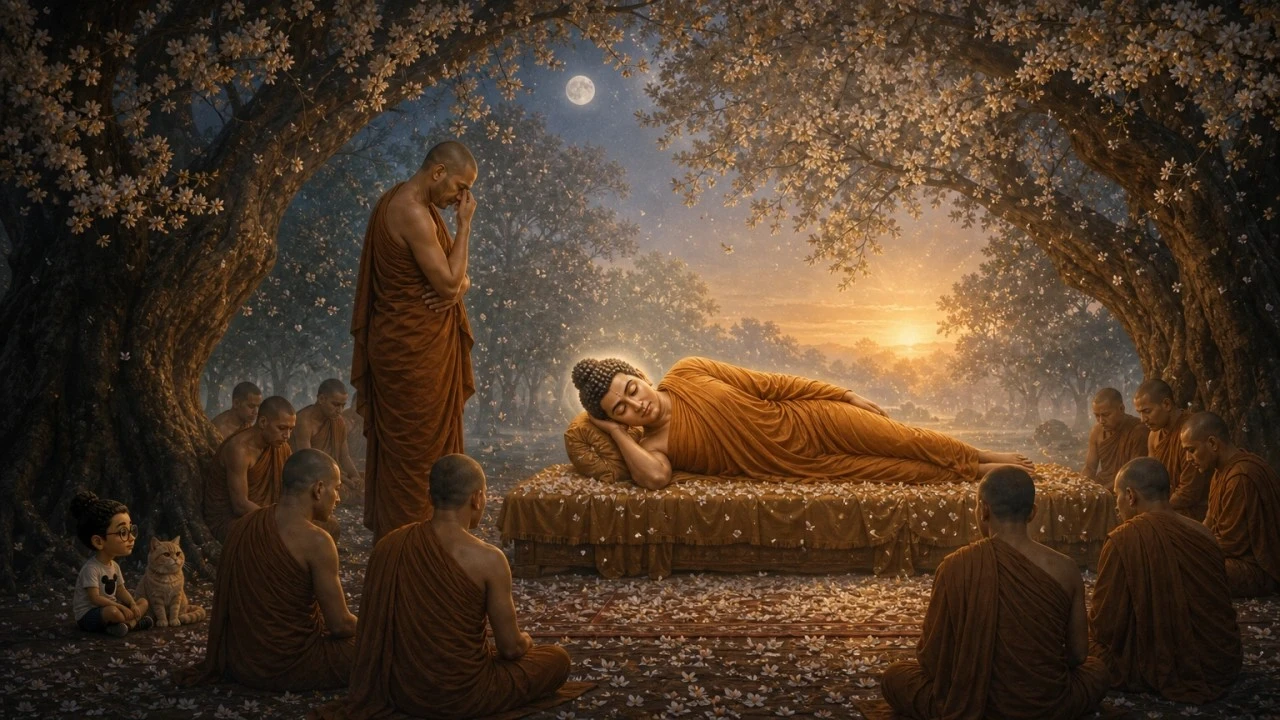
dn16:4.40.2 And then the Buddha laid down in the lion’s posture—on the right side, placing one foot on top of the other—mindful and aware, and focused on the time of getting up.
dn16:4.40.3 But Cundaka sat down right there in front of the Buddha.
dn16:4.41.1 Having gone to Kakudhā Creek,
dn16:4.41.2 whose water was transparent, sweet, and clear,
dn16:4.41.3 the Teacher, being tired, plunged in,
dn16:4.41.4 the Realized One, without compare in the world.
dn16:4.41.5 And after bathing and drinking the Teacher emerged.
dn16:4.41.6 Before the group of mendicants, in the middle, <j>the Buddha,
dn16:4.41.7 the Teacher <j>who rolled forth the present dispensation,
dn16:4.41.8 the great seer went to the mango grove.
dn16:4.41.9 He addressed the mendicant named Cundaka:
dn16:4.41.10 “Spread out my folded robe so I can lie down.”
dn16:4.41.11 The evolved one urged Cunda,
dn16:4.41.12 who quickly spread the folded robe.
dn16:4.41.13 The Teacher lay down so tired,
dn16:4.41.14 while Cunda sat there before him.
dn16:4.42.1 Then the Buddha said to Venerable Ānanda:
dn16:4.42.2 “Now it may happen, Ānanda, that someone may give rise to regret in Cunda the smith:
dn16:4.42.3 ‘It’s your loss, respected Cunda, it’s your misfortune, in that the Realized One was fully quenched after eating his last almsmeal from you.’
dn16:4.42.4 You should dispel remorse in Cunda the smith like this:
dn16:4.42.5 ‘You’re fortunate, respected Cunda, you’re so very fortunate,
dn16:4.42.6 in that the Realized One was fully quenched after eating his last almsmeal from you.
dn16:4.42.7 I have heard and learned this in the presence of the Buddha.
dn16:4.42.8 There are two almsmeal offerings that have identical fruit and result, and are more fruitful and beneficial than other almsmeal offerings.
dn16:4.42.9 What two?
dn16:4.42.10 The almsmeal after eating which a Realized One awakens to the supreme perfect awakening; and the almsmeal after eating which he becomes fully extinguished in the element of extinguishment with no residue.
dn16:4.42.11 These two almsmeal offerings have identical fruit and result, and are more fruitful and beneficial than other almsmeal offerings.
dn16:4.42.12 You’ve accumulated a deed that leads to long life, beauty, happiness, fame, heaven, and sovereignty.’
dn16:4.42.13 That’s how you should dispel remorse in Cunda the smith.”
dn16:4.43.1 Then, understanding this matter, on that occasion the Buddha expressed this heartfelt sentiment:
dn16:4.43.2 “A giver’s merit grows;
dn16:4.43.3 enmity doesn’t build up when you have self-control.
dn16:4.43.4 A skillful person gives up bad things—
dn16:4.43.5 with the end of greed, hate, and delusion, <j>they’re quenched.”
dn16:4.43.6 The fourth recitation section.