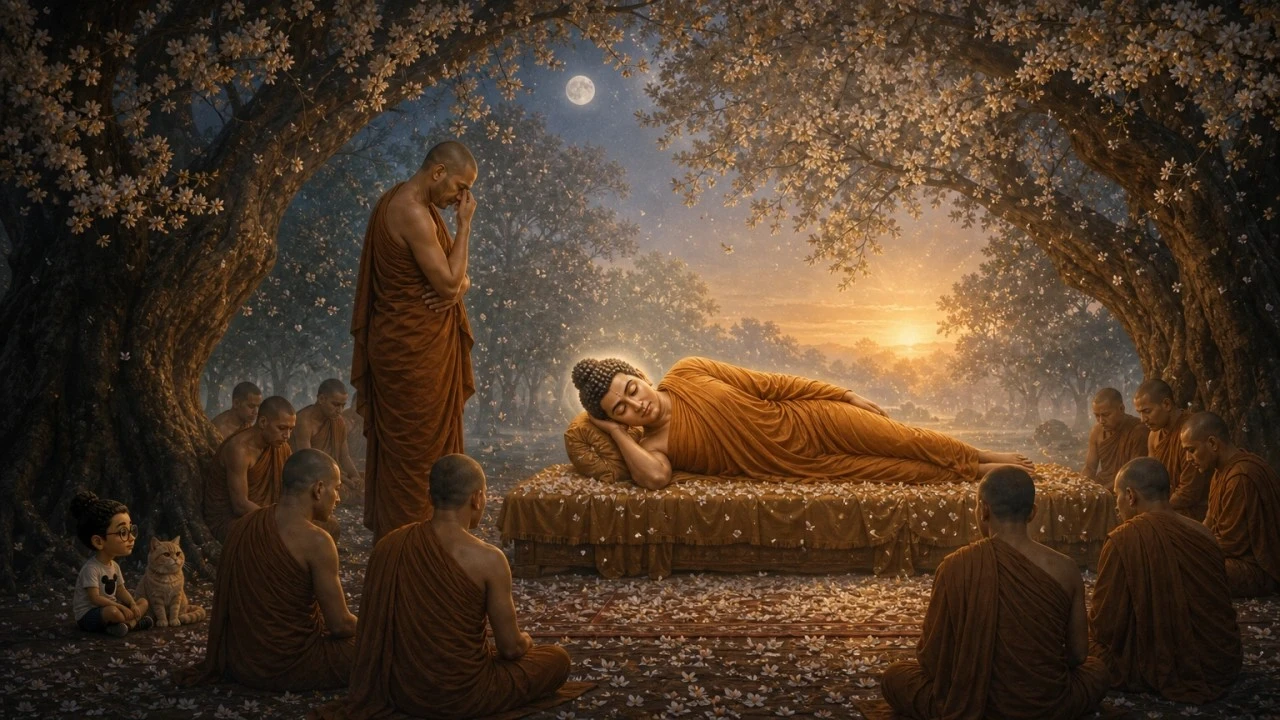







dn16:3.1.0 13. An Obvious Hint
BAGIAN 3
dn16:3.1.1 Then the Buddha robed up in the morning and, taking his bowl and robe, entered Vesālī for alms.
dn16:3.1.2 Then, after the meal, on his return from almsround, he addressed Venerable Ānanda:
dn16:3.1.3 “Ānanda, get your sitting cloth.
dn16:3.1.4 Let’s go to the Cāpāla Shrine for the day’s meditation.”
dn16:3.1.5 “Yes, sir,” replied Ānanda. Taking his sitting cloth he followed behind the Buddha.
dn16:3.2.1 Then the Buddha went up to the Cāpāla Shrine, where he sat down on the seat spread out.
dn16:3.2.2 Ānanda bowed to the Buddha and sat down to one side.
dn16:3.2.3 The Buddha said to him:
dn16:3.2.4 “Ānanda, Vesālī is lovely. And the Udena, Gotamaka, Seven Maidens, Many Sons, Sārandada, and Cāpāla Shrines are all lovely.
dn16:3.3.1 Whoever has developed and cultivated the four bases of psychic power—made them a vehicle and a basis, kept them up, consolidated them, and properly implemented them—may, if they wish, live for the proper lifespan or what’s left of it.
dn16:3.3.2 The Realized One has developed and cultivated the four bases of psychic power, made them a vehicle and a basis, kept them up, consolidated them, and properly implemented them. If he wished, the Realized One could live for the proper lifespan or what’s left of it.”
dn16:3.4.1 But Ānanda didn’t get it, even though the Buddha dropped such an obvious hint, such a clear sign.
dn16:3.4.2 He didn’t beg the Buddha:
dn16:3.4.3 “Sir, may the Blessed One please remain for the proper lifespan! May the Holy One please remain for the proper lifespan! That would be for the welfare and happiness of the people, out of sympathy for the world, for the benefit, welfare, and happiness of gods and humans.” For his mind was as if possessed by Māra.
dn16:3.5.1 For a second time …
dn16:3.5.2 And for a third time, the Buddha said to Ānanda:
dn16:3.5.3 “Ānanda, Vesālī is lovely. And the Udena, Gotamaka, Seven Maidens, Many Sons, Sārandada, and Cāpāla Shrines are all lovely.
dn16:3.5.4 Whoever has developed and cultivated the four bases of psychic power—made them a vehicle and a basis, kept them up, consolidated them, and properly implemented them—may, if they wish, live for the proper lifespan or what’s left of it.
dn16:3.5.5 The Realized One has developed and cultivated the four bases of psychic power, made them a vehicle and a basis, kept them up, consolidated them, and properly implemented them. If he wished, the Realized One could live for the proper lifespan or what’s left of it.”
dn16:3.5.6 But Ānanda didn’t get it, even though the Buddha dropped such an obvious hint, such a clear sign.
dn16:3.5.7 He didn’t beg the Buddha:
dn16:3.5.8 “Sir, may the Blessed One please remain for the proper lifespan! May the Holy One please remain for the proper lifespan! That would be for the welfare and happiness of the people, out of sympathy for the world, for the benefit, welfare, and happiness of gods and humans.” For his mind was as if possessed by Māra.
dn16:3.6.1 Then the Buddha got up and said to Venerable Ānanda,
dn16:3.6.2 “Go now, Ānanda,
dn16:3.6.3 at your convenience.”
dn16:3.6.4 “Yes, sir,” replied Ānanda. He rose from his seat, bowed, and respectfully circled the Buddha, keeping him on his right, before sitting at the root of a tree close by.
dn16:3.7.0 14. The Appeal of Māra
dn16:3.7.1 And then, not long after Ānanda had left, Māra the Wicked went up to the Buddha, stood to one side, and said to him:
dn16:3.7.2 “Sir, may the Blessed One now be fully extinguished! May the Holy One now be fully extinguished! Now is the time for the full extinguishment of the Buddha.
dn16:3.7.3 Sir, you once made this statement:
dn16:3.7.4 ‘Wicked One, I shall not be fully extinguished until I have monk disciples who are competent, educated, assured, learned, have memorized the teachings, and practice in line with the principle of the teaching. Not until they practice properly, living in line with the teaching. Not until they’ve learned their denomination, and explain, teach, assert, establish, disclose, analyze, and make it clear. Not until they can legitimately and completely refute the doctrines of others that come up, and teach with a demonstrable basis.’
dn16:3.8.1 Today you do have such monk disciples.
dn16:3.8.2 May the Blessed One now be fully extinguished! May the Holy One now be fully extinguished! Now is the time for the full extinguishment of the Buddha.
dn16:3.8.3 Sir, you once made this statement:
dn16:3.8.4 ‘Wicked One, I shall not be fully extinguished until I have nun disciples who are competent, educated, self-assured, learned …’
dn16:3.8.5 Today you do have such nun disciples.
dn16:3.8.6 May the Blessed One now be fully extinguished! May the Holy One now be fully extinguished! Now is the time for the full extinguishment of the Buddha.
dn16:3.8.7 Sir, you once made this statement:
dn16:3.8.8 ‘Wicked One, I shall not be fully extinguished until I have layman disciples who are competent, educated, self-assured, learned …’
dn16:3.8.9 Today you do have such layman disciples.
dn16:3.8.10 May the Blessed One now be fully extinguished! May the Holy One now be fully extinguished! Now is the time for the full extinguishment of the Buddha.
dn16:3.8.11 Sir, you once made this statement:
dn16:3.8.12 ‘Wicked One, I shall not be fully extinguished until I have laywoman disciples who are competent, educated, self-assured, learned …’
dn16:3.8.13 Today you do have such laywoman disciples.
dn16:3.8.14 May the Blessed One now be fully extinguished! May the Holy One now be fully extinguished! Now is the time for the full extinguishment of the Buddha.
dn16:3.8.15 Sir, you once made this statement:
dn16:3.8.16 ‘Wicked One, I will not be fully extinguished until my spiritual path is successful and prosperous, extensive, popular, widespread, and fully revealed among gods and humans.’
dn16:3.8.17 Today your spiritual path is successful and prosperous, extensive, popular, widespread, and fully revealed among gods and humans.
dn16:3.8.18 May the Blessed One now be fully extinguished! May the Holy One now be fully extinguished! Now is the time for the full extinguishment of the Buddha.”
dn16:3.9.1 When this was said, the Buddha said to Māra,
dn16:3.9.2 “Relax, Wicked One. The full extinguishment of the Realized One will be soon.
dn16:3.9.3 Three months from now the Realized One will be fully extinguished.”
dn16:3.10.0 15. Surrendering the Life Force
dn16:3.10.1 So at the Cāpāla Shrine the Buddha, mindful and aware, surrendered the life force.
dn16:3.10.2 When he did so there was a great earthquake, awe-inspiring and hair-raising, and thunder cracked the sky.
dn16:3.10.3 Then, understanding this matter, on that occasion the Buddha expressed this heartfelt sentiment:
dn16:3.10.4 “Comparing the incomparable <j>with the creation of prolonged life,
dn16:3.10.5 the sage surrendered the life force.
dn16:3.10.6 Happy inside, serene,
dn16:3.10.7 he shattered self-creation like a suit of armor.”
dn16:3.11.0 16. The Causes of Earthquakes
dn16:3.11.1 Then Venerable Ānanda thought,
dn16:3.11.2 “How incredible, how amazing! That was a really big earthquake!
dn16:3.11.3 That was really a very big earthquake; awe-inspiring and hair-raising, and thunder cracked the sky!
dn16:3.11.4 What’s the cause, what’s the reason for a great earthquake?”
dn16:3.12.1 Then Venerable Ānanda went up to the Buddha,
dn16:3.12.2 bowed, sat down to one side,
dn16:3.12.3 and said to him,
dn16:3.12.4 “How incredible, sir, how amazing!
dn16:3.12.5 That was a really big earthquake!
dn16:3.12.6 That was really a very big earthquake; awe-inspiring and hair-raising, and thunder cracked the sky!
dn16:3.12.7 What’s the cause, what’s the reason for a great earthquake?”
dn16:3.13.1 “Ānanda, there are these eight causes and reasons for a great earthquake.
dn16:3.13.2 What eight?
dn16:3.13.3 This great earth is established on water, the water is established on air, and the air stands in space. At a time when a great wind blows, it stirs the water, and the water stirs the earth.
dn16:3.13.4 This is the first cause and reason for a great earthquake.
dn16:3.14.1 Furthermore, there is an ascetic or brahmin with psychic power who has achieved mastery of the mind, or a god who is mighty and powerful. They’ve developed a limited perception of earth and a limitless perception of water. They make the earth shake and rock and tremble.
dn16:3.14.2 This is the second cause and reason for a great earthquake.
dn16:3.15.1 Furthermore, when the being intent on awakening passes away from the host of joyful gods, he’s conceived in his mother’s womb, mindful and aware. Then the earth shakes and rocks and trembles.
dn16:3.15.2 This is the third cause and reason for a great earthquake.
dn16:3.16.1 Furthermore, when the being intent on awakening comes out of his mother’s womb mindful and aware, the earth shakes and rocks and trembles.
dn16:3.16.2 This is the fourth cause and reason for a great earthquake.
dn16:3.17.1 Furthermore, when the Realized One awakens to the supreme perfect awakening, the earth shakes and rocks and trembles.
dn16:3.17.2 This is the fifth cause and reason for a great earthquake.
dn16:3.18.1 Furthermore, when the Realized One rolls forth the supreme Wheel of Dhamma, the earth shakes and rocks and trembles.
dn16:3.18.2 This is the sixth cause and reason for a great earthquake.
dn16:3.19.1 Furthermore, when the Realized One, mindful and aware, surrenders the life force, the earth shakes and rocks and trembles.
dn16:3.19.2 This is the seventh cause and reason for a great earthquake.
dn16:3.20.1 Furthermore, when the Realized One becomes fully extinguished in the element of extinguishment with no residue, the earth shakes and rocks and trembles.
dn16:3.20.2 This is the eighth cause and reason for a great earthquake.
dn16:3.20.3 These are the eight causes and reasons for a great earthquake.
dn16:3.21.0 17. Eight Assemblies
dn16:3.21.1 There are, Ānanda, these eight assemblies.
dn16:3.21.2 What eight?
dn16:3.21.3 The assemblies of aristocrats, brahmins, householders, and ascetics. An assembly of the gods of the four great kings. An assembly of the gods of the thirty-three. An assembly of Māras. An assembly of divinities.
dn16:3.22.1 I recall having approached an assembly of hundreds of aristocrats.
dn16:3.22.2 There I used to sit with them, converse, and engage in discussion.
dn16:3.22.3 And my appearance and voice became just like theirs.
dn16:3.22.4 I educated, encouraged, fired up, and inspired them with a Dhamma talk.
dn16:3.22.5 But when I spoke they didn’t know:
dn16:3.22.6 ‘Who is this that speaks? Is it a god or a human?’
dn16:3.22.7 And when my Dhamma talk was finished I vanished.
dn16:3.22.8 But when I vanished they didn’t know:
dn16:3.22.9 ‘Who was that who vanished? Was it a god or a human?’
dn16:3.23.1 I recall having approached an assembly of hundreds of brahmins …
dn16:3.23.2 householders …
dn16:3.23.3 ascetics …
dn16:3.23.4 the gods of the four great kings …
dn16:3.23.5 the gods of the thirty-three …
dn16:3.23.6 Māras …
dn16:3.23.7 divinities.
dn16:3.23.8 There too I used to sit with them, converse, and engage in discussion.
dn16:3.23.9 And my appearance and voice became just like theirs.
dn16:3.23.11 I educated, encouraged, fired up, and inspired them with a Dhamma talk.
dn16:3.23.12 But when I spoke they didn’t know:
dn16:3.23.13 ‘Who is this that speaks? Is it a god or a human?’
dn16:3.23.14 And when my Dhamma talk was finished I vanished.
dn16:3.23.15 But when I vanished they didn’t know:
dn16:3.23.16 ‘Who was that who vanished? Was it a god or a human?’
dn16:3.23.17 These are the eight assemblies.
dn16:3.24.0 18. Eight Dimensions of Mastery
dn16:3.24.1 Ānanda, there are these eight dimensions of mastery.
dn16:3.24.2 What eight?
dn16:3.25.1 Perceiving form internally, someone sees forms externally, limited, both pretty and ugly.
dn16:3.25.2 Mastering them, they perceive: ‘I know and see.’
dn16:3.25.3 This is the first dimension of mastery.
dn16:3.26.1 Perceiving form internally, someone sees forms externally, limitless, both pretty and ugly.
dn16:3.26.2 Mastering them, they perceive: ‘I know and see.’
dn16:3.26.3 This is the second dimension of mastery.
dn16:3.27.1 Not perceiving form internally, someone sees forms externally, limited, both pretty and ugly.
dn16:3.27.2 Mastering them, they perceive: ‘I know and see.’
dn16:3.27.3 This is the third dimension of mastery.
dn16:3.28.1 Not perceiving form internally, someone sees forms externally, limitless, both pretty and ugly.
dn16:3.28.2 Mastering them, they perceive: ‘I know and see.’
dn16:3.28.3 This is the fourth dimension of mastery.
dn16:3.29.1 Not perceiving form internally, someone sees forms externally that are blue, with blue color and blue appearance.
dn16:3.29.2 They’re like a flax flower that’s blue, with blue color and blue appearance. Or a cloth from Varanasi that’s smoothed on both sides, blue, with blue color and blue appearance.
dn16:3.29.3 In the same way, not perceiving form internally, someone sees forms externally, blue, with blue color and blue appearance.
dn16:3.29.4 Mastering them, they perceive: ‘I know and see.’
dn16:3.29.5 This is the fifth dimension of mastery.
dn16:3.30.1 Not perceiving form internally, someone sees forms externally that are yellow, with yellow color and yellow appearance.
dn16:3.30.2 They’re like a champak flower that’s yellow, with yellow color and yellow appearance. Or a cloth from Varanasi that’s smoothed on both sides, yellow, with yellow color and yellow appearance.
dn16:3.30.3 In the same way, not perceiving form internally, someone sees forms externally that are yellow, with yellow color and yellow appearance.
dn16:3.30.4 Mastering them, they perceive: ‘I know and see.’
dn16:3.30.5 This is the sixth dimension of mastery.
dn16:3.31.1 Not perceiving form internally, someone sees forms externally that are red, with red color and red appearance.
dn16:3.31.2 They’re like a scarlet mallow flower that’s red, with red color and red appearance. Or a cloth from Varanasi that’s smoothed on both sides, red, with red color and red appearance.
dn16:3.31.3 In the same way, not perceiving form internally, someone sees forms externally that are red, with red color and red appearance.
dn16:3.31.4 Mastering them, they perceive: ‘I know and see.’
dn16:3.31.5 This is the seventh dimension of mastery.
dn16:3.32.1 Not perceiving form internally, someone sees forms externally that are white, with white color and white appearance.
dn16:3.32.2 They’re like the morning star that’s white, with white color and white appearance. Or a cloth from Varanasi that’s smoothed on both sides, white, with white color and white appearance.
dn16:3.32.3 In the same way, not perceiving form internally, someone sees forms externally that are white, with white color and white appearance.
dn16:3.32.4 Mastering them, they perceive: ‘I know and see.’
dn16:3.32.5 This is the eighth dimension of mastery.
dn16:3.32.6 These are the eight dimensions of mastery.
dn16:3.33.0 19. The Eight Liberations
dn16:3.33.1 Ānanda, there are these eight liberations.
dn16:3.33.2 What eight?
dn16:3.33.3 Having physical form, they see forms.
dn16:3.33.4 This is the first liberation.
dn16:3.33.5 Not perceiving form internally, they see forms externally.
dn16:3.33.6 This is the second liberation.
dn16:3.33.7 They’re focused only on beauty.
dn16:3.33.8 This is the third liberation.
dn16:3.33.9 Going totally beyond perceptions of form, with the disappearance of perceptions of impingement, not focusing on perceptions of diversity, aware that ‘space is infinite’, they enter and remain in the dimension of infinite space.
dn16:3.33.10 This is the fourth liberation.
dn16:3.33.11 Going totally beyond the dimension of infinite space, aware that ‘consciousness is infinite’, they enter and remain in the dimension of infinite consciousness.
dn16:3.33.12 This is the fifth liberation.
dn16:3.33.13 Going totally beyond the dimension of infinite consciousness, aware that ‘there is nothing at all’, they enter and remain in the dimension of nothingness.
dn16:3.33.14 This is the sixth liberation.
dn16:3.33.15 Going totally beyond the dimension of nothingness, they enter and remain in the dimension of neither perception nor non-perception.
dn16:3.33.16 This is the seventh liberation.
dn16:3.33.17 Going totally beyond the dimension of neither perception nor non-perception, they enter and remain in the cessation of perception and feeling.
dn16:3.33.18 This is the eighth liberation.
dn16:3.33.19 These are the eight liberations.
dn16:3.34.1 Ānanda, this one time, when I was first awakened, I was staying in Uruvelā at the goatherd’s banyan tree on the bank of the Nerañjarā River.
dn16:3.34.2 Then Māra the wicked approached me, stood to one side, and said:
dn16:3.34.3 ‘Sir, may the Blessed One now be fully extinguished! May the Holy One now be fully extinguished! Now is the time for the full extinguishment of the Buddha.’
dn16:3.34.4 When he had spoken, I said to Māra:
dn16:3.35.1 ‘Wicked One, I shall not be fully extinguished until I have monk disciples …
dn16:3.35.2 nun disciples …
dn16:3.35.3 layman disciples …
dn16:3.35.4 laywoman disciples who are competent, educated, self-assured, learned.
dn16:3.35.5 I shall not be fully extinguished until my spiritual path is successful and prosperous, extensive, popular, widespread, and fully revealed among gods and humans.’
dn16:3.36.1 Today, just now at the Cāpāla Shrine Māra the Wicked approached me once more with the same request, reminding me of my former statement, and saying that those conditions had been fulfilled.
dn16:3.37.1 When he had spoken, I said to Māra:
dn16:3.37.2 ‘Relax, Wicked One. The full extinguishment of the Realized One will be soon.
dn16:3.37.3 Three months from now the Realized One will be fully extinguished.’
dn16:3.37.4 So today, just now at the Cāpāla Shrine, mindful and aware, I surrendered the life force.”
dn16:3.38.0 20. The Appeal of Ānanda
dn16:3.38.1 When he said this, Venerable Ānanda said to the Buddha,
dn16:3.38.2 “Sir, may the Blessed One please remain for the proper lifespan! May the Holy One please remain for the proper lifespan! That would be for the welfare and happiness of the people, out of sympathy for the world, for the benefit, welfare, and happiness of gods and humans.”
dn16:3.38.3 “Enough now, Ānanda.
dn16:3.38.4 Do not beg the Realized One. Now is not the time to beg the Realized One.”
dn16:3.39.1 For a second time …
dn16:3.39.2 For a third time, Ānanda said to the Buddha,
dn16:3.39.3 “Sir, may the Blessed One please remain for the proper lifespan! May the Holy One please remain for the proper lifespan! That would be for the welfare and happiness of the people, out of sympathy for the world, for the benefit, welfare, and happiness of gods and humans.”
dn16:3.39.4 “Ānanda, do you have faith in the Realized One’s awakening?”
dn16:3.39.5 “Yes, sir.”
dn16:3.39.6 “So why then do you keep pressing me up to the third time?”
dn16:3.40.1 “Sir, I have heard and learned this in the presence of the Buddha:
dn16:3.40.2 ‘Whoever has developed and cultivated the four bases of psychic power—made them a vehicle and a basis, kept them up, consolidated them, and properly implemented them—may, if they wish, live for the proper lifespan or what’s left of it.
dn16:3.40.3 The Realized One has developed and cultivated the four bases of psychic power, made them a vehicle and a basis, kept them up, consolidated them, and properly implemented them. If he wished, the Realized One could live for the proper lifespan or what’s left of it.’”
dn16:3.40.4 “Do you have faith, Ānanda?”
dn16:3.40.5 “Yes, sir.”
dn16:3.40.6 “Therefore, Ānanda, the misdeed is yours alone, the mistake is yours alone. For even though the Realized One dropped such an obvious hint, such a clear sign, you didn’t beg me to remain for the proper lifespan, or what’s left of it.
dn16:3.40.8 If you had begged me, I would have turned you down twice, but consented on the third time.
dn16:3.40.9 Therefore, Ānanda, the misdeed is yours alone, the mistake is yours alone.
dn16:3.41.1 Ānanda, this one time I was staying near Rājagaha, on the Vulture’s Peak Mountain.
dn16:3.41.2 There I said to you:
dn16:3.41.3 ‘Ānanda, Rājagaha is lovely, and so is the Vulture’s Peak.
dn16:3.41.4 Whoever has developed and cultivated the four bases of psychic power—made them a vehicle and a basis, kept them up, consolidated them, and properly implemented them—may, if they wish, live for the proper lifespan or what’s left of it.
dn16:3.41.5 The Realized One has developed and cultivated the four bases of psychic power, made them a vehicle and a basis, kept them up, consolidated them, and properly implemented them. If he wished, the Realized One could live for the proper lifespan or what’s left of it.’
dn16:3.41.6 But you didn’t get it, even though I dropped such an obvious hint, such a clear sign. You didn’t beg me to remain for the proper lifespan, or what’s left of it.
dn16:3.41.8 If you had begged me, I would have turned you down twice, but consented on the third time.
dn16:3.41.9 Therefore, Ānanda, the misdeed is yours alone, the mistake is yours alone.
dn16:3.42.1 Ānanda, this one time I was staying right there near Rājagaha, at the Gotama banyan tree …
dn16:3.42.2 at Bandit’s Cliff …
dn16:3.42.3 in the Sattapaṇṇi cave on the slopes of Vebhāra …
dn16:3.42.4 at the Black Rock on the slopes of Isigili …
dn16:3.42.5 in the Cool Grove, under the Cobra’s Hood Grotto …
dn16:3.42.6 in the Hot Springs Monastery …
dn16:3.42.7 in the Bamboo Grove, the squirrels’ feeding ground …
dn16:3.42.8 in Jīvaka’s Mango Grove …
dn16:3.42.9 in the Maddakucchi deer park …
dn16:3.43.1 And in each place I said to you:
dn16:3.43.2 ‘Ānanda, Rājagaha is lovely, and so are all these places. …
dn16:3.44.2 If he wished, the Realized One could live for the proper lifespan or what’s left of it.’
dn16:3.44.3 But you didn’t get it, even though I dropped such an obvious hint, such a clear sign. You didn’t beg me to remain for the proper lifespan, or what’s left of it.
dn16:3.45.1 Ānanda, this one time I was staying right here near Vesālī, at the Udena Shrine …
dn16:3.46.1 at the Gotamaka Shrine …
dn16:3.46.2 at the Seven Maidens Shrine …
dn16:3.46.3 at the Many Sons Shrine …
dn16:3.46.4 at the Sārandada Shrine …
dn16:3.47.1 and just now, today at the Cāpāla Shrine. There I said to you:
dn16:3.47.2 ‘Ānanda, Vesālī is lovely. And the Udena, Gotamaka, Seven Maidens, Many Sons, Sārandada, and Cāpāla Shrines are all lovely.
dn16:3.47.3 Whoever has developed and cultivated the four bases of psychic power—made them a vehicle and a basis, kept them up, consolidated them, and properly implemented them—may, if they wish, live for the proper lifespan or what’s left of it.
dn16:3.47.4 The Realized One has developed and cultivated the four bases of psychic power, made them a vehicle and a basis, kept them up, consolidated them, and properly implemented them. If he wished, the Realized One could live for the proper lifespan or what’s left of it.’
dn16:3.47.5 But you didn’t get it, even though I dropped such an obvious hint, such a clear sign. You didn’t beg me to remain for the proper lifespan, or what’s left of it, saying:
dn16:3.47.6 ‘Sir, may the Blessed One please remain for the proper lifespan! May the Holy One please remain for the proper lifespan! That would be for the welfare and happiness of the people, out of sympathy for the world, for the benefit, welfare, and happiness of gods and humans.’
dn16:3.47.7 If you had begged me, I would have turned you down twice, but consented on the third time.
dn16:3.47.8 Therefore, Ānanda, the misdeed is yours alone, the mistake is yours alone.
dn16:3.48.1 Did I not prepare for this when I explained that
dn16:3.48.2 we must be parted and separated from all we hold dear and beloved?
dn16:3.48.3 How could it possibly be so that what is born, created, conditioned, and liable to wear out should not wear out?
dn16:3.48.4 The Realized One has discarded, eliminated, released, given up, relinquished, and surrendered the life force. He has categorically stated:
dn16:3.48.5 ‘The full extinguishment of the Realized One will be soon.
dn16:3.48.6 Three months from now the Realized One will be fully extinguished.’
dn16:3.48.7 It’s not possible for the Realized One, for the sake of life, to take back the life force once it has been given up like that.
dn16:3.48.8 Come, Ānanda, let’s go to the Great Wood, the hall with the peaked roof.”
dn16:3.48.9 “Yes, sir,” Ānanda replied.
dn16:3.49.1 So the Buddha went with Ānanda to the hall with the peaked roof, and said to him,
dn16:3.49.2 “Go, Ānanda, gather all the mendicants staying in the vicinity of Vesālī together in the assembly hall.”
dn16:3.49.3 “Yes, sir,” replied Ānanda. He did what the Buddha asked, went up to him, bowed, stood to one side, and said to him,
dn16:3.49.4 “Sir, the mendicant Saṅgha has assembled. Please, sir, go at your convenience.”
dn16:3.50.1 Then the Buddha went to the assembly hall, where he sat down on the seat spread out
dn16:3.50.2 and addressed the mendicants:
dn16:3.50.3 “So, mendicants, having carefully memorized those things I have taught you from my direct knowledge, you should cultivate, develop, and make much of them so that this spiritual practice may last for a long time. That would be for the welfare and happiness of the people, out of sympathy for the world, for the benefit, welfare, and happiness of gods and humans.
dn16:3.50.4 And what are those things I have taught from my direct knowledge?
dn16:3.50.5 They are: the four kinds of mindfulness meditation, the four right efforts, the four bases of psychic power, the five faculties, the five powers, the seven awakening factors, and the noble eightfold path.
dn16:3.51.1 These are the things I have taught from my direct knowledge. Having carefully memorized them, you should cultivate, develop, and make much of them so that this spiritual practice may last for a long time. That would be for the welfare and happiness of the people, out of sympathy for the world, for the benefit, welfare, and happiness of gods and humans.”
dn16:3.51.2 Then the Buddha said to the mendicants:
dn16:3.51.3 “Come now, mendicants, I say to you all:
dn16:3.51.4 ‘Conditions fall apart. Persist with diligence.’
dn16:3.51.5 The full extinguishment of the Realized One will be soon.
dn16:3.51.6 Three months from now the Realized One will be fully extinguished.”
dn16:3.51.7 That is what the Buddha said.
dn16:3.51.8 Then the Holy One, the Teacher, went on to say:
dn16:3.51.9 “I’ve reached a ripe old age,
dn16:3.51.10 and little of my life is left.
dn16:3.51.11 Having given it up, I’ll depart;
dn16:3.51.12 I’ve made a refuge for myself.
dn16:3.51.13 Diligent and mindful,
dn16:3.51.14 be of good virtues, mendicants!
dn16:3.51.15 With well-settled thoughts,
dn16:3.51.16 take good care of your minds.
dn16:3.51.17 Whoever meditates diligently
dn16:3.51.18 in this teaching and training,
dn16:3.51.19 giving up transmigration through rebirths,
dn16:3.51.20 will make an end to suffering.”
dn16:3.51.21 The third recitation section.