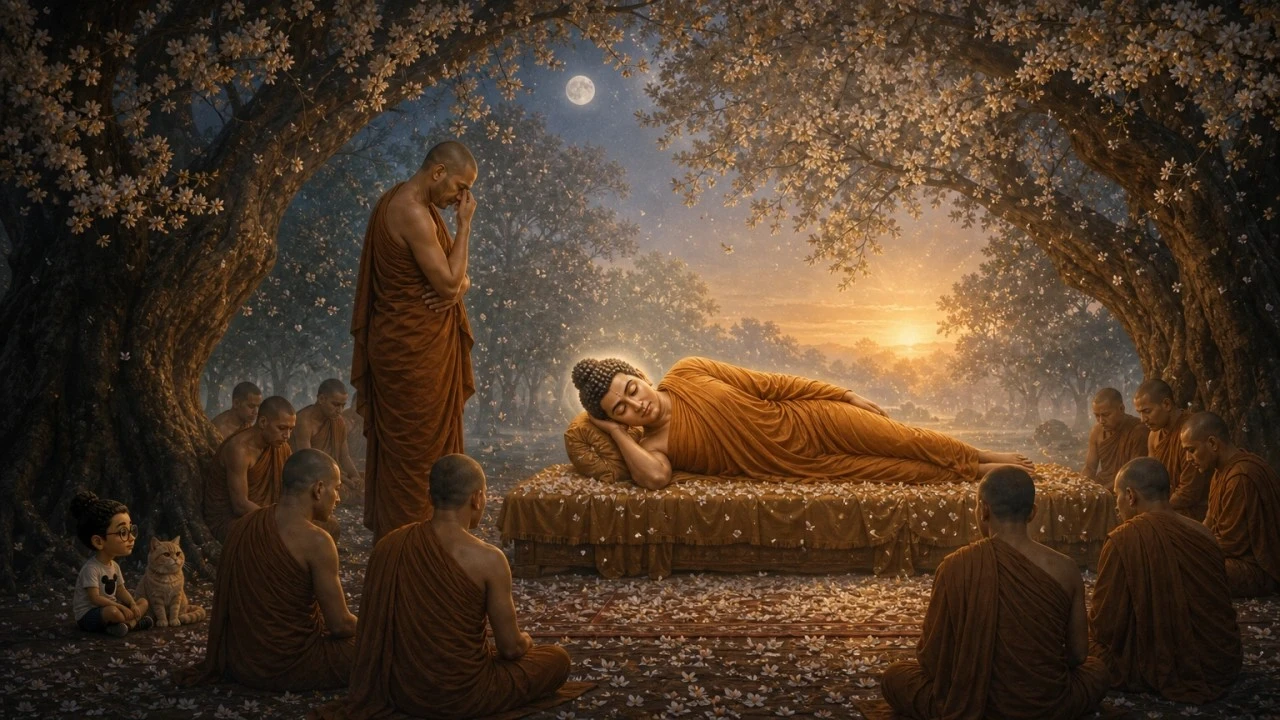






dn16:2.1.0 8. Talk on the Noble Truths
BAGIAN 2
dn16:2.1.1 Then the Buddha said to Venerable Ānanda,
dn16:2.1.2 “Come, Ānanda, let’s go to the village of Koṭi.”
dn16:2.1.3 “Yes, sir,” Ānanda replied.
dn16:2.1.4 Then the Buddha together with a large Saṅgha of mendicants arrived at the village of Koṭi,
dn16:2.1.5 and stayed there.
dn16:2.2.1 There he addressed the mendicants:
dn16:2.2.2 “Mendicants, due to not understanding and not penetrating four noble truths, both you and I have wandered and transmigrated for such a very long time.
dn16:2.2.3 What four?
dn16:2.2.4 The noble truths of suffering,
dn16:2.2.5 the origin of suffering,
dn16:2.2.6 the cessation of suffering,
dn16:2.2.7 and the practice that leads to the cessation of suffering.
dn16:2.2.8 These noble truths of suffering, origin, cessation, and the path have been understood and comprehended. Craving for continued existence has been cut off; the leash to existence is ended; now there’ll be no more future lives.”
dn16:2.3.1 That is what the Buddha said.
dn16:2.3.2 Then the Holy One, the Teacher, went on to say:
dn16:2.3.3 “Because of not truly seeing
dn16:2.3.4 the four noble truths,
dn16:2.3.5 we have transmigrated for a long time
dn16:2.3.6 from one rebirth to the next.
dn16:2.3.7 But now that these truths have been seen,
dn16:2.3.8 the leash to existence is eradicated.
dn16:2.3.9 The root of suffering is cut off,
dn16:2.3.10 now there’ll be no more future lives.”
dn16:2.4.1 And while staying at the village of Koṭi, too, the Buddha often gave this Dhamma talk to the mendicants:
dn16:2.4.2 “Such is ethics, such is immersion, such is wisdom.
dn16:2.4.3 When immersion is imbued with ethics it’s very fruitful and beneficial.
dn16:2.4.4 When wisdom is imbued with immersion it’s very fruitful and beneficial.
dn16:2.4.5 When the mind is imbued with wisdom it is rightly freed from the defilements, namely,
dn16:2.4.6 the defilements of sensuality, desire to be reborn, and ignorance.”
dn16:2.5.0 9. The Deaths in Ñātika
dn16:2.5.1 When the Buddha had stayed in the village of Koṭi as long as he pleased, he said to Ānanda,
dn16:2.5.2 “Come, Ānanda, let’s go to the land of the Ñātikas.”
dn16:2.5.3 “Yes, sir,” Ānanda replied.
dn16:2.5.4 Then the Buddha together with a large Saṅgha of mendicants arrived in the land of the Ñātikas,
dn16:2.5.5 where he stayed in the brick house at Ñātika.
dn16:2.6.1 Then Venerable Ānanda went up to the Buddha, bowed, sat down to one side, and said to him,
dn16:2.6.2 “Sir, the monk named Sāḷha has passed away in Ñātika. Where has he been reborn in his next life?
dn16:2.6.3 The nun named Nandā,
dn16:2.6.4 the layman named Sudatta,
dn16:2.6.5 and the laywoman named Sujātā have passed away in Ñātika. Where have they been reborn in the next life?
dn16:2.6.6 The laymen named Kakkaṭa,
dn16:2.6.7 Kaḷibha,
dn16:2.6.8 Nikata,
dn16:2.6.9 Kaṭissaha,
dn16:2.6.10 Tuṭṭha,
dn16:2.6.11 Santuṭṭha,
dn16:2.6.12 Bhadda, and
dn16:2.6.13 Subhadda have passed away in Ñātika. Where have they been reborn in the next life?”
dn16:2.7.1 “Ānanda, the monk Sāḷha had realized the undefiled freedom of heart and freedom by wisdom, having realized it with his own insight in this very life due to the ending of defilements.
dn16:2.7.2 The nun Nandā had ended the five lower fetters. She’s been reborn spontaneously, and will be extinguished there, not liable to return from that world.
dn16:2.7.3 The layman Sudatta had ended three fetters, and weakened greed, hate, and delusion. He’s a once-returner; he will come back to this world once only, then make an end of suffering.
dn16:2.7.4 The laywoman Sujātā had ended three fetters. She’s a stream-enterer, not liable to be reborn in the underworld, assured, destined for awakening.
dn16:2.7.5 The laymen Kakkaṭa,
dn16:2.7.6 Kaḷibha,
dn16:2.7.7 Nikata,
dn16:2.7.8 Kaṭissaha,
dn16:2.7.9 Tuṭṭha,
dn16:2.7.10 Santuṭṭha,
dn16:2.7.11 Bhadda,
dn16:2.7.12 and Subhadda had ended the five lower fetters. They’ve been reborn spontaneously, and will be extinguished there, not liable to return from that world.
dn16:2.7.13 Over fifty laymen in Ñātika have passed away having ended the five lower fetters. They’ve been reborn spontaneously, and will be extinguished there, not liable to return from that world.
dn16:2.7.14 More than ninety laymen in Ñātika have passed away having ended three fetters, and weakened greed, hate, and delusion. They’re once-returners, who will come back to this world once only, then make an end of suffering.
dn16:2.7.15 More than five hundred laymen in Ñātika have passed away having ended three fetters. They’re stream-enterers, not liable to be reborn in the underworld, assured, destined for awakening.
dn16:2.8.0 10. The Mirror of the Teaching
dn16:2.8.1 It’s no wonder that a human being should pass away.
dn16:2.8.2 But if you should come and ask me about it each and every time someone passes away, that would be a bother for me.
dn16:2.8.3 So Ānanda, I will teach you the explanation of the Dhamma named ‘the mirror of the teaching’. A noble disciple who has this may declare of themselves:
dn16:2.8.4 ‘I’ve finished with rebirth in hell, the animal realm, and the ghost realm. I’ve finished with all places of loss, bad places, the underworld. I am a stream-enterer! I’m not liable to be reborn in the underworld, and am assured, destined for awakening.’
dn16:2.9.1 And what is that mirror of the teaching?
dn16:2.9.3 It’s when a noble disciple has experiential confidence in the Buddha:
dn16:2.9.4 ‘That Blessed One is perfected, a fully awakened Buddha, accomplished in knowledge and conduct, holy, knower of the world, supreme guide for those fit for training, teacher of gods and humans, awakened, blessed.’
dn16:2.9.5 They have experiential confidence in the teaching:
dn16:2.9.6 ‘The teaching is well explained by the Buddha—apparent in the present life, immediately effective, inviting inspection, relevant, so that sensible people can know it for themselves.’
dn16:2.9.7 They have experiential confidence in the Saṅgha:
dn16:2.9.8 ‘The Saṅgha of the Buddha’s disciples is practicing the way that’s good, direct, systematic, and proper. It consists of the four pairs, the eight individual persons. This is the Saṅgha of the Buddha’s disciples that is worthy of offerings dedicated to the gods, worthy of hospitality, worthy of a religious donation, worthy of greeting with cupped palms, and is the supreme field of merit for the world.’
dn16:2.9.9 And a noble disciple’s ethical conduct is loved by the noble ones, unbroken, impeccable, spotless, and unmarred, liberating, praised by sensible people, not mistaken, and leading to immersion.
dn16:2.9.10 This is that mirror of the teaching.”
dn16:2.10.1 And while staying there in Ñātika the Buddha often gave this Dhamma talk to the mendicants:
dn16:2.10.2 “Such is ethics, such is immersion, such is wisdom.
dn16:2.10.3 When immersion is imbued with ethics it’s very fruitful and beneficial.
dn16:2.10.4 When wisdom is imbued with immersion it’s very fruitful and beneficial.
dn16:2.10.5 When the mind is imbued with wisdom it is rightly freed from the defilements, namely,
dn16:2.10.6 the defilements of sensuality, desire to be reborn, and ignorance.”
dn16:2.11.1 When the Buddha had stayed in Ñātika as long as he pleased, he addressed Venerable Ānanda,
dn16:2.11.2 “Come, Ānanda, let’s go to Vesālī.”
dn16:2.11.3 “Yes, sir,” Ānanda replied.
dn16:2.11.4 Then the Buddha together with a large Saṅgha of mendicants arrived at Vesālī,
dn16:2.11.5 where he stayed in Ambapālī’s Mango Grove.
dn16:2.12.1 There the Buddha addressed the mendicants:
dn16:2.12.2 “Mendicants, a mendicant should live mindful and aware.
dn16:2.12.3 This is my instruction to you.
dn16:2.12.4 And how is a mendicant mindful?
dn16:2.12.5 It’s when a mendicant meditates by observing an aspect of the body—keen, aware, and mindful, rid of covetousness and displeasure for the world.
dn16:2.12.6 They meditate observing an aspect of feelings …
dn16:2.12.7 mind …
dn16:2.12.8 principles—keen, aware, and mindful, rid of covetousness and displeasure for the world.
dn16:2.12.9 That’s how a mendicant is mindful.
dn16:2.13.1 And how is a mendicant aware?
dn16:2.13.2 It’s when a mendicant acts with situational awareness when going out and coming back; when looking ahead and aside; when bending and extending the limbs; when bearing the outer robe, bowl and robes; when eating, drinking, chewing, and tasting; when urinating and defecating; when walking, standing, sitting, sleeping, waking, speaking, and keeping silent.
dn16:2.13.3 That’s how a mendicant is aware.
dn16:2.13.4 A mendicant should live mindful and aware.
dn16:2.13.5 This is my instruction to you.”
dn16:2.14.0 11. Ambapālī the Courtesan
dn16:2.14.1 Ambapālī the courtesan heard that the Buddha had arrived and was staying in her mango grove.
dn16:2.14.2 She had the finest carriages harnessed. Then she mounted a fine carriage and, along with other fine carriages, set out from Vesālī for her own park.
dn16:2.14.3 She went by carriage as far as the terrain allowed, then descended and approached the Buddha on foot. She bowed and sat down to one side.
dn16:2.14.4 The Buddha educated, encouraged, fired up, and inspired her with a Dhamma talk.
dn16:2.14.5 Then she said to the Buddha,
dn16:2.14.6 “Sir, would the Buddha, together with the mendicant Saṅgha, please accept tomorrow’s meal from me?”
dn16:2.14.7 The Buddha consented with silence.
dn16:2.14.8 Then, knowing that the Buddha had consented, Ambapālī rose from her seat, bowed, and respectfully circled the Buddha, keeping him on her right, before leaving.
dn16:2.15.1 The Licchavis of Vesālī also heard that the Buddha had arrived and was staying in Ambapālī’s Mango Grove.
dn16:2.15.2 They had the finest carriages harnessed. Then they mounted a fine carriage and, along with other fine carriages, set out from Vesālī.
dn16:2.15.3 Some of the Licchavis were in blue, of blue color, clad in blue, adorned with blue. And some were similarly colored in yellow, red, or white.
dn16:2.16.1 Then Ambapālī the courtesan collided with those Licchavi youths, axle to axle, wheel to wheel, yoke to yoke.
dn16:2.16.2 The Licchavis said to her,
dn16:2.16.3 “What, you wench Ambapālī, are you doing colliding with us axle to axle, wheel to wheel, yoke to yoke?”
dn16:2.16.4 “Well, masters, it’s because I’ve invited the Buddha for tomorrow’s meal together with the mendicant Saṅgha.”
dn16:2.16.5 “Wench, give us that meal for a hundred thousand!”
dn16:2.16.6 “Masters, even if you were to give me Vesālī with her provinces, I still wouldn’t give that meal to you.”
dn16:2.16.7 Then the Licchavis snapped their fingers, saying,
dn16:2.16.8 “We’ve been beaten by the aunty! We’ve been beaten by the aunty!”
dn16:2.16.9 Then they continued on to Ambapālī’s Mango Grove.
dn16:2.17.1 The Buddha saw them coming off in the distance,
dn16:2.17.2 and addressed the mendicants:
dn16:2.17.3 “Any of the mendicants who’ve never seen the gods of the thirty-three before, just have a look at the assembly of Licchavis.
dn16:2.17.4 See the assembly of Licchavis,
dn16:2.17.5 check them out:
dn16:2.17.6 they’re just like the thirty-three!”
dn16:2.18.1 The Licchavis went by carriage as far as the terrain allowed, then descended and approached the Buddha on foot. They bowed to the Buddha, sat down to one side,
dn16:2.18.2 and the Buddha educated, encouraged, fired up, and inspired them with a Dhamma talk.
dn16:2.18.3 Then they said to the Buddha,
dn16:2.18.4 “Sir, would the Buddha, together with the mendicant Saṅgha, please accept tomorrow’s meal from us?”
dn16:2.18.5 Then the Buddha said to the Licchavis,
dn16:2.18.6 “I have already accepted tomorrow’s meal from Ambapālī the courtesan.”
dn16:2.18.7 Then the Licchavis snapped their fingers, saying,
dn16:2.18.8 “We’ve been beaten by the aunty! We’ve been beaten by the aunty!”
dn16:2.18.9 And then those Licchavis approved and agreed with what the Buddha said. They got up from their seat, bowed and respectfully circled the Buddha, keeping him on their right, before leaving.
dn16:2.19.1 And when the night had passed Ambapālī had delicious fresh and cooked foods prepared in her own park. Then she had the Buddha informed of the time, saying,
dn16:2.19.2 “Sir, it’s time. The meal is ready.”
dn16:2.19.3 Then the Buddha robed up in the morning and, taking his bowl and robe, went to the home of Ambapālī together with the mendicant Saṅgha, where he sat down on the seat spread out.
dn16:2.19.4 Then Ambapālī served and satisfied the mendicant Saṅgha headed by the Buddha with her own hands with delicious fresh and cooked foods.
dn16:2.19.5 When the Buddha had eaten and washed his hands and bowl, Ambapālī took a low seat, sat to one side,
dn16:2.19.6 and said to the Buddha,
dn16:2.19.7 “Sir, I present this park to the mendicant Saṅgha headed by the Buddha.”
dn16:2.19.8 The Buddha accepted the park.
dn16:2.19.9 Then the Buddha educated, encouraged, fired up, and inspired her with a Dhamma talk, after which he rose from his seat and left.
dn16:2.20.1 And while staying at Vesālī, too, the Buddha often gave this Dhamma talk to the mendicants:
dn16:2.20.2 “Such is ethics, such is immersion, such is wisdom.
dn16:2.20.3 When immersion is imbued with ethics it’s very fruitful and beneficial.
dn16:2.20.4 When wisdom is imbued with immersion it’s very fruitful and beneficial.
dn16:2.20.5 When the mind is imbued with wisdom it is rightly freed from the defilements, namely,
dn16:2.20.6 the defilements of sensuality, desire to be reborn, and ignorance.”
dn16:2.21.0 12. Commencing the Rains at Beluva
dn16:2.21.1 When the Buddha had stayed in Ambapālī’s Mango Grove as long as he pleased, he addressed Venerable Ānanda,
dn16:2.21.2 “Come, Ānanda, let’s go to the little village of Beluva.”
dn16:2.21.3 “Yes, sir,” Ānanda replied.
dn16:2.21.4 Then the Buddha together with a large Saṅgha of mendicants arrived at the little village of Beluva,
dn16:2.21.5 and stayed there.
dn16:2.22.1 There the Buddha addressed the mendicants:
dn16:2.22.2 “Mendicants, please enter the rainy season residence with whatever friends or acquaintances you have around Vesālī.
dn16:2.22.3 I’ll commence the rainy season residence right here in the little village of Beluva.”
dn16:2.22.4 “Yes, sir,” those mendicants replied. They did as the Buddha said,
dn16:2.22.5 while the Buddha commenced the rainy season residence right there in the little village of Beluva.
dn16:2.23.1 After the Buddha had commenced the rainy season residence, he fell severely ill, struck by dreadful pains, close to death.
dn16:2.23.2 But he endured unbothered, with mindfulness and situational awareness.
dn16:2.23.3 Then it occurred to the Buddha,
dn16:2.23.4 “It would not be appropriate for me to be fully extinguished before informing my supporters and taking leave of the mendicant Saṅgha.
dn16:2.23.5 Why don’t I forcefully suppress this illness, stabilize the life force, and live on?”
dn16:2.24.1 So that is what he did.
dn16:2.24.2 Then the Buddha’s illness died down.
dn16:2.24.3 Soon after the Buddha had recovered from that sickness, he left his dwelling and sat in the shade of the porch on the seat spread out.
dn16:2.24.4 Then Venerable Ānanda went up to the Buddha, bowed, sat down to one side, and said to him,
dn16:2.24.5 “Sir, it’s fantastic that the Buddha is comfortable and well. Because when the Buddha was sick, my body felt like it was drugged. I was disorientated, and the teachings didn’t spring to mind.
dn16:2.24.6 Still, at least I was consoled by the thought that
dn16:2.24.7 the Buddha won’t be fully extinguished without bringing something up regarding the Saṅgha of mendicants.”
dn16:2.25.1 “But what could the mendicant Saṅgha expect from me, Ānanda?
dn16:2.25.2 I’ve taught the Dhamma without making any distinction between secret and public teachings.
dn16:2.25.3 The Realized One doesn’t have the closed fist of a tutor when it comes to the teachings.
dn16:2.25.4 If there’s anyone who thinks:
dn16:2.25.5 ‘I shall lead the mendicant Saṅgha,’ or ‘the Saṅgha of mendicants is meant for me,’ let them bring something up regarding the Saṅgha.
dn16:2.25.6 But the Realized One doesn’t think like this,
dn16:2.25.8 so why should he bring something up regarding the Saṅgha?
dn16:2.25.9 I’m now old, elderly and senior. I’m advanced in years and have reached the final stage of life.
dn16:2.25.10 I’m currently eighty years old.
dn16:2.25.11 Just as a decrepit old cart is kept going by a rope,
dn16:2.25.12 in the same way, the Realized One’s body is kept going as if by a rope.
dn16:2.25.13 Sometimes the Realized One, not focusing on any signs, and with the cessation of certain feelings, enters and remains in the signless immersion of the heart. Only then does the Realized One’s body become more comfortable.
dn16:2.26.1 So Ānanda, live as your own island, your own refuge, with no other refuge. Let the teaching be your island and your refuge, with no other refuge.
dn16:2.26.2 And how does a mendicant do this?
dn16:2.26.3 It’s when a mendicant meditates by observing an aspect of the body—keen, aware, and mindful, rid of covetousness and displeasure for the world.
dn16:2.26.4 They meditate observing an aspect of feelings …
dn16:2.26.5 mind …
dn16:2.26.6 principles—keen, aware, and mindful, rid of covetousness and displeasure for the world.
dn16:2.26.7 That’s how a mendicant lives with themselves as island and refuge, without other refuge; with the teachings as island and refuge, without other refuge.
dn16:2.26.8 Whether now or after I have passed, any who shall live as their own island, their own refuge, with no other refuge; with the teaching as their island and their refuge, with no other refuge—those mendicants of mine who want to train shall be among the best of the best.”
dn16:2.26.9 The second recitation section.