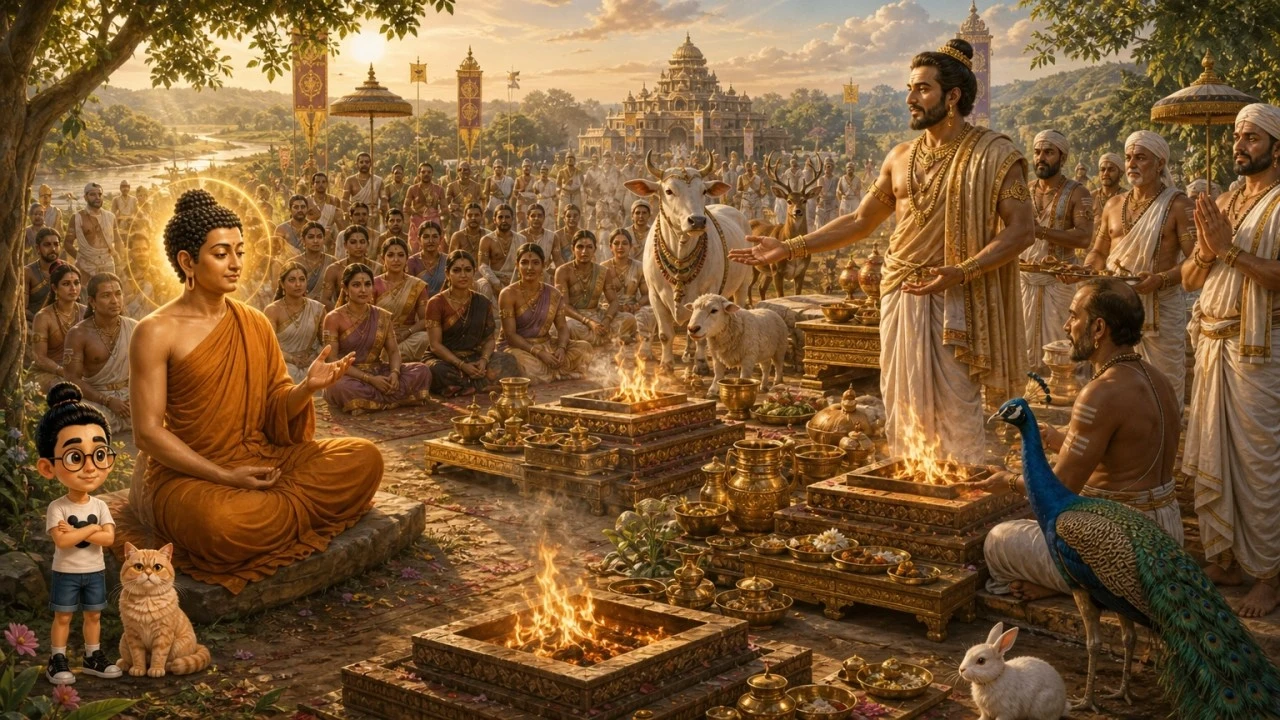


dn5:7.0 3. The Qualities of the Buddha
BAGIAN 7
dn5:7.1 When they had spoken, Kūṭadanta said to those brahmins:
dn5:7.2 “Well then, gentlemen, listen to why it’s appropriate for me to go to see the ascetic Gotama,
dn5:7.3 and it’s not appropriate for him to come to see me.
dn5:7.4 He is well born on both his mother’s and father’s side, stemming from a clean vessel, with irrefutable and impeccable genealogy back to the seventh paternal generation.
dn5:7.5 For this reason it’s not appropriate for the ascetic Gotama to come to see me;
dn5:7.6 rather, it’s appropriate for me to go to see him.
dn5:7.7 When he went forth he abandoned a large family circle. …
dn5:7.8 When he went forth he abandoned abundant gold, both coined and uncoined, stored above and below ground. …
dn5:7.9 He went forth from the lay life to homelessness while still a youth, young, with pristine black hair, blessed with youth, in the prime of life. …
dn5:7.10 Though his mother and father wished otherwise, weeping with tearful faces, he shaved off his hair and beard, dressed in ocher robes, and went forth from the lay life to homelessness. …
dn5:7.11 He is attractive, good-looking, lovely, of surpassing beauty. He has divine looks and lustre, remarkable to behold. …
dn5:7.12 He is ethical, possessing ethical conduct that is noble and skillful. …
dn5:7.13 He’s a good speaker who enunciates well, with a polished, clear, and articulate voice that expresses the meaning. …
dn5:7.14 He’s a tutor of tutors. …
dn5:7.15 He has ended sensual desire, and is rid of caprice. …
dn5:7.16 He teaches the efficacy of deeds and action. He doesn’t wish any harm upon the community of brahmins. …
dn5:7.17 He went forth from an eminent family of unbroken aristocratic lineage. …
dn5:7.18 He went forth from a rich, affluent, and wealthy family. …
dn5:7.19 People come from distant lands and distant countries to question him. …
dn5:7.20 Many thousands of deities have gone for refuge for life to him. …
dn5:7.21 He has this good reputation:
dn5:7.22 ‘That Blessed One is perfected, a fully awakened Buddha, accomplished in knowledge and conduct, holy, knower of the world, supreme guide for those fit for training, teacher of gods and humans, awakened, blessed.’ …
dn5:7.23 He has the thirty-two marks of a great man. …
dn5:7.24 He is welcoming, congenial, polite, smiling, open, the first to speak. …
dn5:7.25 He’s honored, respected, revered, venerated, and esteemed by the four assemblies. …
dn5:7.26 Many gods and humans are devoted to him. …
dn5:7.27 While he is residing in a village or town, non-human entities do not harass them. …
dn5:7.28 He leads an order and a community, and tutors a community, and is said to be the best of the various religious founders. He didn’t come by his fame in the same ways as those other ascetics and brahmins.
dn5:7.29 Rather, he came by his fame due to his supreme knowledge and conduct. …
dn5:7.30 King Seniya Bimbisāra of Magadha and his wives and children have gone for refuge for life to the ascetic Gotama. …
dn5:7.31 King Pasenadi of Kosala and his wives and children have gone for refuge for life to the ascetic Gotama. …
dn5:7.32 The brahmin Pokkharasāti and his wives and children have gone for refuge for life to the ascetic Gotama. …
dn5:7.33 He’s honored, respected, revered, venerated, and esteemed by King Bimbisāra of Magadha …
dn5:7.34 King Pasenadi of Kosala …
dn5:7.35 and the brahmin Pokkharasāti.
dn5:7.36 The ascetic Gotama has arrived at Khāṇumata and is staying at Ambalaṭṭhikā.
dn5:7.37 Any ascetic or brahmin who comes to stay in our village district is our guest,
dn5:7.38 and should be honored and respected as such.
dn5:7.41 For this reason, too, it’s not appropriate for Worthy Gotama to come to see me;
dn5:7.42 rather, it’s appropriate for me to go to see him.
dn5:7.43 This is the extent of the worthy Gotama’s praise that I have memorized. But his praises are not confined to this,
dn5:7.44 for the praise of the worthy Gotama is limitless.”
dn5:7.45 When he had spoken, those brahmins said to him,
dn5:7.46 “According to Kūṭadanta’s praises, if the worthy Gotama were staying within a hundred leagues, it’d be worthwhile for a faithful gentleman to go to see him, even if he had to carry his own provisions in a knapsack.”
dn5:7.47 “Well then, gentlemen, let’s all go to see the ascetic Gotama.”