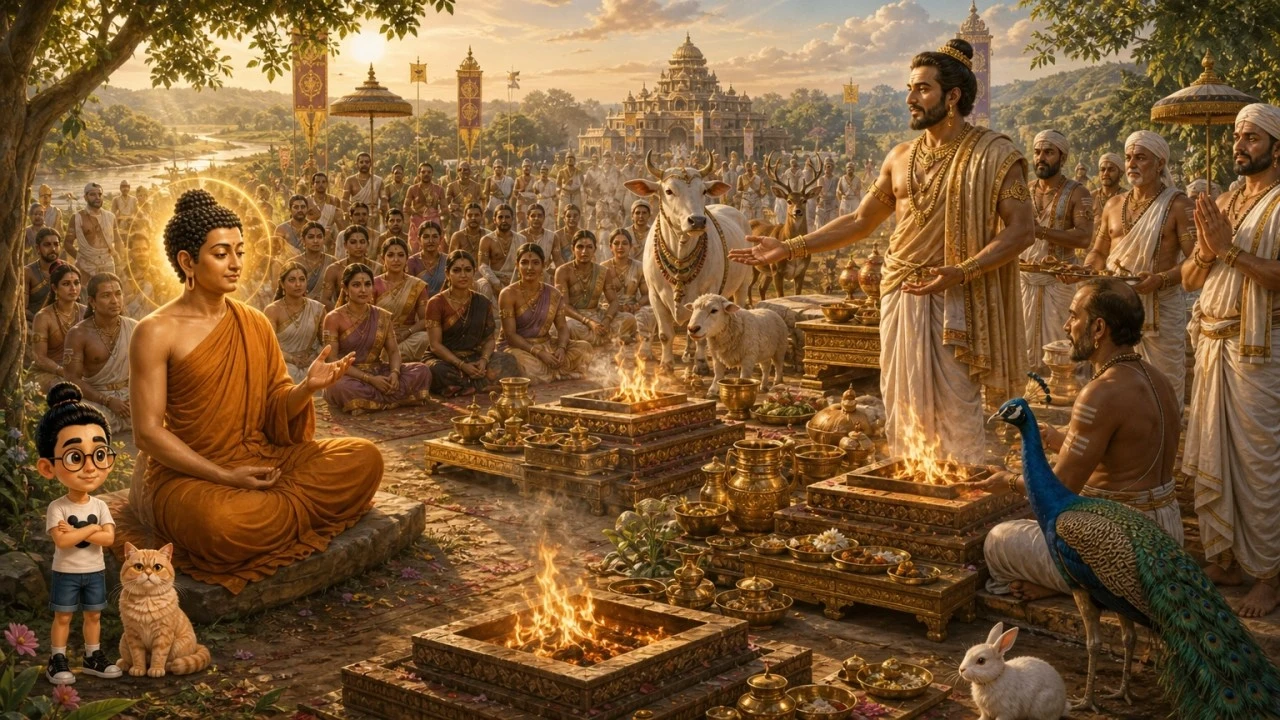


dn5:20.1 Then the aristocrat vassals of town and country set up gifts to the east of the sacrificial enclosure.
BAGIAN 20
dn5:20.2 The ministers and councillors of town and country set up gifts to the south of the sacrificial enclosure.
dn5:20.3 The well-to-do brahmins of town and country set up gifts to the west of the sacrificial enclosure.
dn5:20.4 The well-off householders of town and country set up gifts to the north of the sacrificial enclosure.
dn5:20.5 And brahmin, in that sacrifice too no cattle were killed, no goats were killed, and no chickens or pigs were killed. There was no slaughter of various kinds of creatures. No trees were felled for the sacrificial post. No grass was reaped to strew over the place of sacrifice.
dn5:20.6 No bondservants, servants, or workers did their jobs under threat of punishment and danger, weeping with tearful faces.
dn5:20.7 Those who wished to work did so, while those who did not wish to did not.
dn5:20.8 They did the work they wanted to, and did not do what they didn’t want to.
dn5:20.9 The sacrifice was completed with just ghee, oil, butter, curds, honey, and molasses.
dn5:20.10 And so there were four consenting factions, eight factors possessed by King Mahāvijita, four factors possessed by the high priest,
dn5:20.11 and three modes.
dn5:20.12 Brahmin, this is called the sacrifice accomplished with three modes and sixteen accessories.”