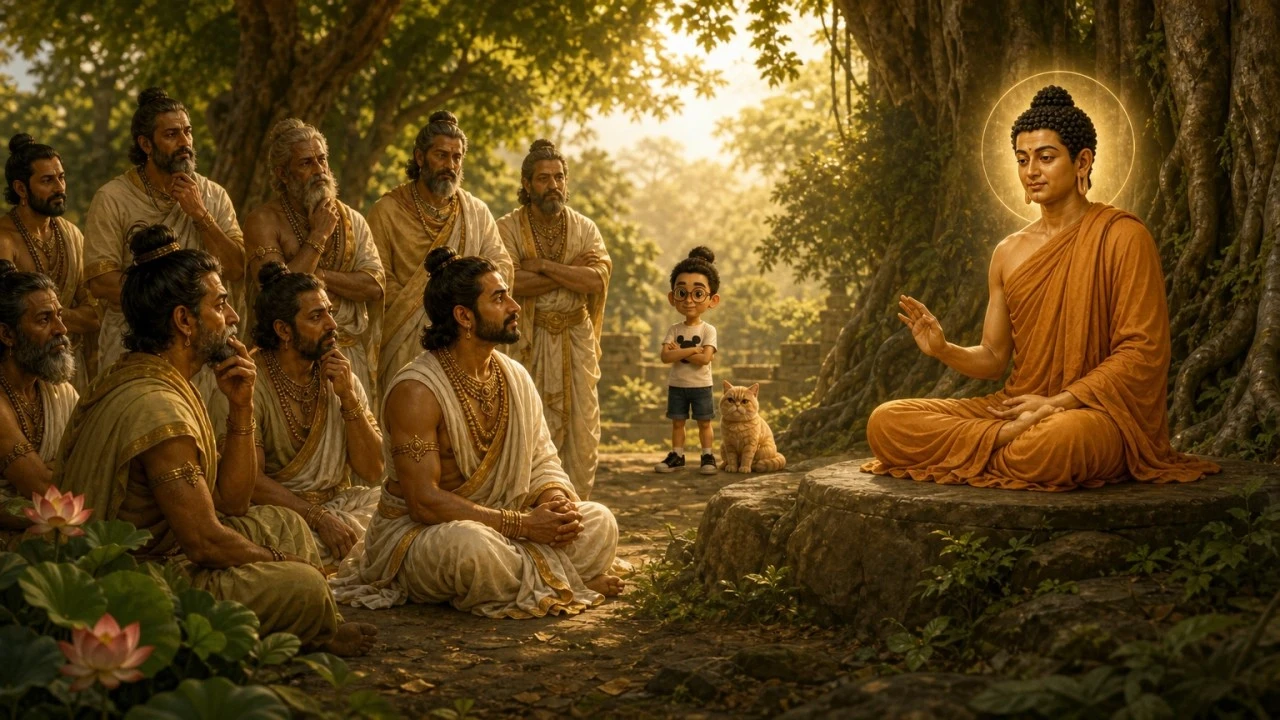

dn4:20.1 Now at that time Soṇadaṇḍa’s nephew, the young student Aṅgaka was sitting in that assembly.
BAGIAN 20
dn4:20.2 Then Soṇadaṇḍa said to those brahmins,
dn4:20.3 “Gentlemen, do you see my nephew, the young student Aṅgaka?”
dn4:20.4 “Yes, sir.”
dn4:20.5 “Aṅgaka is attractive, good-looking, lovely, of surpassing beauty. He has divine looks and lustre, remarkable to behold. There’s no one in this assembly so good-looking, apart from the ascetic Gotama.
dn4:20.6 Aṅgaka recites and remembers the hymns, and has mastered the three Vedas, together with their vocabularies and ritual performance, their phonology and word classification, and the testaments as fifth. He knows them word-by-word, and their grammar. He is well versed in cosmology and the marks of a great man.
dn4:20.7 And I am the one who teaches him the hymns.
dn4:20.8 Aṅgaka is well born on both his mother’s and father’s side, stemming from a clean vessel, with irrefutable and impeccable genealogy back to the seventh paternal generation.
dn4:20.9 And I know his mother and father.
dn4:20.10 But if Aṅgaka were to kill living creatures, steal, commit adultery, lie, and drink liquor, then what’s the use of his appearance, his hymns, or his birth?
dn4:20.11 It’s when a brahmin is ethical, mature in ethical conduct;
dn4:20.12 and he’s astute and intelligent, being the first or second to hold the sacrificial ladle.
dn4:20.13 A brahmin must possess these two factors for the brahmins to rightly describe him as a brahmin.”