
dn3:2.1.0 4. Knowledge and Conduct
BAGIAN 2
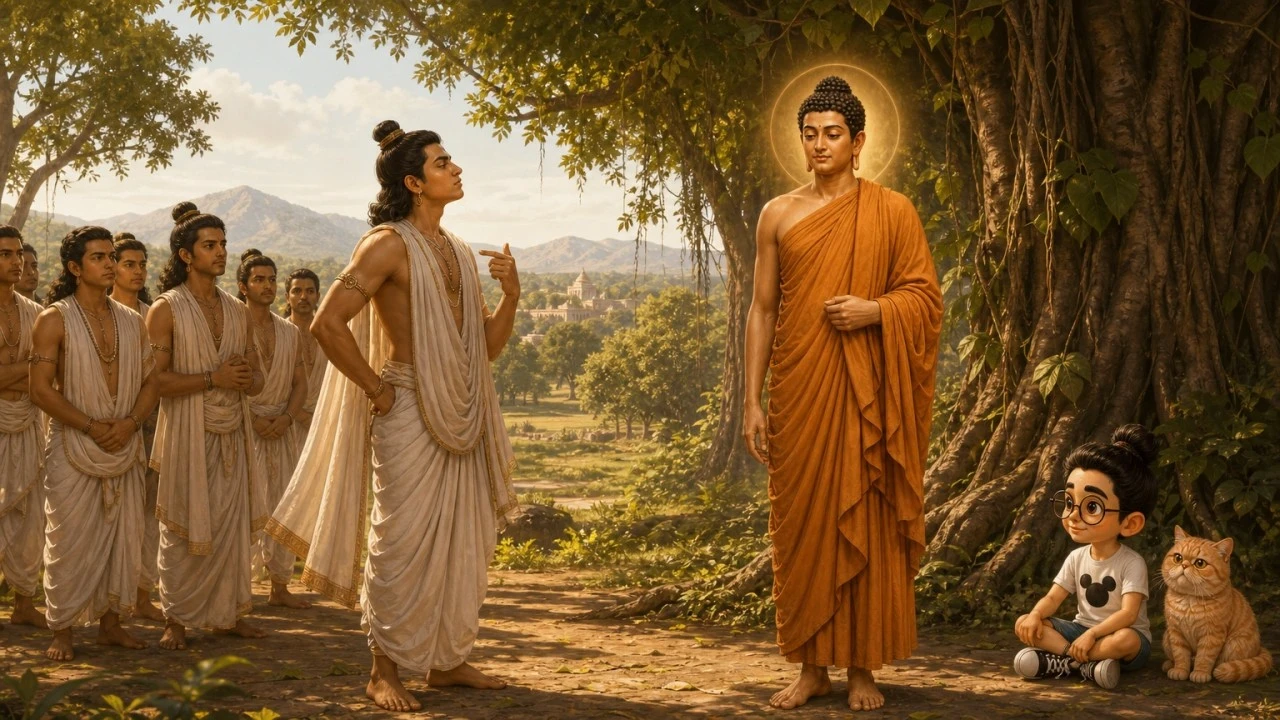
dn3:2.1.1 “But what, worthy Gotama, is that conduct, and what is that knowledge?”
dn3:2.1.2 “Ambaṭṭha, in the supreme knowledge and conduct there is no discussion of genealogy or clan or pride—
dn3:2.1.3 ‘You deserve me’ or ‘You don’t deserve me.’
dn3:2.1.4 Wherever there is giving and taking in marriage there is such discussion.
dn3:2.1.6 Whoever is shackled to questions of genealogy or clan or pride, or to giving and taking in marriage, is far from the supreme knowledge and conduct.
dn3:2.1.7 The realization of supreme knowledge and conduct occurs when you’ve given up such things.”
dn3:2.2.1 “But what, worthy Gotama, is that conduct, and what is that knowledge?”
dn3:2.2.2 “Ambaṭṭha, it’s when a Realized One arises in the world, perfected, a fully awakened Buddha, accomplished in knowledge and conduct, holy, knower of the world, supreme guide for those fit for training, teacher of gods and humans, awakened, blessed.
dn3:2.2.3 He has realized with his own insight this world—with its gods, Māras, and divinities, this population with its ascetics and brahmins, gods and humans—and he makes it known to others.
dn3:2.2.4 He teaches Dhamma that’s good in the beginning, good in the middle, and good in the end, meaningful and well-phrased. And he reveals a spiritual practice that’s entirely full and pure.
dn3:2.2.5 A householder hears that teaching, or a householder’s child, or someone reborn in a good family.
dn3:2.2.6 They gain faith in the Realized One
dn3:2.2.7 and reflect …
dn3:2.2.8 Quite secluded from sensual pleasures, secluded from unskillful qualities, they enter and remain in the first absorption …
dn3:2.2.9 This pertains to their conduct.
dn3:2.2.10 Furthermore, as the placing of the mind and keeping it connected are stilled, a mendicant enters and remains in the second absorption …
dn3:2.2.11 This pertains to their conduct.
dn3:2.2.12 Furthermore, with the fading away of rapture, they enter and remain in the third absorption …
dn3:2.2.13 This pertains to their conduct.
dn3:2.2.14 Furthermore, with the giving up of pleasure and pain and the disappearance of former happiness and sadness, they enter and remain in the fourth absorption …
dn3:2.2.15 This pertains to their conduct.
dn3:2.2.16 This is that conduct.
dn3:2.2.17 When their mind has become immersed in samādhi like this—purified, bright, flawless, rid of corruptions, pliable, workable, steady, and imperturbable—they project it and extend it toward knowledge and vision.
dn3:2.2.18 This pertains to their knowledge. …
dn3:2.2.19 They understand: ‘There is nothing further for this place.’
dn3:2.2.20 This pertains to their knowledge.
dn3:2.2.21 This is that knowledge.
dn3:2.2.22 This mendicant is said to be ‘accomplished in knowledge’, and also ‘accomplished in conduct’, and also ‘accomplished in knowledge and conduct’.
dn3:2.2.23 And, Ambaṭṭha, there is no accomplishment in knowledge and conduct that is better or finer than this.
dn3:2.3.0 5. Four Causes of Quitting
dn3:2.3.1 There are these four causes of quitting this supreme knowledge and conduct.
dn3:2.3.2 What four?
dn3:2.3.3 Firstly, take some ascetic or brahmin who, not managing to obtain this supreme knowledge and conduct, plunges into a wilderness region carrying their pack with a shoulder-pole, thinking
dn3:2.3.4 they will get by eating fallen fruit.
dn3:2.3.5 In fact they succeed only in serving someone accomplished in knowledge and conduct.
dn3:2.3.6 This is the first cause of quitting this supreme knowledge and conduct.
dn3:2.3.7 Furthermore, take some ascetic or brahmin who, not managing to obtain this supreme knowledge and conduct or to get by eating fallen fruit, plunges into a wilderness region carrying a spade and basket, thinking
dn3:2.3.8 they will get by eating tubers and fruit.
dn3:2.3.9 In fact they succeed only in serving someone accomplished in knowledge and conduct.
dn3:2.3.10 This is the second cause of quitting this supreme knowledge and conduct.
dn3:2.3.11 Furthermore, take some ascetic or brahmin who, not managing to obtain this supreme knowledge and conduct, or to get by eating fallen fruit, or to get by eating tubers and fruit, sets up a fire chamber in the neighborhood of a village or town and dwells there serving the sacred flame.
dn3:2.3.12 In fact they succeed only in serving someone accomplished in knowledge and conduct.
dn3:2.3.13 This is the third cause of quitting this supreme knowledge and conduct.
dn3:2.3.14 Furthermore, take some ascetic or brahmin who, not managing to obtain this supreme knowledge and conduct, or to get by eating fallen fruit, or to get by eating tubers and fruit, or to serve the sacred flame, sets up a four-doored fire chamber at the crossroads and dwells there, thinking:
dn3:2.3.15 ‘When an ascetic or brahmin comes from the four quarters, I will honor them as best I can.’
dn3:2.3.16 In fact they succeed only in serving someone accomplished in knowledge and conduct.
dn3:2.3.17 This is the fourth cause of quitting this supreme knowledge and conduct.
dn3:2.3.18 These are the four causes of quitting this supreme knowledge and conduct.
dn3:2.4.1 What do you think, Ambaṭṭha?
dn3:2.4.2 Is this supreme knowledge and conduct seen in your own denomination?”
dn3:2.4.3 “No, worthy Gotama.
dn3:2.4.4 Who am I and my denomination compared with the supreme knowledge and conduct?
dn3:2.4.5 We are far from that.”
dn3:2.4.6 “What do you think, Ambaṭṭha?
dn3:2.4.7 Since you’re not managing to obtain this supreme knowledge and conduct, have you with your denomination plunged into a wilderness region carrying your pack with a shoulder-pole, thinking
dn3:2.4.8 you will get by eating fallen fruit?”
dn3:2.4.9 “No, worthy Gotama.”
dn3:2.4.10 “What do you think, Ambaṭṭha?
dn3:2.4.11 Have you with your denomination … plunged into a wilderness region carrying a spade and basket, thinking
dn3:2.4.12 you will get by eating tubers and fruit?”
dn3:2.4.13 “No, worthy Gotama.”
dn3:2.4.14 “What do you think, Ambaṭṭha?
dn3:2.4.15 Have you with your denomination … set up a fire chamber in the neighborhood of a village or town and dwelt there serving the sacred flame?”
dn3:2.4.16 “No, worthy Gotama.”
dn3:2.4.17 “What do you think, Ambaṭṭha?
dn3:2.4.18 Have you with your denomination … set up a four-doored fire chamber at the crossroads and dwelt there, thinking:
dn3:2.4.19 ‘When an ascetic or brahmin comes from the four quarters, I will honor them as best I can’?”
dn3:2.4.20 “No, worthy Gotama.”
dn3:2.5.1 “So you with your denomination are not only inferior to the supreme knowledge and conduct,
dn3:2.5.2 you are even inferior to the four causes of quitting the supreme knowledge and conduct.
dn3:2.5.3 But you have been told this by your tutor, the brahmin Pokkharasāti:
dn3:2.5.4 ‘Who are these shavelings, fake ascetics, primitives, black spawn from the feet of our kinsman compared with conversation with the brahmins of the three knowledges?’ Yet he himself has not even fulfilled one of the quittings!
dn3:2.5.5 See, Ambaṭṭha, how your tutor Pokkharasāti has wronged you.
dn3:2.6.0 6. Being Like the Seers of the Past
dn3:2.6.1 Pokkharasāti lives off an endowment provided by King Pasenadi of Kosala.
dn3:2.6.2 But the king won’t even grant him an audience face to face.
dn3:2.6.3 When he consults, he does so behind a curtain.
dn3:2.6.4 Why wouldn’t the king grant a face to face audience with someone who’d receive his legitimate presentation of food?
dn3:2.6.5 See, Ambaṭṭha, how your tutor Pokkharasāti has wronged you.
dn3:2.7.1 What do you think, Ambaṭṭha?
dn3:2.7.2 Suppose King Pasenadi was holding consultations with warrior-chiefs or chieftains while sitting on an elephant’s neck or on horseback, or while standing on the mat in a chariot.
dn3:2.7.3 And suppose he’d get down from that place and stand aside.
dn3:2.7.4 Then along would come a worker or their bondservant, who’d stand in the same place and continue the consultation:
dn3:2.7.5 ‘This is what King Pasenadi says, and this too is what the king says.’
dn3:2.7.6 Though he spoke the king’s words and gave the king’s advice,
dn3:2.7.7 does that qualify him to be the king or the king’s minister?”
dn3:2.7.8 “No, worthy Gotama.”
dn3:2.8.1 “In the same way, Ambaṭṭha, the ancient seers of the brahmins were Aṭṭhaka, Vāmaka, Vāmadeva, Vessāmitta, Yamadaggi, Aṅgīrasa, Bhāradvāja, Vāseṭṭha, Kassapa, and Bhagu. They were the authors and propagators of the hymns. Their hymnal was sung and propagated and compiled in ancient times; and these days, brahmins continue to sing and chant it, chanting what was chanted and teaching what was taught.
dn3:2.8.2 You might imagine that, since you’ve learned their hymns by heart in your own denomination, that makes you a seer or someone on the path to becoming a seer. But that is not possible.
dn3:2.9.1 What do you think, Ambaṭṭha?
dn3:2.9.2 According to what you have heard from elderly and senior brahmins, the tutors of tutors,
dn3:2.9.3 did those ancient brahmin seers—
dn3:2.9.4 nicely bathed and anointed, with hair and beard dressed, bedecked with jewels, earrings, and bracelets, dressed in white—amuse themselves, supplied and provided with the five kinds of sensual stimulation, like you do today in your denomination?”
dn3:2.9.5 “No, worthy Gotama.”
dn3:2.10.2 “Did they eat boiled fine rice, garnished with clean meat, with the dark grains picked out, served with many soups and sauces, like you do today in your denomination?”
dn3:2.10.3 “No, worthy Gotama.”
dn3:2.10.5 “Did they amuse themselves with girls wearing thongs that show off their curves, like you do today in your denomination?”
dn3:2.10.6 “No, worthy Gotama.”
dn3:2.10.8 “Did they drive about in chariots drawn by mares with plaited manes, whipping and lashing them onward with long goads, like you do today in your denomination?”
dn3:2.10.9 “No, worthy Gotama.”
dn3:2.10.11 “Did they get men with long swords to guard them in fortresses with moats dug and barriers in place, like you do today in your denomination?”
dn3:2.10.12 “No, worthy Gotama.”
dn3:2.10.13 “So, Ambaṭṭha, in your own denomination you are neither a seer nor someone on the path to becoming a seer.
dn3:2.10.14 Whoever has any doubt or uncertainty about me, let them ask me and I will clear up their doubts with my answer.”
dn3:2.11.0 7. Seeing the Two Marks
dn3:2.11.1 Then the Buddha left his dwelling and proceeded to begin walking mindfully,
dn3:2.11.2 and Ambaṭṭha did likewise.
dn3:2.11.3 Then while walking beside the Buddha, Ambaṭṭha scrutinized his body for the thirty-two marks of a great man.
dn3:2.11.4 He saw all of them except two,
dn3:2.11.5 which he had doubts about:
dn3:2.11.6 whether the private parts are sheathed in a foreskin, and the largeness of the tongue.
dn3:2.12.1 Then it occurred to the Buddha,
dn3:2.12.2 “This student Ambaṭṭha sees all the marks except two,
dn3:2.12.3 which he has doubts about:
dn3:2.12.4 whether the private parts are sheathed in a foreskin, and the largeness of the tongue.”
dn3:2.12.5 Then the Buddha used his psychic power to will that Ambaṭṭha would see his private parts sheathed in a foreskin.
dn3:2.12.6 And he stuck out his tongue and stroked back and forth on his ear holes and nostrils, and covered his entire forehead with his tongue.
dn3:2.12.7 Then Ambaṭṭha thought,
dn3:2.12.8 “The ascetic Gotama possesses the thirty-two marks completely, lacking none.”
dn3:2.12.9 He said to the Buddha,
dn3:2.12.10 “Well, now, sir, I must go. I have many duties, and much to do.”
dn3:2.12.11 “Please, Ambaṭṭha, go at your convenience.”
dn3:2.12.12 Then Ambaṭṭha mounted his chariot drawn by mares and left.
dn3:2.13.1 Now at that time the brahmin Pokkharasāti had come out from Ukkaṭṭhā together with a large group of brahmins and was sitting in his own park just waiting for Ambaṭṭha.
dn3:2.13.2 Then Ambaṭṭha entered the park.
dn3:2.14.1 He went by carriage as far as the terrain allowed, then descended and approached the brahmin Pokkharasāti on foot. He bowed and sat down to one side, and Pokkharasāti said to him:
dn3:2.14.2 “I hope, dear Ambaṭṭha, you saw the worthy Gotama?”
dn3:2.14.3 “I saw him, sir.”
dn3:2.14.4 “Well, does he live up to his reputation or not?”
dn3:2.14.6 “He does, sir.
dn3:2.14.7 The worthy Gotama possesses the thirty-two marks completely, lacking none.”
dn3:2.14.8 “And did you have some discussion with him?”
dn3:2.14.9 “I did.”
dn3:2.14.10 “And what kind of discussion did you have with him?”
dn3:2.14.11 Then Ambaṭṭha informed Pokkharasāti of all they had discussed.
dn3:2.15.1 Then Pokkharasāti said to Ambaṭṭha,
dn3:2.15.2 “Oh, our bloody fake scholar, our fake learned man, who pretends to be proficient in the three Vedas! A man who behaves like this ought, when their body breaks up, after death, to be reborn in a place of loss, a bad place, the underworld, hell.
dn3:2.15.3 It’s only because you repeatedly attacked the worthy Gotama like that that he kept bringing up charges against us!”
dn3:2.15.4 Angry and upset, he kicked Ambaṭṭha over,
dn3:2.15.5 and wanted to go and see the Buddha right away.
dn3:2.16.0 8. Pokkharasāti Visits the Buddha
dn3:2.16.1 Then those brahmins said to Pokkharasāti,
dn3:2.16.2 “It’s much too late to visit the ascetic Gotama today.
dn3:2.16.3 You can visit him tomorrow.”
dn3:2.16.4 So Pokkharasāti had delicious fresh and cooked foods prepared in his own home. Then he mounted a carriage and, with attendants carrying torches, set out from Ukkaṭṭhā for the forest near Icchānaṅgala.
dn3:2.17.1 He went by carriage as far as the terrain allowed, then descended and entered the monastery on foot. He went up to the Buddha and exchanged greetings with him. When the greetings and polite conversation were over, he sat down to one side and said to the Buddha,
dn3:2.17.2 “Master Gotama, has my resident pupil, the student Ambaṭṭha, come here?”
dn3:2.17.3 “Yes he has, brahmin.”
dn3:2.17.4 “And did you have some discussion with him?”
dn3:2.17.5 “I did.”
dn3:2.17.6 “And what kind of discussion did you have with him?”
dn3:2.17.7 Then the Buddha informed Pokkharasāti of all they had discussed.
dn3:2.17.8 Then Pokkharasāti said to the Buddha,
dn3:2.17.9 “Ambaṭṭha is a fool, worthy Gotama. Please forgive him.”
dn3:2.17.10 “May the student Ambaṭṭha be happy, brahmin.”
dn3:2.18.1 Then Pokkharasāti scrutinized the Buddha’s body for the thirty-two marks of a great man.
dn3:2.18.2 He saw all of them except two,
dn3:2.18.3 which he had doubts about:
dn3:2.18.4 whether the private parts are sheathed in a foreskin, and the largeness of the tongue.
dn3:2.18.5 Then it occurred to the Buddha,
dn3:2.18.6 “Pokkharasāti sees all the marks except two,
dn3:2.18.7 which he has doubts about:
dn3:2.18.8 whether the private parts are sheathed in a foreskin, and the largeness of the tongue.”
dn3:2.18.9 Then the Buddha used his psychic power to will that Pokkharasāti would see his private parts sheathed in a foreskin.
dn3:2.18.10 And he stuck out his tongue and stroked back and forth on his ear holes and nostrils, and covered his entire forehead with his tongue.
dn3:2.19.1 Pokkharasāti thought,
dn3:2.19.2 “The ascetic Gotama possesses the thirty-two marks completely, lacking none.”
dn3:2.19.3 He said to the Buddha,
dn3:2.19.4 “Would the worthy Gotama together with the mendicant Saṅgha please accept today’s meal from me?”
dn3:2.19.5 The Buddha consented with silence.
dn3:2.20.1 Then, knowing that the Buddha had consented, Pokkharasāti announced the time to him,
dn3:2.20.2 “It’s time, worthy Gotama, the meal is ready.”
dn3:2.20.3 Then the Buddha robed up in the morning and, taking his bowl and robe, went to the home of Pokkharasāti together with the mendicant Saṅgha, where he sat down on the seat spread out.
dn3:2.20.4 Then Pokkharasāti served and satisfied the Buddha with his own hands with delicious fresh and cooked foods, while his young students served the Saṅgha.
dn3:2.20.5 When the Buddha had eaten and washed his hand and bowl, Pokkharasāti took a low seat and sat to one side.
dn3:2.21.1 Then the Buddha taught him step by step, with
dn3:2.21.2 a talk on giving, ethical conduct, and heaven. He revealed the drawbacks of sensual pleasures, so sordid and corrupt, and the benefit of renunciation.
dn3:2.21.3 And when the Buddha knew that Pokkharasāti’s mind was ready, pliable, rid of hindrances, elated, and confident he revealed the special teaching of the Buddhas:
dn3:2.21.4 suffering, its origin, its cessation, and the path.
dn3:2.21.5 Just as a clean cloth rid of stains would properly absorb dye,
dn3:2.21.6 in that very seat the stainless, immaculate vision of the Dhamma arose in the brahmin Pokkharasāti:
dn3:2.21.7 “Everything that is liable to arise is liable to cease.”
dn3:2.22.0 9. Pokkharasāti Declares Himself a Lay Follower
dn3:2.22.1 Then Pokkharasāti saw, attained, understood, and fathomed the Dhamma. He went beyond doubt, got rid of indecision, and became self-assured and independent of others regarding the Teacher’s instructions. He said to the Buddha,
dn3:2.22.2 “Excellent, worthy Gotama! Excellent!
dn3:2.22.3 As if he were righting the overturned, or revealing the hidden, or pointing out the path to the lost, or lighting a lamp in the dark so people with clear eyes can see what’s there, just so has the worthy Gotama made the Teaching clear in many ways.
dn3:2.22.4 Together with my children, wives, retinue, and ministers, I go for refuge to the worthy Gotama, to the teaching, and to the mendicant Saṅgha.
dn3:2.22.5 From this day forth, may the worthy Gotama remember me as a lay follower who has gone for refuge for life.
dn3:2.22.6 Just as the worthy Gotama visits other devoted families in Ukkaṭṭhā, may he visit mine.
dn3:2.22.7 The brahmin boys and girls there will bow to you, rise in your presence, give you a seat and water, and gain confidence in their hearts. That will be for their lasting welfare and happiness.”
dn3:2.22.8 “That’s nice of you to say, householder.”