
dn3:1.1.1 So I have heard.
BAGIAN 1
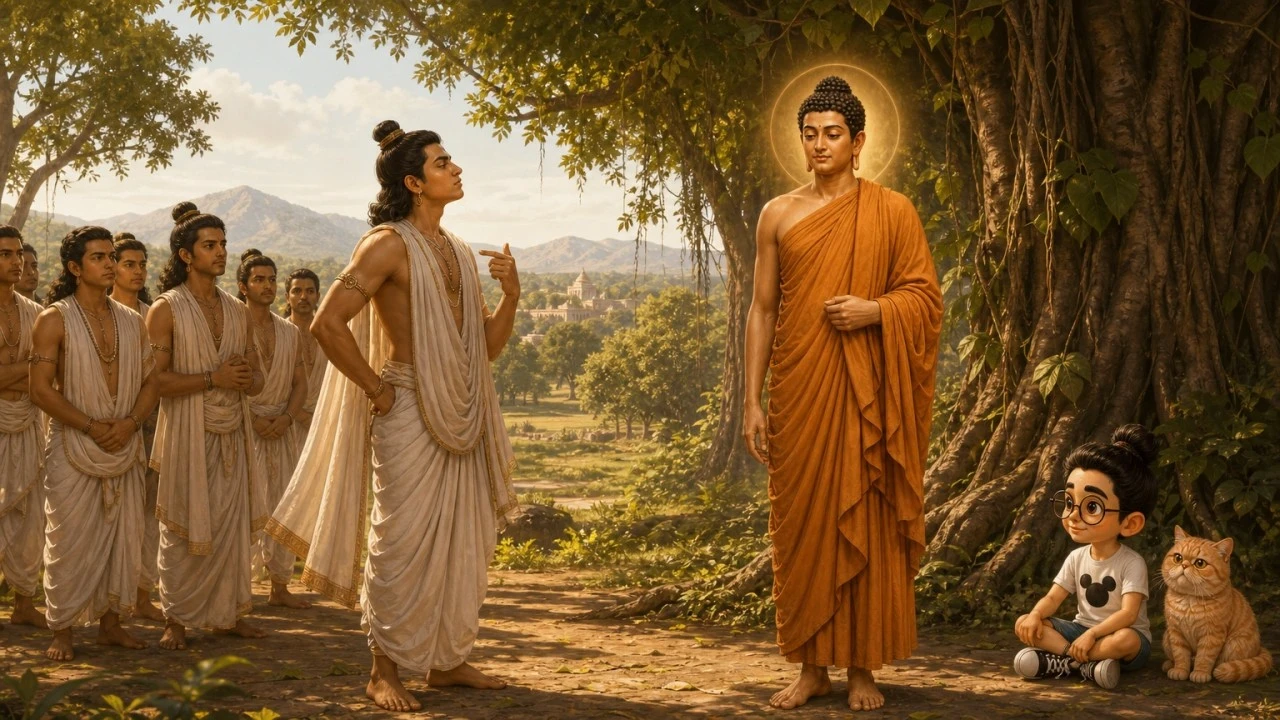
dn3:1.1.2 At one time the Buddha was wandering in the land of the Kosalans together with a large Saṅgha of five hundred mendicants when he arrived at a village of the Kosalan brahmins named Icchānaṅgala.
dn3:1.1.3 He stayed in a forest near Icchānaṅgala.
dn3:1.2.0 1. The Section on Pokkharasāti
dn3:1.2.1 Now at that time the brahmin Pokkharasāti was living in Ukkaṭṭhā. It was a crown property given by King Pasenadi of Kosala, teeming with living creatures, full of hay, wood, water, and grain, a royal park endowed to a brahmin.
dn3:1.2.2 Pokkharasāti heard:
dn3:1.2.3 “It seems the ascetic Gotama—a Sakyan, gone forth from a Sakyan family—has arrived at Icchānaṅgala and is staying in a forest nearby.
dn3:1.2.4 He has this good reputation:
dn3:1.2.5 ‘That Blessed One is perfected, a fully awakened Buddha, accomplished in knowledge and conduct, holy, knower of the world, supreme guide for those fit for training, teacher of gods and humans, awakened, blessed.’
dn3:1.2.6 He has realized with his own insight this world—with its gods, Māras, and divinities, this population with its ascetics and brahmins, gods and humans—and he makes it known to others.
dn3:1.2.7 He teaches Dhamma that’s good in the beginning, good in the middle, and good in the end, meaningful and well-phrased. And he reveals a spiritual practice that’s entirely full and pure.
dn3:1.2.8 It’s good to see such perfected ones.”
dn3:1.3.0 2. The Student Ambaṭṭha
dn3:1.3.1 Now at that time Pokkharasāti had a student named Ambaṭṭha as his resident pupil. He was one who recited and remembered the hymns, and had mastered in the three Vedas, together with their vocabularies and ritual performance, their phonology and word classification, and the testaments as fifth. He knew them word-by-word, and their grammar. He was well versed in cosmology and the marks of a great man. He had been authorized as a master in his own tutor’s scriptural heritage of the three Vedas with the words:
dn3:1.3.2 “What I know, you know.
dn3:1.3.3 And what you know, I know.”
dn3:1.4.1 Then Pokkharasāti addressed Ambaṭṭha,
dn3:1.4.2 “Dear Ambaṭṭha, the ascetic Gotama—a Sakyan, gone forth from a Sakyan family—has arrived at Icchānaṅgala and is staying in a forest nearby.
dn3:1.4.3 He has this good reputation …
dn3:1.4.7 It’s good to see such perfected ones.
dn3:1.4.8 Please, dear Ambaṭṭha, go to the ascetic Gotama and find out whether or not he lives up to his reputation.
dn3:1.4.9 Through you I shall learn about the worthy Gotama.”
dn3:1.5.1 “But sir, how shall I find out whether or not the ascetic Gotama lives up to his reputation?”
dn3:1.5.2 “Dear Ambaṭṭha, the thirty-two marks of a great man have been handed down in our hymns. A great man who possesses these has only two possible destinies, no other.
dn3:1.5.3 If he stays at home he becomes a king, a wheel-turning monarch, a just and principled king. His dominion extends to all four sides, he achieves stability in the country, and he possesses the seven treasures.
dn3:1.5.4 He has the following seven treasures:
dn3:1.5.5 the wheel, the elephant, the horse, the jewel, the woman, the householder, and the commander as the seventh treasure.
dn3:1.5.6 He has over a thousand sons who are valiant and heroic, crushing the armies of his enemies.
dn3:1.5.7 After conquering this land girt by sea, he reigns by principle, without rod or sword.
dn3:1.5.8 But if he goes forth from the lay life to homelessness, he becomes a perfected one, a fully awakened Buddha, who has cast off the world’s veil.
dn3:1.5.9 But, dear Ambaṭṭha, I am the one who gives the hymns,
dn3:1.5.10 and you are the one who receives them.”
dn3:1.6.1 “Yes, worthy sir,” replied Ambaṭṭha. He got up from his seat, bowed, and respectfully circled Pokkharasāti, keeping him on his right. He mounted a chariot drawn by mares and, together with several young students, set out for the forest near Icchānaṅgala.
dn3:1.6.2 He went by carriage as far as the terrain allowed, then descended and entered the monastery on foot.
dn3:1.7.1 At that time several mendicants were walking mindfully in the open air.
dn3:1.7.2 Then the student Ambaṭṭha went up to those mendicants and said,
dn3:1.7.3 “Good fellows, where is the worthy Gotama at present?
dn3:1.7.4 For we have come here to see him.”
dn3:1.8.1 Then those mendicants thought,
dn3:1.8.2 “This Ambaṭṭha is from a well-known family, and he is the pupil of the well-known brahmin Pokkharasāti.
dn3:1.8.3 The Buddha won’t mind having a discussion together with such gentlemen.”
dn3:1.8.4 They said to Ambaṭṭha,
dn3:1.8.5 “Ambaṭṭha, that’s his dwelling, with the door closed. Approach it quietly, without hurrying; go onto the porch, clear your throat, and knock on the door-panel. The Buddha will open the door.”
dn3:1.9.1 So he approached the Buddha’s dwelling, cleared his throat and knocked on the door-panel, and the Buddha opened the door.
dn3:1.9.2 Ambaṭṭha and the young students entered the dwelling. The young students exchanged greetings with the Buddha, and when the greetings and polite conversation were over, sat down to one side.
dn3:1.9.3 But while the Buddha was sitting, Ambaṭṭha spoke some polite words or other while walking around or standing.
dn3:1.9.4 So the Buddha said to him,
dn3:1.9.5 “Ambaṭṭha, is this how you hold a discussion with elderly and senior brahmins, the tutors of tutors: walking around or standing while I’m sitting, speaking some polite words or other?”
dn3:1.10.0 2.1. The First Use of the Word “Primitives”
dn3:1.10.1 “No, worthy Gotama.
dn3:1.10.2 For it is proper for one brahmin to converse with another while both are walking, standing, sitting, or lying down.
dn3:1.10.3 But as to these shavelings, fake ascetics, primitives, black spawn from the feet of our kinsman, I converse with them as I do with the worthy Gotama.”
dn3:1.11.1 “But Ambaṭṭha, you must have come here for some purpose. You should focus on that.
dn3:1.11.2 Though this Ambaṭṭha is unqualified, he thinks he’s qualified. What is that but lack of qualifications?”
dn3:1.12.1 When he said this, Ambaṭṭha became angry and upset with the Buddha because of being described as unqualified. He even attacked and badmouthed the Buddha himself, saying,
dn3:1.12.2 “The ascetic Gotama will be worsted!” He said to the Buddha,
dn3:1.12.3 “Worthy Gotama, the Sakyans are rude,
dn3:1.12.4 harsh,
dn3:1.12.5 touchy,
dn3:1.12.6 and argumentative.
dn3:1.12.7 Primitive they are, and primitive they remain! They don’t honor, respect, revere, worship, or venerate brahmins.
dn3:1.12.8 It is neither proper nor appropriate that the Sakyans—primitives that they are—don’t honor, respect, revere, worship, or venerate brahmins.”
dn3:1.12.9 And that’s how Ambaṭṭha denigrated the Sakyans with the word “primitives” for the first time.
dn3:1.13.0 2.2. The Second Use of the Word “Primitives”
dn3:1.13.1 “But Ambaṭṭha, how have the Sakyans wronged you?”
dn3:1.13.2 “This one time, worthy Gotama, I went to Kapilavatthu on some business for my tutor, the brahmin Pokkharasāti.
dn3:1.13.3 I approached the Sakyans in their town hall.
dn3:1.13.4 Now at that time several Sakyans and Sakyan princes were sitting on high seats, poking each other with their fingers, giggling and playing together. In fact, they even presumed to giggle at me, and didn’t invite me to a seat.
dn3:1.13.5 It is neither proper nor appropriate that the Sakyans—primitives that they are—don’t honor, respect, revere, worship, or venerate brahmins.”
dn3:1.13.6 And that’s how Ambaṭṭha denigrated the Sakyans with the word “primitives” for the second time.
dn3:1.14.0 2.3. The Third Use of the Word “Primitives”
dn3:1.14.1 “Even a little quail, Ambaṭṭha, speaks as she likes in her own nest.
dn3:1.14.2 Kapilavatthu is the Sakyans’ own place, Ambaṭṭha. It’s not worthy of the Venerable Ambaṭṭha to lose his temper over such a small thing.”
dn3:1.14.3 “Worthy Gotama, there are these four classes:
dn3:1.14.4 aristocrats, brahmins, peasants, and menials.
dn3:1.14.5 Three of these classes—
dn3:1.14.6 aristocrats, peasants, and menials—
dn3:1.14.7 in fact succeed only when serving the brahmins.
dn3:1.14.8 It is neither proper nor appropriate that the Sakyans—primitives that they are—don’t honor, respect, revere, worship, or venerate brahmins.”
dn3:1.14.9 And that’s how Ambaṭṭha denigrated the Sakyans with the word “primitives” for the third time.
dn3:1.15.0 2.4. The Word “Son of a Slavegirl” is Used
dn3:1.15.1 Then it occurred to the Buddha,
dn3:1.15.2 “This Ambaṭṭha puts the Sakyans down way too much by calling them primitives. Why don’t I ask him about his own clan?”
dn3:1.15.3 So the Buddha said to him,
dn3:1.15.4 “What is your clan, Ambaṭṭha?”
dn3:1.15.5 “I am a Kaṇhāyana, worthy Gotama.”
dn3:1.15.6 “But, recollecting the ancient name and clan of your mother and father, the Sakyans were the children of the masters, while you’re descended from the son of a slavegirl of the Sakyans.
dn3:1.15.7 But the Sakyans regard King Okkāka as their grandfather.
dn3:1.15.8 Once upon a time, King Okkāka, wishing to divert the royal succession to the son of his most beloved queen, banished the elder princes from the realm—
dn3:1.15.9 Okkāmukha, Karakaṇḍa, Hatthinika, and Sinisūra.
dn3:1.15.10 They made their home beside a lotus pond on the slopes of the Himalayas, where there was a large grove of <i lang='pi' translate='no'>sakhua</i> trees.
dn3:1.15.11 For fear of breaking their line of birth, they slept with their own (<i lang='pi' translate='no'>saka</i>) sisters.
dn3:1.15.12 Then King Okkāka addressed his ministers and councillors,
dn3:1.15.13 ‘Where, sirs, have the princes settled now?’
dn3:1.15.14 ‘Your Majesty, there is a lotus pond on the slopes of the Himalayas, by a large grove of <i lang='pi' translate='no'>sakhua</i> trees. They’ve settled there.
dn3:1.15.15 For fear of breaking their line of birth, they are sleeping with their own sisters.’
dn3:1.15.16 Then, Ambaṭṭha, King Okkāka expressed this heartfelt sentiment:
dn3:1.15.17 ‘The princes are indeed Sakyans! The princes are indeed the best Sakyans!’
dn3:1.15.18 From that day on the Sakyans were recognized and he was their founder.
dn3:1.16.1 Now, King Okkāka had a slavegirl named Disā.
dn3:1.16.2 She gave birth to a boy named Black.
dn3:1.16.3 When he was born, Black Boy said:
dn3:1.16.4 ‘Wash me, mum, bathe me! Get this filth off of me! I will be useful for you!’
dn3:1.16.5 Whereas these days when people see goblins they recognize them as goblins,
dn3:1.16.6 in those days they recognized goblins as ‘blackboys’.
dn3:1.16.7 They said:
dn3:1.16.8 ‘He spoke as soon as he was born—a blackboy is born! A goblin is born!’
dn3:1.16.9 From that day on the Kaṇhāyanas were proclaimed, and he was their founder.
dn3:1.16.10 That’s how, recollecting the ancient name and clan of your mother and father, the Sakyans were the children of the masters, while you’re descended from the son of a slavegirl of the Sakyans.”
dn3:1.17.1 When he said this, those young students said to him,
dn3:1.17.2 “Worthy Gotama, please don’t put Ambaṭṭha down too much by calling him the son of a slavegirl.
dn3:1.17.3 He’s well-born, a gentleman, learned, who enunciates well, and is astute. He is capable of debating with the worthy Gotama about this.”
dn3:1.18.1 So the Buddha said to them,
dn3:1.18.2 “Well, young students, if you think that
dn3:1.18.3 Ambaṭṭha is ill-born, not a gentleman, unlearned, a poor speaker, witless, and not capable of debating with me about this, then leave him aside and you can debate with me.
dn3:1.18.4 But if you think that
dn3:1.18.5 he’s well-born, a gentleman, learned, who enunciates well, is astute, and is capable of debating with me about this, then you should stand aside and let him debate with me.”
dn3:1.19.1 “He is capable of debating you. We will be silent, and let Ambaṭṭha debate with the worthy Gotama about this.”
dn3:1.20.1 So the Buddha said to Ambaṭṭha,
dn3:1.20.2 “Well, Ambaṭṭha, there’s a legitimate question that comes up. You won’t like it, but you ought to answer anyway.
dn3:1.20.3 If you fail to answer—by dodging the issue, remaining silent, or leaving—your head will explode into seven pieces right here.
dn3:1.20.4 What do you think, Ambaṭṭha?
dn3:1.20.5 According to what you have heard from elderly and senior brahmins, the tutors of tutors, what is the origin of the Kaṇhāyanas, and who is their founder?”
dn3:1.20.6 When he said this, Ambaṭṭha kept silent.
dn3:1.20.7 For a second time, the Buddha put the question,
dn3:1.20.9 and for a second time Ambaṭṭha kept silent.
dn3:1.20.10 So the Buddha said to him,
dn3:1.20.11 “Answer now, Ambaṭṭha. Now is not the time for silence.
dn3:1.20.12 If someone fails to answer a legitimate question when asked three times by the Buddha, their head explodes into seven pieces there and then.”
dn3:1.21.1 Now at that time the spirit Vajirapāṇī, holding a massive iron spear, burning, blazing, and glowing, stood in the air above Ambaṭṭha, thinking,
dn3:1.21.2 “If this Ambaṭṭha doesn’t answer when asked a third time, I’ll blow his head into seven pieces there and then!”
dn3:1.21.3 And both the Buddha and Ambaṭṭha could see Vajirapāṇī.
dn3:1.21.4 Ambaṭṭha was terrified, shocked, and awestruck. Looking to the Buddha for shelter, asylum, and refuge, he sat down close by the Buddha and said,
dn3:1.21.5 “What did you say?
dn3:1.21.6 Please repeat the question.”
dn3:1.21.7 “What do you think, Ambaṭṭha?
dn3:1.21.8 According to what you have heard from elderly and senior brahmins, the tutors of tutors, what is the origin of the Kaṇhāyanas, and who is their founder?”
dn3:1.21.9 “I have heard, worthy Gotama, that it is just as you say.
dn3:1.21.10 That’s the origin of the Kaṇhāyanas,
dn3:1.21.11 and that’s who their founder is.”
dn3:1.22.0 2.5. The Discussion of Ambaṭṭha’s Heritage
dn3:1.22.1 When he said this, those young students made an uproar,
dn3:1.22.2 “It turns out Ambaṭṭha is ill-born, not a gentleman, son of a Sakyan slavegirl, and that the Sakyans are sons of his masters!
dn3:1.22.3 And it seems that the ascetic Gotama spoke only the truth, though we presumed to rebuke him!”
dn3:1.23.1 Then it occurred to the Buddha,
dn3:1.23.2 “These young students put Ambaṭṭha down too much by calling him the son of a slavegirl. Why don’t I get him out of this?”
dn3:1.23.3 So the Buddha said to the young students,
dn3:1.23.4 “Young students, please don’t put Ambaṭṭha down too much by calling him the son of a slavegirl.
dn3:1.23.5 That Black Boy was an eminent seer.
dn3:1.23.6 He went to a southern country and memorized the Divine Spell. Then he approached King Okkāka and asked for the hand of his daughter Maddarūpī.
dn3:1.23.7 The king said to him,
dn3:1.23.8 ‘Who the hell is this son of a slavegirl to ask for the hand of my daughter!’ Angry and upset he fastened a razor-tipped arrow.
dn3:1.23.9 But he wasn’t able to either shoot it or to relax it.
dn3:1.23.10 Then the ministers and councillors approached the seer Black Boy and said:
dn3:1.23.11 ‘Spare the king, sir,
dn3:1.23.12 spare him!’
dn3:1.23.13 ‘The king will be safe. But if he shoots the arrow downwards, there will be an earthquake across the entire realm.’
dn3:1.23.14 ‘Spare the king, sir, and spare the country!’
dn3:1.23.15 ‘Both king and country will be safe. But if he shoots the arrow upwards, the heavens will not rain in the entire realm for seven years.’
dn3:1.23.16 ‘Spare the king, sir, spare the country, and let the heavens rain!’
dn3:1.23.17 ‘Both king and country will be safe, and the heavens rain will rain. And if the king shoots the crown prince with an arrow, he will be safe and unruffled.’
dn3:1.23.18 So the ministers said to Okkāka:
dn3:1.23.19 ‘Okkāka must shoot the crown prince with an arrow. He will be safe and unruffled.’
dn3:1.23.20 So King Okkāka shot the crown prince with an arrow. And he was safe and unruffled.
dn3:1.23.21 Then the king was terrified, shocked, and awestruck. Scared by the divine punishment, he gave the hand of his daughter Maddarūpī.
dn3:1.23.22 Young students, please don’t put Ambaṭṭha down too much by calling him the son of a slavegirl. That Black Boy was an eminent seer.”
dn3:1.24.0 3. The Supremacy of the Aristocrats
dn3:1.24.1 Then the Buddha addressed Ambaṭṭha,
dn3:1.24.2 “What do you think, Ambaṭṭha?
dn3:1.24.3 Suppose an aristocrat boy was to sleep with a brahmin girl, and they had a son.
dn3:1.24.4 Would he receive a seat and water from the brahmins?”
dn3:1.24.5 “He would, worthy Gotama.”
dn3:1.24.6 “And would the brahmins feed him at an offering of food for ancestors, an offering of a dish of milk-rice, a sacrifice, or a feast for guests?”
dn3:1.24.7 “They would.”
dn3:1.24.8 “And would the brahmins teach him the hymns or not?”
dn3:1.24.9 “They would.”
dn3:1.24.10 “And would he be kept from the women or not?”
dn3:1.24.11 “He would not.”
dn3:1.24.12 “And would the aristocrats anoint him as king?”
dn3:1.24.13 “No, worthy Gotama.
dn3:1.24.14 Why is that?
dn3:1.24.15 Because his maternity is unsuitable.”
dn3:1.25.1 “What do you think, Ambaṭṭha?
dn3:1.25.2 Suppose a brahmin boy was to sleep with an aristocrat girl, and they had a son.
dn3:1.25.3 Would he receive a seat and water from the brahmins?”
dn3:1.25.4 “He would, worthy Gotama.”
dn3:1.25.5 “And would the brahmins feed him at an offering of food for ancestors, an offering of a dish of milk-rice, a sacrifice, or a feast for guests?”
dn3:1.25.6 “They would.”
dn3:1.25.7 “And would the brahmins teach him the hymns or not?”
dn3:1.25.8 “They would.”
dn3:1.25.9 “And would he be kept from the women or not?”
dn3:1.25.10 “He would not.”
dn3:1.25.11 “And would the aristocrats anoint him as king?”
dn3:1.25.12 “No, worthy Gotama.
dn3:1.25.13 Why is that?
dn3:1.25.14 Because his paternity is unsuitable.”
dn3:1.26.1 “And so, Ambaṭṭha, the aristocrats are superior and the brahmins inferior, whether comparing women with women or men with men.
dn3:1.26.2 What do you think, Ambaṭṭha?
dn3:1.26.3 Suppose the brahmins for some reason were to shave a brahmin’s head, inflict him with a sack of ashes, and banish him from the nation or the city.
dn3:1.26.4 Would he receive a seat and water from the brahmins?”
dn3:1.26.5 “No, worthy Gotama.”
dn3:1.26.6 “And would the brahmins feed him at an offering of food for ancestors, an offering of a dish of milk-rice, a sacrifice, or a feast for guests?”
dn3:1.26.7 “No, worthy Gotama.”
dn3:1.26.8 “And would the brahmins teach him the hymns or not?”
dn3:1.26.9 “No, worthy Gotama.”
dn3:1.26.10 “And would he be kept from the women or not?”
dn3:1.26.11 “He would be.”
dn3:1.27.1 “What do you think, Ambaṭṭha?
dn3:1.27.2 Suppose the aristocrats for some reason were to shave an aristocrat’s head, inflict him with a sack of ashes, and banish him from the nation or the city.
dn3:1.27.3 Would he receive a seat and water from the brahmins?”
dn3:1.27.4 “He would, worthy Gotama.”
dn3:1.27.5 “And would the brahmins feed him at an offering of food for ancestors, an offering of a dish of milk-rice, a sacrifice, or a feast for guests?”
dn3:1.27.6 “They would.”
dn3:1.27.7 “And would the brahmins teach him the hymns or not?”
dn3:1.27.8 “They would.”
dn3:1.27.9 “And would he be kept from the women or not?”
dn3:1.27.10 “He would not.”
dn3:1.27.11 “At this point, Ambaṭṭha, that aristocrat has reached rock bottom, with head shaven, inflicted with a sack of ashes, and banished from city or nation.
dn3:1.27.12 Yet still the aristocrats are superior and the brahmins inferior.
dn3:1.28.1 The divinity Sanaṅkumāra also spoke this verse:
dn3:1.28.2 ‘The aristocrat is best among people
dn3:1.28.3 who take clan as the standard.
dn3:1.28.4 But one accomplished in knowledge and conduct
dn3:1.28.5 is first among gods and humans.’
dn3:1.28.6 That verse was well sung by the Divinity Sanaṅkumāra, not poorly sung; well spoken, not poorly spoken, beneficial, not harmful, and it was approved by me.
dn3:1.28.7 For I also say this:
dn3:1.28.8 The aristocrat is best among people
dn3:1.28.9 who take clan as the standard.
dn3:1.28.10 But one accomplished in knowledge and conduct
dn3:1.28.11 is first among gods and humans.”
dn3:1.28.12 The first recitation section.