

dn33:1.1.1 So I have heard.
BAGIAN 1
dn33:1.1.2 At one time the Buddha was wandering in the land of the Mallas together with a large Saṅgha of five hundred mendicants when he arrived at a Mallian town named Pāvā.
dn33:1.1.3 There he stayed in Cunda the smith’s mango grove.
dn33:1.2.1 Now at that time a new town hall named Ubbhaṭaka had recently been constructed for the Mallas of Pāvā. It had not yet been occupied by an ascetic or brahmin or any human at all.
dn33:1.2.2 The Mallas of Pāvā also heard that the Buddha had arrived and was staying in Cunda’s mango grove.
dn33:1.2.3 Then they went up to the Buddha, bowed, sat down to one side, and said to him,
dn33:1.2.4 “Sir, a new town hall named Ubbhaṭaka has recently been constructed for the Mallas of Pāvā. It has not yet been occupied by an ascetic or brahmin or any human at all.
dn33:1.2.5 May the Buddha be the first to use it, and only then will the Mallas of Pāvā use it.
dn33:1.2.6 That would be for the lasting welfare and happiness of the Mallas of Pāvā.”
dn33:1.2.7 The Buddha consented in silence.
dn33:1.3.1 Then, knowing that the Buddha had consented, the Mallas got up from their seat, bowed and respectfully circled the Buddha, keeping him on their right. Then they went to the new town hall, where they spread carpets all over, prepared seats, set up a water jar, and placed an oil lamp. Then they went back to the Buddha,
dn33:1.3.2 bowed, stood to one side,
dn33:1.3.3 and told him of their preparations, saying,
dn33:1.3.5 “Please, sir, come at your convenience.”
dn33:1.4.1 Then the Buddha robed up and, taking his bowl and robe, went to the new town hall together with the Saṅgha of mendicants. Having washed his feet, he entered the town hall and sat against the central column facing east.
dn33:1.4.2 The Saṅgha of mendicants also washed their feet, entered the town hall, and sat against the west wall facing east, with the Buddha right in front of them.
dn33:1.4.3 The Mallas of Pāvā also washed their feet, entered the town hall, and sat against the east wall facing west, with the Buddha right in front of them.
dn33:1.4.4 The Buddha spent much of the night educating, encouraging, firing up, and inspiring the Mallas with a Dhamma talk. Then he sent them off,
dn33:1.4.5 “The night is getting late, Vāseṭṭhas.
dn33:1.4.6 Please go at your convenience.”
dn33:1.4.7 “Yes, sir,” replied the Mallas. They got up from their seat, bowed and respectfully circled the Buddha, keeping him on their right, before leaving.
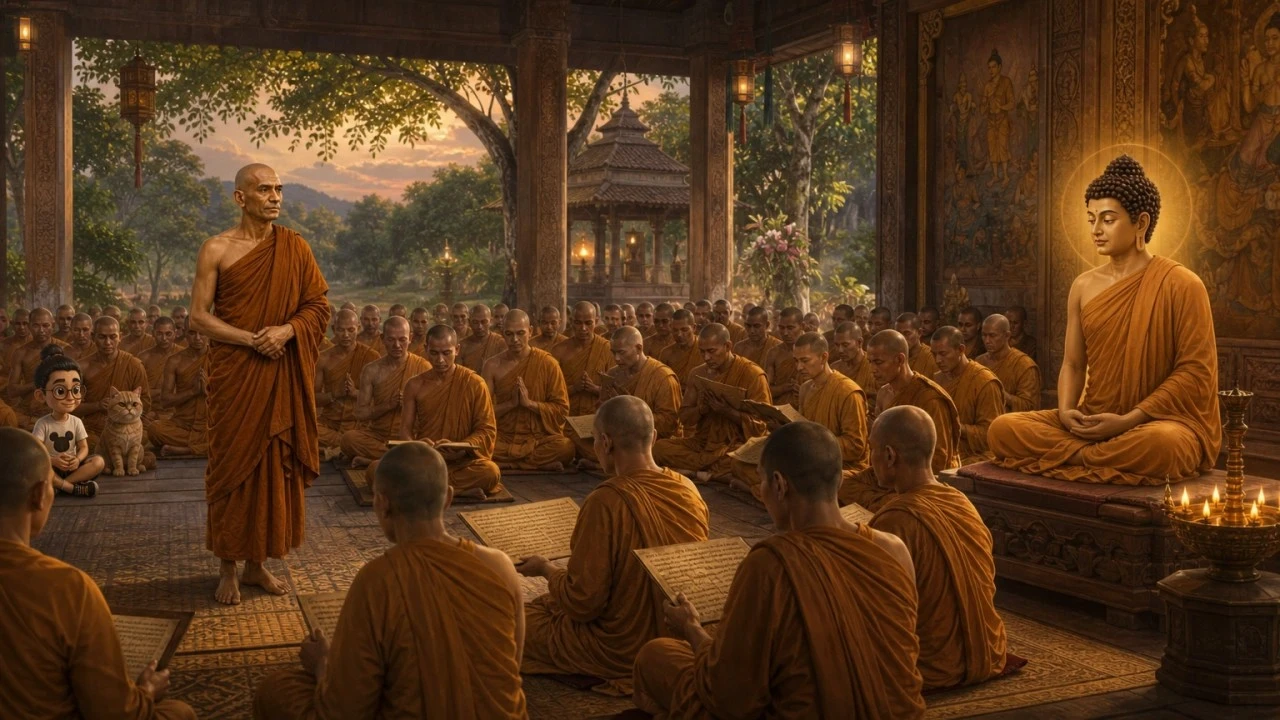
dn33:1.5.1 Soon after they left, the Buddha looked around the Saṅgha of mendicants, who were so very silent. He addressed Venerable Sāriputta,
dn33:1.5.2 “Sāriputta, the Saṅgha of mendicants is rid of dullness and drowsiness.
dn33:1.5.3 Give them some Dhamma talk as you feel inspired.
dn33:1.5.4 My back is sore,
dn33:1.5.5 I’ll stretch it.”
dn33:1.5.6 “Yes, sir,” Sāriputta replied.
dn33:1.5.7 And then the Buddha spread out his outer robe folded in four and laid down in the lion’s posture—on the right side, placing one foot on top of the other—mindful and aware, and focused on the time of getting up.
dn33:1.6.1 Now at that time the Jain ascetic of the Ñātika clan had recently passed away at Pāvā.
dn33:1.6.2 With his passing the Jain ascetics split, dividing into two factions, fighting, quarreling, and disputing, continually wounding each other with barbed words:
dn33:1.6.3 “You don’t understand this teaching and training. I understand this teaching and training. What, you understand this teaching and training? You’re practicing wrong. I’m practicing right. I stay on topic, you don’t. You said last what you should have said first. You said first what you should have said last. What you’ve thought so much about has been disproved. Your doctrine is refuted. Go on, save your doctrine! You’re trapped; get yourself out of this—if you can!”
dn33:1.6.4 You’d think there was nothing but slaughter going on among the Jain ascetics.
dn33:1.6.5 And the Jain Ñātika’s white-clothed lay disciples were disillusioned, dismayed, and disappointed in the Jain ascetics. They were equally disappointed with a teaching and training so poorly explained and poorly propounded, not emancipating, not leading to peace, proclaimed by someone who is not a fully awakened Buddha, with broken monument and without a refuge.
dn33:1.7.1 Then Sāriputta told the mendicants about these things. He went on to say,
dn33:1.7.4 “That’s what happens, reverends, when a teaching and training is poorly explained and poorly propounded, not emancipating, not leading to peace, proclaimed by someone who is not a fully awakened Buddha.
dn33:1.7.5 But this teaching is well explained and well propounded to us by the Blessed One, emancipating, leading to peace, proclaimed by someone who is a fully awakened Buddha.
dn33:1.7.6 You should all recite this in concert, without disputing, so that this spiritual path may last for a long time. That would be for the welfare and happiness of the people, out of sympathy for the world, for the benefit, welfare, and happiness of gods and humans.
dn33:1.7.7 And what is that teaching?
dn33:1.7.9.0 1. Ones
dn33:1.7.10 There are teachings grouped by one that have been rightly explained by the Blessed One, who knows and sees, the perfected one, the fully awakened Buddha.
dn33:1.7.11 You should all recite these in concert, without disputing, so that this spiritual path may last for a long time. That would be for the welfare and happiness of the people, out of sympathy for the world, for the benefit, welfare, and happiness of gods and humans.
dn33:1.8.1 What are the teachings grouped by one?
dn33:1.8.2 All sentient beings are sustained by food.
dn33:1.8.3 All sentient beings are sustained by conditions.
dn33:1.8.4 These are the teachings grouped by one that have been rightly explained by the Blessed One, who knows and sees, the perfected one, the fully awakened Buddha.
dn33:1.8.5 You should all recite these in concert, without disputing, so that this spiritual path may last for a long time. That would be for the welfare and happiness of the people, out of sympathy for the world, for the benefit, welfare, and happiness of gods and humans.
dn33:1.9.0 2. Twos
dn33:1.9.1 There are teachings grouped by two that have been rightly explained by the Buddha.
dn33:1.9.2 You should all recite these in concert.
dn33:1.9.3 What are the teachings grouped by two?
dn33:1.9.4 Name and form.
dn33:1.9.5 Ignorance and craving for continued existence.
dn33:1.9.6 Views favoring existence and views favoring nonexistence.
dn33:1.9.7 Lack of conscience and prudence.
dn33:1.9.8 Conscience and prudence.
dn33:1.9.9 Being hard to admonish and having bad friends.
dn33:1.9.10 Being easy to admonish and having good friends.
dn33:1.9.11 Skill in offenses and skill in resolving offenses.
dn33:1.9.12 Skill in meditative attainments and skill in emerging from those attainments.
dn33:1.9.13 Skill in the elements and skill in application of mind.
dn33:1.9.14 Skill in the sense fields and skill in dependent origination.
dn33:1.9.15 Skill in what is possible and skill in what is impossible.
dn33:1.9.16 Integrity and scrupulousness.
dn33:1.9.17 Patience and gentleness.
dn33:1.9.18 Camaraderie and hospitality.
dn33:1.9.19 Harmlessness and purity.
dn33:1.9.20 Lack of mindfulness and lack of situational awareness.
dn33:1.9.21 Mindfulness and situational awareness.
dn33:1.9.22 Not guarding the sense doors and eating too much.
dn33:1.9.23 Guarding the sense doors and moderation in eating.
dn33:1.9.24 The power of reflection and the power of development.
dn33:1.9.25 The power of mindfulness and the power of immersion.
dn33:1.9.26 Serenity and discernment.
dn33:1.9.27 The basis of serenity and the basis of exertion.
dn33:1.9.28 Exertion, and not being scattered.
dn33:1.9.29 Failure in ethics and failure in view.
dn33:1.9.30 Accomplishment in ethics and accomplishment in view.
dn33:1.9.31 Purification of ethics and purification of view.
dn33:1.9.32 Purification of view and making an effort in line with that view.
dn33:1.9.33 Inspiration, and making a suitable effort when inspired by inspiring places.
dn33:1.9.34 To never be content with skillful qualities, and to never stop trying.
dn33:1.9.35 Knowledge and freedom.
dn33:1.9.36 Knowledge of ending and knowledge of non-arising.
dn33:1.9.37 These are the teachings grouped by two that have been rightly explained by the Buddha.
dn33:1.9.38 You should all recite these in concert.
dn33:1.10.0 3. Threes
dn33:1.10.1 There are teachings grouped by three that have been rightly explained by the Buddha.
dn33:1.10.2 You should all recite these in concert.
dn33:1.10.3 What are the teachings grouped by three?
dn33:1.10.4 <b>Three unskillful roots:</b>
dn33:1.10.5 greed, hate, and delusion.
dn33:1.10.6 <b>Three skillful roots:</b>
dn33:1.10.7 contentment, love, and understanding.
dn33:1.10.8 <b>Three ways of performing bad conduct:</b>
dn33:1.10.9 by body, speech, and mind.
dn33:1.10.10 <b>Three ways of performing good conduct:</b>
dn33:1.10.11 by body, speech, and mind.
dn33:1.10.12 <b>Three unskillful thoughts:</b>
dn33:1.10.13 sensuality, malice, and cruelty.
dn33:1.10.14 <b>Three skillful thoughts:</b>
dn33:1.10.15 renunciation, good will, and harmlessness.
dn33:1.10.16 <b>Three unskillful intentions:</b>
dn33:1.10.17 sensuality, malice, and cruelty.
dn33:1.10.18 <b>Three skillful intentions:</b>
dn33:1.10.19 renunciation, good will, and harmlessness.
dn33:1.10.20 <b>Three unskillful perceptions:</b>
dn33:1.10.21 sensuality, malice, and cruelty.
dn33:1.10.22 <b>Three skillful perceptions:</b>
dn33:1.10.23 renunciation, good will, and harmlessness.
dn33:1.10.24 <b>Three unskillful elements:</b>
dn33:1.10.25 sensuality, malice, and cruelty.
dn33:1.10.26 <b>Three skillful elements:</b>
dn33:1.10.27 renunciation, good will, and harmlessness.
dn33:1.10.28 <b>Another three elements:</b>
dn33:1.10.29 the sensual realm, the realm of luminous form, and the formless realm.
dn33:1.10.30 <b>Another three elements:</b>
dn33:1.10.31 the realm of luminous form, the formless realm, and cessation.
dn33:1.10.32 <b>Another three elements:</b>
dn33:1.10.33 lower, middle, and higher.
dn33:1.10.34 <b>Three cravings:</b>
dn33:1.10.35 for sensual pleasures, for continued existence, and for nonexistence.
dn33:1.10.36 <b>Another three cravings:</b>
dn33:1.10.37 for the sensual realm, the realm of luminous form, and the formless realm.
dn33:1.10.38 <b>Another three cravings:</b>
dn33:1.10.39 for the realm of luminous form, and the formless realm, and cessation.
dn33:1.10.40 <b>Three fetters:</b>
dn33:1.10.41 substantialist view, doubt, and misapprehension of precepts and observances.
dn33:1.10.42 <b>Three defilements:</b>
dn33:1.10.43 sensuality, desire for continued existence, and ignorance.
dn33:1.10.44 <b>Three realms of existence:</b>
dn33:1.10.45 sensual, luminous form, and formless.
dn33:1.10.46 <b>Three searches:</b>
dn33:1.10.47 for sensual pleasures, for continued existence, and for a spiritual path.
dn33:1.10.48 <b>Three kinds of discrimination:</b>
dn33:1.10.49 ‘I’m better’, ‘I’m equal’, and ‘I’m worse’.
dn33:1.10.50 <b>Three periods:</b>
dn33:1.10.51 past, future, and present.
dn33:1.10.52 <b>Three extremes:</b>
dn33:1.10.53 substantial reality, the origin of substantial reality, and the cessation of substantial reality.
dn33:1.10.54 <b>Three feelings:</b>
dn33:1.10.55 pleasure, pain, and neutral.
dn33:1.10.56 <b>Three forms of suffering:</b>
dn33:1.10.57 the suffering inherent in painful feeling, the suffering inherent in conditions, and the suffering inherent in perishing.
dn33:1.10.58 <b>Three heaps:</b>
dn33:1.10.59 the heap of surety in the wrong way, the heap of surety in the right way, and the heap of lack of surety.
dn33:1.10.60 <b>Three darknesses:</b>
dn33:1.10.61 one is doubtful, uncertain, undecided, and lacking confidence about the past, future, and present.
dn33:1.10.62 <b>Three things a Realized One need not hide:</b>
dn33:1.10.63 The Realized One’s behavior by way of body, speech, and mind is pure. He has no misconduct in these three ways that need be hidden, thinking:
dn33:1.10.64 ‘Don’t let others find this out about me!’
dn33:1.10.69 <b>Three possessions:</b>
dn33:1.10.70 greed, hate, and delusion.
dn33:1.10.71 <b>Three fires:</b>
dn33:1.10.72 greed, hate, and delusion.
dn33:1.10.73 <b>Another three fires:</b>
dn33:1.10.74 a fire for those worthy of offerings dedicated to the gods, a fire for householders, and a fire for those worthy of a religious donation.
dn33:1.10.75 <b>Threefold classification of the physical:</b>
dn33:1.10.76 visible and resistant, invisible and resistant, and invisible and non-resistant.
dn33:1.10.77 <b>Three choices:</b>
dn33:1.10.78 good choices, bad choices, and imperturbable choices.
dn33:1.10.79 <b>Three individuals:</b>
dn33:1.10.80 a trainee, an adept, and one who is neither a trainee nor an adept.
dn33:1.10.81 <b>Three seniors:</b>
dn33:1.10.82 a senior by birth, a senior in the teaching, and a senior by convention.
dn33:1.10.83 <b>Three grounds for making merit:</b>
dn33:1.10.84 giving, ethical conduct, and meditation.
dn33:1.10.85 <b>Three grounds for accusations:</b>
dn33:1.10.86 what is seen, heard, and suspected.
dn33:1.10.87 <b>Three kinds of sensual rebirth:</b>
dn33:1.10.88 There are sentient beings who desire what is present. They fall under the sway of presently arisen sensual pleasures. Namely, humans, some gods, and some beings in the underworld.
dn33:1.10.89 This is the first kind of sensual rebirth.
dn33:1.10.90 There are sentient beings who desire to create. Having repeatedly created, they fall under the sway of sensual pleasures. Namely, the gods who love to create.
dn33:1.10.91 This is the second kind of sensual rebirth.
dn33:1.10.92 There are sentient beings who desire what is created by others. They fall under the sway of sensual pleasures created by others. Namely, the gods who control what is created by others.
dn33:1.10.93 This is the third kind of sensual rebirth.
dn33:1.10.94 <b>Three kinds of pleasant rebirth:</b>
dn33:1.10.95 There are sentient beings who, having repeatedly given rise to it, dwell in pleasure. Namely, the gods of the Divinity’s host.
dn33:1.10.96 This is the first pleasant rebirth.
dn33:1.10.97 There are sentient beings who are drenched, steeped, filled, and soaked with pleasure.
dn33:1.10.98 Every so often they feel inspired to exclaim:
dn33:1.10.99 ‘Oh, what bliss! Oh, what bliss!’ Namely, the gods of sublime luminosity.
dn33:1.10.100 This is the second pleasant rebirth.
dn33:1.10.101 There are sentient beings who are drenched, steeped, filled, and soaked with pleasure.
dn33:1.10.102 Since they’re truly content, they experience pleasure. Namely, the gods of universal beauty.
dn33:1.10.103 This is the third pleasant rebirth.
dn33:1.10.104 <b>Three kinds of wisdom:</b>
dn33:1.10.105 the wisdom of a trainee, the wisdom of an adept, and the wisdom of one who is neither a trainee nor an adept.
dn33:1.10.106 <b>Another three kinds of wisdom:</b>
dn33:1.10.107 wisdom produced by thought, learning, and meditation.
dn33:1.10.108 <b>Three weapons:</b>
dn33:1.10.109 learning, seclusion, and wisdom.
dn33:1.10.110 <b>Three faculties:</b>
dn33:1.10.111 the faculty of understanding that enlightenment is imminent, the faculty of enlightenment, and the faculty of one who is enlightened.
dn33:1.10.112 <b>Three eyes:</b>
dn33:1.10.113 the eye of the flesh, the eye of clairvoyance, and the eye of wisdom.
dn33:1.10.114 <b>Three trainings:</b>
dn33:1.10.115 in higher ethics, higher mind, and higher wisdom.
dn33:1.10.116 <b>Three kinds of development:</b>
dn33:1.10.117 the development of physical endurance, the development of the mind, and the development of wisdom.
dn33:1.10.118 <b>Three unsurpassable qualities:</b>
dn33:1.10.119 unsurpassable seeing, practice, and freedom.
dn33:1.10.120 <b>Three kinds of immersion:</b>
dn33:1.10.121 Immersion with placing the mind and keeping it connected. Immersion without placing the mind, merely keeping it connected. Immersion without placing the mind or keeping it connected.
dn33:1.10.122 <b>Another three kinds of immersion:</b>
dn33:1.10.123 emptiness, signless, and undirected.
dn33:1.10.124 <b>Three purities:</b>
dn33:1.10.125 purity of body, speech, and mind.
dn33:1.10.126 <b>Three kinds of sagacity:</b>
dn33:1.10.127 sagacity of body, speech, and mind.
dn33:1.10.128 <b>Three skills:</b>
dn33:1.10.129 skill in progress, skill in regress, and skill in means.
dn33:1.10.130 <b>Three vanities:</b>
dn33:1.10.131 the vanity of health, the vanity of youth, and the vanity of life.
dn33:1.10.132 <b>Three ways of putting something in charge:</b>
dn33:1.10.133 putting oneself, the world, or the teaching in charge.
dn33:1.10.134 <b>Three topics of discussion:</b>
dn33:1.10.135 You might discuss the past:
dn33:1.10.136 ‘That is how it was in the past.’
dn33:1.10.137 You might discuss the future:
dn33:1.10.138 ‘That is how it will be in the future.’
dn33:1.10.139 Or you might discuss the present:
dn33:1.10.140 ‘This is how it is at present.’
dn33:1.10.141 <b>Three knowledges:</b>
dn33:1.10.142 recollection of past lives, knowledge of the death and rebirth of sentient beings, and knowledge of the ending of defilements.
dn33:1.10.143 <b>Three meditative abidings:</b>
dn33:1.10.144 the heavenly meditation, the divine meditation, and the noble meditation.
dn33:1.10.145 <b>Three demonstrations:</b>
dn33:1.10.146 The demonstration of psychic power, the demonstration of revealing, and the demonstration of instruction.
dn33:1.10.147 These are the teachings grouped by three that have been rightly explained by the Buddha.
dn33:1.10.148 You should all recite these in concert.
dn33:1.11.0 4. Fours
dn33:1.11.1 There are teachings grouped by four that have been rightly explained by the Buddha.
dn33:1.11.2 You should all recite these in concert.
dn33:1.11.3 What are the teachings grouped by four?
dn33:1.11.4 <b>Four kinds of mindfulness meditation:</b>
dn33:1.11.5 It’s when a mendicant meditates by observing an aspect of the body—keen, aware, and mindful, rid of covetousness and displeasure for the world.
dn33:1.11.6 They meditate observing an aspect of feelings …
dn33:1.11.7 mind …
dn33:1.11.8 principles—keen, aware, and mindful, rid of covetousness and displeasure for the world.
dn33:1.11.9 <b>Four right efforts:</b>
dn33:1.11.10 A mendicant generates enthusiasm, tries, makes an effort, exerts the mind, and strives so that bad, unskillful qualities don’t arise.
dn33:1.11.11 They generate enthusiasm, try, make an effort, exert the mind, and strive so that bad, unskillful qualities that have arisen are given up.
dn33:1.11.12 They generate enthusiasm, try, make an effort, exert the mind, and strive so that skillful qualities arise.
dn33:1.11.13 They generate enthusiasm, try, make an effort, exert the mind, and strive so that skillful qualities that have arisen remain, are not lost, but increase, mature, and are fully developed.
dn33:1.11.14 <b>Four bases of psychic power:</b>
dn33:1.11.15 A mendicant develops the basis of psychic power that has immersion due to enthusiasm, and active effort.
dn33:1.11.16 They develop the basis of psychic power that has immersion due to mental development, and active effort.
dn33:1.11.17 They develop the basis of psychic power that has immersion due to energy, and active effort.
dn33:1.11.18 They develop the basis of psychic power that has immersion due to inquiry, and active effort.
dn33:1.11.19 <b>Four absorptions:</b>
dn33:1.11.20 A mendicant, quite secluded from sensual pleasures, secluded from unskillful qualities, enters and remains in the first absorption, which has the rapture and bliss born of seclusion, while placing the mind and keeping it connected.
dn33:1.11.21 As the placing of the mind and keeping it connected are stilled, they enter and remain in the second absorption, which has the rapture and bliss born of immersion, with internal clarity and mind at one, without placing the mind and keeping it connected.
dn33:1.11.22 And with the fading away of rapture, they enter and remain in the third absorption, where they meditate with equanimity, mindful and aware, experiencing for themselves the bliss of which the noble ones declare, ‘Equanimous and mindful, one meditates in bliss.’
dn33:1.11.23 With the giving up of pleasure and pain and the disappearance of former happiness and sadness, they enter and remain in the fourth absorption, without pleasure or pain, with pure equanimity and mindfulness.
dn33:1.11.24 <b>Four ways of developing immersion further:</b>
dn33:1.11.25 There is a way of developing immersion further that leads to blissful meditation in this life.
dn33:1.11.26 There is a way of developing immersion further that leads to gaining knowledge and vision.
dn33:1.11.27 There is a way of developing immersion further that leads to mindfulness and awareness.
dn33:1.11.28 There is a way of developing immersion further that leads to the ending of defilements.
dn33:1.11.29 And what is the way of developing immersion further that leads to blissful meditation in this life?
dn33:1.11.30 It’s when a mendicant, quite secluded from sensual pleasures, secluded from unskillful qualities, enters and remains in the first absorption …
dn33:1.11.31 second absorption …
dn33:1.11.32 fourth absorption.
dn33:1.11.33 This is the way of developing immersion further that leads to blissful meditation in this life.
dn33:1.11.34 And what is the way of developing immersion further that leads to gaining knowledge and vision?
dn33:1.11.35 A mendicant applies their mind to the perception of light, focusing on the perception of day regardless of whether it’s night or day.
dn33:1.11.36 And so, with an open and unenveloped heart, they develop a mind that’s full of radiance.
dn33:1.11.37 This is the way of developing immersion further that leads to gaining knowledge and vision.
dn33:1.11.38 And what is the way of developing immersion further that leads to mindfulness and awareness?
dn33:1.11.39 A mendicant knows feelings as they arise, as they remain, and as they go away.
dn33:1.11.40 They know perceptions as they arise, as they remain, and as they go away.
dn33:1.11.41 They know thoughts as they arise, as they remain, and as they go away.
dn33:1.11.42 This is the way of developing immersion further that leads to mindfulness and awareness.
dn33:1.11.43 And what is the way of developing immersion further that leads to the ending of defilements?
dn33:1.11.44 A mendicant meditates observing rise and fall in the five grasping aggregates.
dn33:1.11.45 ‘Such is form, such is the origin of form, such is the disappearance of form.
dn33:1.11.46 Such are feelings …
dn33:1.11.47 perceptions …
dn33:1.11.48 choices …
dn33:1.11.49 consciousness, such is the origin of consciousness, such is the disappearance of consciousness.’
dn33:1.11.50 This is the way of developing immersion further that leads to the ending of defilements.
dn33:1.11.51 <b>Four limitless states:</b>
dn33:1.11.52 A mendicant meditates spreading a heart full of love to one direction, and to the second, and to the third, and to the fourth. In the same way above, below, across, everywhere, all around, they spread a heart full of love to the whole world—abundant, expansive, limitless, free of enmity and ill will.
dn33:1.11.53 They meditate spreading a heart full of compassion …
dn33:1.11.54 rejoicing …
dn33:1.11.55 equanimity to one direction, and to the second, and to the third, and to the fourth. In the same way above, below, across, everywhere, all around, they spread a heart full of equanimity to the whole world—abundant, expansive, limitless, free of enmity and ill will.
dn33:1.11.56 <b>Four formless states:</b>
dn33:1.11.57 A mendicant, going totally beyond perceptions of form, with the disappearance of perceptions of impingement, not focusing on perceptions of diversity, aware that ‘space is infinite’, enters and remains in the dimension of infinite space.
dn33:1.11.58 Going totally beyond the dimension of infinite space, aware that ‘consciousness is infinite’, they enter and remain in the dimension of infinite consciousness.
dn33:1.11.59 Going totally beyond the dimension of infinite consciousness, aware that ‘there is nothing at all’, they enter and remain in the dimension of nothingness.
dn33:1.11.60 Going totally beyond the dimension of nothingness, they enter and remain in the dimension of neither perception nor non-perception.
dn33:1.11.61 <b>Four supports:</b>
dn33:1.11.62 After appraisal, a mendicant uses some things, endures some things, avoids some things, and dispels some things.
dn33:1.11.63 <b>Four noble customs:</b>
dn33:1.11.64 A mendicant is content with any kind of robe, and praises such contentment. They don’t employ improper solicitation for the sake of a robe. They don’t worry if they don’t get a robe. And if they do get a robe, they use it untied, uninfatuated, unattached, seeing the drawback, and understanding the escape. And on account of that they don’t glorify themselves or put others down.
dn33:1.11.65 A mendicant who is deft, tireless, aware, and mindful in this is said to stand in the ancient, primordial noble custom.
dn33:1.11.66 Furthermore, a mendicant is content with any kind of almsfood …
dn33:1.11.68 Furthermore, a mendicant is content with any kind of lodgings …
dn33:1.11.70 Furthermore, a mendicant enjoys giving up and loves to give up. They enjoy meditation and love to meditate. But they don’t glorify themselves or put down others on account of their love for giving up and meditation.
dn33:1.11.71 A mendicant who is deft, tireless, aware, and mindful in this is said to stand in the ancient, primordial noble custom.
dn33:1.11.72 <b>Four efforts:</b>
dn33:1.11.73 The efforts to restrain, to give up, to develop, and to preserve.
dn33:1.11.74 And what is the effort to restrain?
dn33:1.11.75 When a mendicant sees a sight with their eyes, they don’t get caught up in the features and details.
dn33:1.11.76 If the faculty of sight were left unrestrained, bad unskillful qualities of covetousness and displeasure would become overwhelming. For this reason, they practice restraint, protecting the faculty of sight, and achieving its restraint.
dn33:1.11.77 When they hear a sound with their ears …
dn33:1.11.78 When they smell an odor with their nose …
dn33:1.11.79 When they taste a flavor with their tongue …
dn33:1.11.80 When they feel a touch with their body …
dn33:1.11.81 When they know an idea with their mind, they don’t get caught up in the features and details.
dn33:1.11.82 If the faculty of mind were left unrestrained, bad unskillful qualities of covetousness and displeasure would become overwhelming. For this reason, they practice restraint, protecting the faculty of mind, and achieving its restraint.
dn33:1.11.83 This is called the effort to restrain.
dn33:1.11.84 And what is the effort to give up?
dn33:1.11.85 It’s when a mendicant doesn’t tolerate a sensual,
dn33:1.11.86 malicious,
dn33:1.11.87 or cruel thought that’s arisen, but gives it up, dispels it, eliminates it, and obliterates it.
dn33:1.11.88 They don’t tolerate any bad, unskillful qualities that have arisen, but give them up, dispel them, eliminate them, and obliterate them.
dn33:1.11.89 This is called the effort to give up.
dn33:1.11.90 And what is the effort to develop?
dn33:1.11.91 It’s when a mendicant develops the awakening factors of mindfulness,
dn33:1.11.92 investigation of principles,
dn33:1.11.93 energy,
dn33:1.11.94 rapture,
dn33:1.11.95 tranquility,
dn33:1.11.96 immersion,
dn33:1.11.97 and equanimity, which rely on seclusion, fading away, and cessation, and ripen as letting go.
dn33:1.11.98 This is called the effort to develop.
dn33:1.11.99 And what is the effort to preserve?
dn33:1.11.100 It’s when a mendicant preserves a meditation subject that’s a fine basis of immersion: the perception of a skeleton, a worm-infested corpse, a livid corpse, a split open corpse, or a bloated corpse.
dn33:1.11.101 This is called the effort to preserve.
dn33:1.11.102 <b>Four knowledges:</b>
dn33:1.11.103 knowledge of the teaching, inferential knowledge, knowledge of encompassing, and conventional knowledge.
dn33:1.11.104 <b>Another four knowledges:</b>
dn33:1.11.105 knowing about suffering, the origin of suffering, the cessation of suffering, and the practice that leads to the cessation of suffering.
dn33:1.11.106 <b>Four factors for stream-entry:</b>
dn33:1.11.107 associating with true persons, listening to the true teaching, rational application of mind, and practicing in line with the teaching.
dn33:1.11.108 <b>Four factors of a stream-enterer:</b>
dn33:1.11.109 A noble disciple has experiential confidence in the Buddha:
dn33:1.11.110 ‘That Blessed One is perfected, a fully awakened Buddha, accomplished in knowledge and conduct, holy, knower of the world, supreme guide for those fit for training, teacher of gods and humans, awakened, blessed.’
dn33:1.11.111 They have experiential confidence in the teaching:
dn33:1.11.112 ‘The teaching is well explained by the Buddha—apparent in the present life, immediately effective, inviting inspection, relevant, so that sensible people can know it for themselves.’
dn33:1.11.113 They have experiential confidence in the Saṅgha:
dn33:1.11.114 ‘The Saṅgha of the Buddha’s disciples is practicing the way that’s good, direct, systematic, and proper. It consists of the four pairs, the eight individual persons. This is the Saṅgha of the Buddha’s disciples that is worthy of offerings dedicated to the gods, worthy of hospitality, worthy of a religious donation, worthy of greeting with cupped palms, and is the supreme field of merit for the world.’
dn33:1.11.115 And a noble disciple’s ethical conduct is loved by the noble ones, unbroken, impeccable, spotless, and unmarred, liberating, praised by sensible people, not mistaken, and leading to immersion.
dn33:1.11.116 <b>Four fruits of the ascetic life:</b>
dn33:1.11.117 stream-entry, once-return, non-return, and perfection.
dn33:1.11.118 <b>Four elements:</b>
dn33:1.11.119 earth, water, fire, and air.
dn33:1.11.120 <b>Four foods:</b>
dn33:1.11.121 edible food, whether solid or subtle; contact is the second, mental intention the third, and consciousness the fourth.
dn33:1.11.122 <b>Four establishings of consciousness:</b>
dn33:1.11.123 As long as consciousness continues, it gets involved with form, supported by form, established on form. And with a sprinkle of relishing, it grows, increases, and matures.
dn33:1.11.124 Or consciousness gets involved with feeling …
dn33:1.11.125 Or consciousness gets involved with perception …
dn33:1.11.126 Or as long as consciousness continues, it gets involved with choices, supported by choices, established on choices. And with a sprinkle of relishing, it grows, increases, and matures.
dn33:1.11.127 <b>Four prejudices:</b>
dn33:1.11.128 making decisions prejudiced by favoritism, hostility, stupidity, and cowardice.
dn33:1.11.129 <b>Four things that give rise to craving:</b>
dn33:1.11.130 Craving arises in a mendicant for the sake of robes,
dn33:1.11.131 almsfood,
dn33:1.11.132 lodgings,
dn33:1.11.133 or rebirth in this or that state.
dn33:1.11.134 <b>Four ways of practice:</b>
dn33:1.11.135 painful practice with slow insight, painful practice with swift insight, pleasant practice with slow insight, and pleasant practice with swift insight.
dn33:1.11.136 <b>Another four ways of practice:</b>
dn33:1.11.137 impatient practice, patient practice, taming practice, and calming practice.
dn33:1.11.138 <b>Four footprints of the Dhamma:</b>
dn33:1.11.139 contentment, good will, right mindfulness, and right immersion.
dn33:1.11.140 <b>Four ways of taking up practices:</b>
dn33:1.11.141 There is a way of taking up practices that is painful now and results in future pain.
dn33:1.11.142 There is a way of taking up practices that is painful now but results in future pleasure.
dn33:1.11.143 There is a way of taking up practices that is pleasant now but results in future pain.
dn33:1.11.144 There is a way of taking up practices that is pleasant now and results in future pleasure.
dn33:1.11.145 <b>Four spectrums of the teaching:</b>
dn33:1.11.146 ethics, immersion, wisdom, and freedom.
dn33:1.11.147 <b>Four powers:</b>
dn33:1.11.148 energy, mindfulness, immersion, and wisdom.
dn33:1.11.149 <b>Four foundations:</b>
dn33:1.11.150 the foundations of wisdom, truth, generosity, and peace.
dn33:1.11.151 <b>Four ways of answering questions:</b>
dn33:1.11.152 There is a question that should be answered categorically. There is a question that should be answered analytically. There is a question that should be answered with a counter-question. There is a question that should be set aside.
dn33:1.11.153 <b>Four deeds:</b>
dn33:1.11.154 There are deeds that are dark with dark result.
dn33:1.11.155 There are deeds that are bright with bright result.
dn33:1.11.156 There are deeds that are dark and bright with dark and bright result.
dn33:1.11.157 There are neither dark nor bright deeds with neither dark nor bright results, which lead to the ending of deeds.
dn33:1.11.158 <b>Four things to be realized:</b>
dn33:1.11.159 Past lives are to be realized with recollection.
dn33:1.11.160 The passing away and rebirth of sentient beings is to be realized with vision.
dn33:1.11.161 The eight liberations are to be realized with direct meditative experience.
dn33:1.11.162 The ending of defilements is to be realized with wisdom.
dn33:1.11.163 <b>Four floods:</b>
dn33:1.11.164 the floods of sensuality, desire for rebirth, views, and ignorance.
dn33:1.11.165 <b>Four yokes:</b>
dn33:1.11.166 the yokes of sensuality, desire for rebirth, views, and ignorance.
dn33:1.11.167 <b>Four unyokings:</b>
dn33:1.11.168 unyoking from the yokes of sensuality, desire for rebirth, views, and ignorance.
dn33:1.11.169 <b>Four ties:</b>
dn33:1.11.170 the personal ties to covetousness, ill will, misapprehension of precepts and observances, and the insistence that this is the only truth.
dn33:1.11.171 <b>Four kinds of grasping:</b>
dn33:1.11.172 grasping at sensual pleasures, views, precepts and observances, and theories of a self.
dn33:1.11.173 <b>Four kinds of reproduction:</b>
dn33:1.11.174 reproduction for creatures born from an egg, from a womb, from moisture, or spontaneously.
dn33:1.11.175 <b>Four kinds of conception:</b>
dn33:1.11.176 Someone is unaware when conceived in their mother’s womb, unaware as they remain there, and unaware as they emerge. This is the first kind of conception.
dn33:1.11.177 Furthermore, someone is aware when conceived in their mother’s womb, but unaware as they remain there, and unaware as they emerge. This is the second kind of conception.
dn33:1.11.178 Furthermore, someone is aware when conceived in their mother’s womb, aware as they remain there, but unaware as they emerge. This is the third kind of conception.
dn33:1.11.179 Furthermore, someone is aware when conceived in their mother’s womb, aware as they remain there, and aware as they emerge. This is the fourth kind of conception.
dn33:1.11.180 <b>Four kinds of incarnation:</b>
dn33:1.11.181 There is an incarnation where only one’s own intention is effective, not that of others.
dn33:1.11.182 There is an incarnation where only the intention of others is effective, not one’s own.
dn33:1.11.183 There is an incarnation where both one’s own and others’ intentions are effective.
dn33:1.11.184 There is an incarnation where neither one’s own nor others’ intentions are effective.
dn33:1.11.185 <b>Four ways of purifying a religious donation:</b>
dn33:1.11.186 There’s a religious donation that’s purified by the giver, not the recipient.
dn33:1.11.187 There’s a religious donation that’s purified by the recipient, not the giver.
dn33:1.11.188 There’s a religious donation that’s purified by neither the giver nor the recipient.
dn33:1.11.189 There’s a religious donation that’s purified by both the giver and the recipient.
dn33:1.11.190 <b>Four ways of being inclusive:</b>
dn33:1.11.191 giving, kindly words, taking care, and equality.
dn33:1.11.192 <b>Four ignoble expressions:</b>
dn33:1.11.193 speech that’s false, backbiting, harsh, or nonsensical.
dn33:1.11.194 <b>Four noble expressions:</b>
dn33:1.11.195 refraining from speech that’s false, backbiting, harsh, or nonsensical.
dn33:1.11.196 <b>Another four ignoble expressions:</b>
dn33:1.11.197 saying you’ve seen, heard, thought, or known something, but you haven’t.
dn33:1.11.198 <b>Another four noble expressions:</b>
dn33:1.11.199 saying you haven’t seen, heard, thought, or known something, and you haven’t.
dn33:1.11.200 <b>Another four ignoble expressions:</b>
dn33:1.11.201 saying you haven’t seen, heard, thought, or known something, and you have.
dn33:1.11.202 <b>Another four noble expressions:</b>
dn33:1.11.203 saying you’ve seen, heard, thought, or known something, and you have.
dn33:1.11.204 <b>Four individuals:</b>
dn33:1.11.205 One individual mortifies themselves, committed to the practice of mortifying themselves.
dn33:1.11.206 One individual mortifies others, committed to the practice of mortifying others.
dn33:1.11.207 One individual mortifies themselves and others, committed to the practice of mortifying themselves and others.
dn33:1.11.208 One individual doesn’t mortify either themselves or others, committed to the practice of not mortifying themselves or others.
dn33:1.11.209 They live without wishes in this very life, quenched, cooled, experiencing bliss, with self become divine.
dn33:1.11.210 <b>Another four individuals:</b>
dn33:1.11.211 One individual practices to benefit themselves, but not others.
dn33:1.11.212 One individual practices to benefit others, but not themselves.
dn33:1.11.213 One individual practices to benefit neither themselves nor others.
dn33:1.11.214 One individual practices to benefit both themselves and others.
dn33:1.11.215 <b>Another four individuals:</b>
dn33:1.11.216 the dark bound for darkness, the dark bound for light, the light bound for darkness, and the light bound for light.
dn33:1.11.217 <b>Another four individuals:</b>
dn33:1.11.218 the confirmed ascetic, the white lotus ascetic, the pink lotus ascetic, and the delicate ascetic of ascetics.
dn33:1.11.219 These are the teachings grouped by four that have been rightly explained by the Buddha.
dn33:1.11.220 You should all recite these in concert.
dn33:1.11.221 The first recitation section is complete.