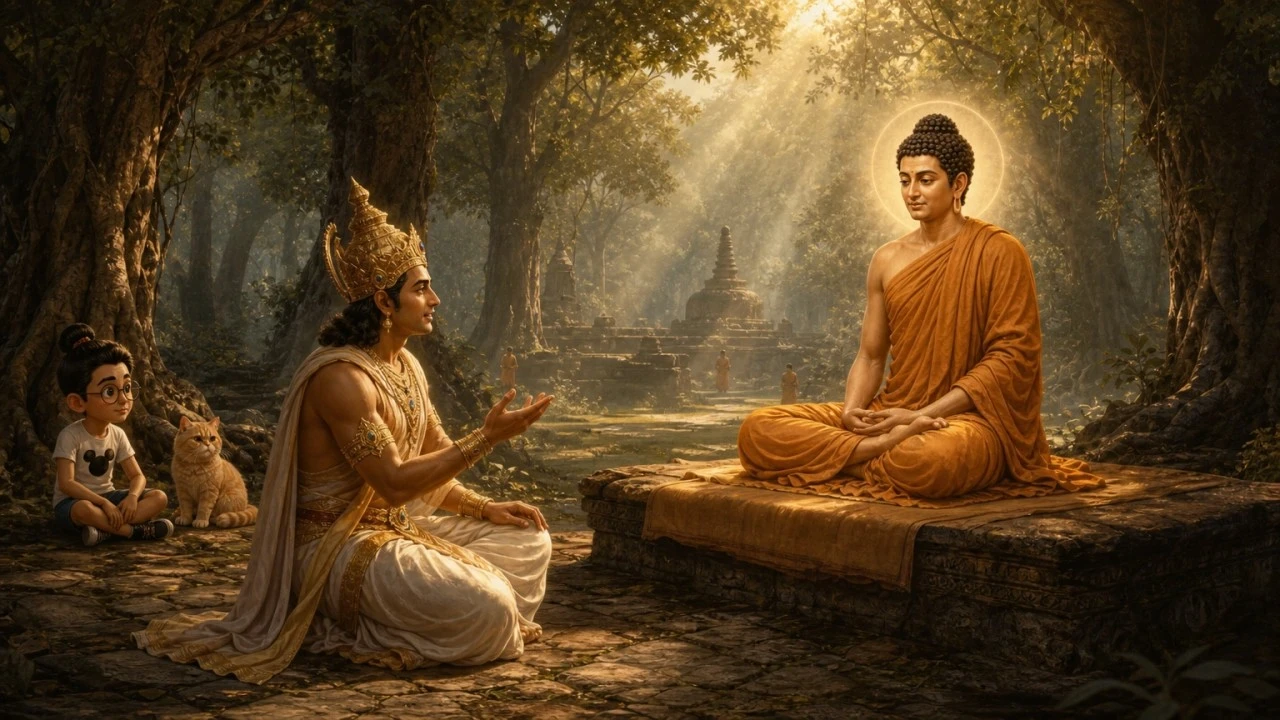


dn21:2.1.1 Having been granted an opportunity by the Buddha, Sakka asked the first question.
BAGIAN 2
dn21:2.1.2 “Good fellow, what fetters bind the gods, humans, titans, dragons, centaurs—and any of the other diverse creatures—
dn21:2.1.3 so that, though they wish to be free of enmity, violence, hostility, and hate, they still have enmity, violence, hostility, and hate?”
dn21:2.1.4 Such was Sakka’s question to the Buddha.
dn21:2.1.5 And the Buddha answered him:
dn21:2.1.6 “Lord of gods, the fetters of jealousy and stinginess bind the gods, humans, titans, dragons, centaurs—and any of the other diverse creatures—
dn21:2.1.7 so that, though they wish to be free of enmity, violence, hostility, and hate, they still have enmity, violence, hostility, and hate.”
dn21:2.1.8 Such was the Buddha’s answer to Sakka.
dn21:2.1.9 Delighted, Sakka approved and agreed with what the Buddha said, saying,
dn21:2.1.10 “That’s so true, Blessed One! That’s so true, Holy One!
dn21:2.1.11 Hearing the Buddha’s answer, I’ve gone beyond doubt and got rid of indecision.”
dn21:2.2.1 And then, having approved and agreed with what the Buddha said, Sakka asked another question:
dn21:2.2.2 “But good fellow, what is the source, origin, birthplace, and inception of jealousy and stinginess?
dn21:2.2.3 When what exists is there jealousy and stinginess?
dn21:2.2.4 When what doesn’t exist is there no jealousy and stinginess?”
dn21:2.2.5 “The liked and the disliked, lord of gods, are the source of jealousy and stinginess.
dn21:2.2.6 When the liked and the disliked exist there is jealousy and stinginess.
dn21:2.2.7 When the liked and the disliked don’t exist there is no jealousy and stinginess.”
dn21:2.2.8 “But good fellow, what is the source of what is liked and disliked?”
dn21:2.2.11 “Desire is the source of what is liked and disliked.”
dn21:2.2.14 “But what is the source of desire?”
dn21:2.2.17 “Thought is the source of desire.”
dn21:2.2.20 “But what is the source of thought?”
dn21:2.2.23 “Judgments driven by the proliferation of perceptions are the source of thoughts.”
dn21:2.3.1 “But how does a mendicant fittingly practice for the cessation of judgments driven by the proliferation of perceptions?”
dn21:2.3.2.0 2.2. Meditation on Feelings
dn21:2.3.3 “Lord of gods, there are two kinds of happiness, I say:
dn21:2.3.4 that which you should cultivate, and that which you should not cultivate.
dn21:2.3.5 There are two kinds of sadness, I say:
dn21:2.3.6 that which you should cultivate, and that which you should not cultivate.
dn21:2.3.7 There are two kinds of equanimity, I say:
dn21:2.3.8 that which you should cultivate, and that which you should not cultivate.
dn21:2.3.9 Why did I say that there are two kinds of happiness?
dn21:2.3.10 Well, should you know of a happiness:
dn21:2.3.11 ‘When I cultivate this kind of happiness, unskillful qualities grow, and skillful qualities decline.’ You should not cultivate that kind of happiness.
dn21:2.3.12 Whereas, should you know of a happiness:
dn21:2.3.13 ‘When I cultivate this kind of happiness, unskillful qualities decline, and skillful qualities grow.’ You should cultivate that kind of happiness.
dn21:2.3.14 And that which is free of placing the mind and keeping it connected is better than that which still involves placing the mind and keeping it connected.
dn21:2.3.15 That’s why I said there are two kinds of happiness.
dn21:2.3.17 Why did I say that there are two kinds of sadness?
dn21:2.3.18 Well, should you know of a sadness:
dn21:2.3.19 ‘When I cultivate this kind of sadness, unskillful qualities grow, and skillful qualities decline.’ You should not cultivate that kind of sadness.
dn21:2.3.20 Whereas, should you know of a sadness:
dn21:2.3.21 ‘When I cultivate this kind of sadness, unskillful qualities decline, and skillful qualities grow.’ You should cultivate that kind of sadness.
dn21:2.3.22 And that which is free of placing the mind and keeping it connected is better than that which still involves placing the mind and keeping it connected.
dn21:2.3.23 That’s why I said there are two kinds of sadness.
dn21:2.3.25 Why did I say that there are two kinds of equanimity?
dn21:2.3.26 Well, should you know of an equanimity:
dn21:2.3.27 ‘When I cultivate this kind of equanimity, unskillful qualities grow, and skillful qualities decline.’ You should not cultivate that kind of equanimity.
dn21:2.3.28 Whereas, should you know of an equanimity:
dn21:2.3.29 ‘When I cultivate this kind of equanimity, unskillful qualities decline, and skillful qualities grow.’ You should cultivate that kind of equanimity.
dn21:2.3.30 And that which is free of placing the mind and keeping it connected is better than that which still involves placing the mind and keeping it connected.
dn21:2.3.31 That’s why I said there are two kinds of equanimity.
dn21:2.3.33 That’s how a mendicant fittingly practices for the cessation of judgments driven by the proliferation of perceptions.”
dn21:2.3.34 Such was the Buddha’s answer to Sakka.
dn21:2.3.35 Delighted, Sakka approved and agreed with what the Buddha said, saying,
dn21:2.3.36 “That’s so true, Blessed One! That’s so true, Holy One!
dn21:2.3.37 Hearing the Buddha’s answer, I’ve gone beyond doubt and got rid of indecision.”
dn21:2.4.0 2.3. Restraint in the Monastic Code
dn21:2.4.1 And then Sakka asked another question:
dn21:2.4.2 “But good fellow, how does a mendicant practice for restraint in the monastic code?”
dn21:2.4.3 “Lord of gods, I say that there are two kinds of bodily behavior:
dn21:2.4.4 that which you should cultivate, and that which you should not cultivate.
dn21:2.4.5 I say that there are two kinds of verbal behavior:
dn21:2.4.6 that which you should cultivate, and that which you should not cultivate.
dn21:2.4.7 There are two kinds of search, I say:
dn21:2.4.8 that which you should cultivate, and that which you should not cultivate.
dn21:2.4.9 Why did I say that there are two kinds of bodily behavior?
dn21:2.4.10 Well, should you know of a bodily behavior:
dn21:2.4.11 ‘When I cultivate this kind of bodily behavior, unskillful qualities grow, and skillful qualities decline.’ You should not cultivate that kind of bodily conduct.
dn21:2.4.12 Whereas, should you know of a bodily behavior:
dn21:2.4.13 ‘When I cultivate this kind of bodily behavior, unskillful qualities decline, and skillful qualities grow.’ You should cultivate that kind of bodily conduct.
dn21:2.4.14 That’s why I said there are two kinds of bodily behavior.
dn21:2.4.17 Why did I say that there are two kinds of verbal behavior?
dn21:2.4.19 Well, should you know of a kind of verbal behavior that it causes unskillful qualities to grow while skillful qualities decline, you should not cultivate it.
dn21:2.4.20 Whereas, should you know of a kind of verbal behavior that it causes unskillful qualities to decline while skillful qualities grow, you should cultivate it.
dn21:2.4.21 That’s why I said there are two kinds of verbal behavior.
dn21:2.4.24 Why did I say that there are two kinds of search?
dn21:2.4.26 Well, should you know of a kind of search that it causes unskillful qualities to grow while skillful qualities decline, you should not cultivate it.
dn21:2.4.27 Whereas, should you know of a kind of search that it causes unskillful qualities to decline while skillful qualities grow, you should cultivate it.
dn21:2.4.28 That’s why I said there are two kinds of search.
dn21:2.4.31 That’s how a mendicant practices for restraint in the monastic code.”
dn21:2.4.32 Such was the Buddha’s answer to Sakka.
dn21:2.4.33 Delighted, Sakka approved and agreed with what the Buddha said, saying,
dn21:2.4.34 “That’s so true, Blessed One! That’s so true, Holy One!
dn21:2.4.35 Hearing the Buddha’s answer, I’ve gone beyond doubt and got rid of indecision.”
dn21:2.5.0 2.4. Sense Restraint
dn21:2.5.1 And then Sakka asked another question:
dn21:2.5.2 “But good fellow, how does a mendicant practice for restraint of the sense faculties?”
dn21:2.5.3 “Lord of gods, I say that there are two kinds of sight known by the eye:
dn21:2.5.4 that which you should cultivate, and that which you should not cultivate.
dn21:2.5.5 There are two kinds of sound known by the ear …
dn21:2.5.7 smells known by the nose …
dn21:2.5.9 tastes known by the tongue …
dn21:2.5.11 touches known by the body …
dn21:2.5.13 ideas known by the mind:
dn21:2.5.14 that which you should cultivate, and that which you should not cultivate.”
dn21:2.5.15 When the Buddha said this, Sakka said to him:
dn21:2.5.16 “Sir, this is how I understand the detailed meaning of the Buddha’s brief statement:
dn21:2.5.17 You should not cultivate the kind of sight known by the eye which causes unskillful qualities to grow while skillful qualities decline.
dn21:2.5.18 And you should cultivate the kind of sight known by the eye which causes unskillful qualities to decline while skillful qualities grow.
dn21:2.5.19 You should not cultivate the kind of sound,
dn21:2.5.20 smell,
dn21:2.5.21 taste,
dn21:2.5.22 touch,
dn21:2.5.23 or idea known by the mind which causes unskillful qualities to grow while skillful qualities decline.
dn21:2.5.24 And you should cultivate the kind of idea known by the mind which causes unskillful qualities to decline while skillful qualities grow.
dn21:2.5.25 Sir, that’s how I understand the detailed meaning of the Buddha’s brief statement.
dn21:2.5.26 Hearing the Buddha’s answer, I’ve gone beyond doubt and got rid of indecision.”
dn21:2.6.1 And then Sakka asked another question:
dn21:2.6.2 “Good fellow, do all ascetics and brahmins have a single doctrine, ethics, desire, and attachment?”
dn21:2.6.3 “No, lord of gods, they do not.”
dn21:2.6.4 “Why not?”
dn21:2.6.5 “The world has many and diverse elements.
dn21:2.6.6 Whatever element sentient beings insist on in this world of many and diverse elements, they obstinately stick to it, insisting that:
dn21:2.6.7 ‘This is the only truth, anything else is futile.’
dn21:2.6.8 That’s why not all ascetics and brahmins have a single doctrine, ethics, desire, and attachment.”
dn21:2.6.9 “Good fellow, have all ascetics and brahmins reached the ultimate end, the ultimate sanctuary from the yoke, the ultimate spiritual life, the ultimate goal?”
dn21:2.6.10 “No, lord of gods, they have not.”
dn21:2.6.11 “Why not?”
dn21:2.6.12 “Those mendicants who are freed through the ending of craving have reached the ultimate end, the ultimate sanctuary from the yoke, the ultimate spiritual life, the ultimate goal.
dn21:2.6.13 That’s why not all ascetics and brahmins have reached the ultimate end, the ultimate sanctuary from the yoke, the ultimate spiritual life, the ultimate goal.”
dn21:2.6.14 Such was the Buddha’s answer to Sakka.
dn21:2.6.15 Delighted, Sakka approved and agreed with what the Buddha said, saying,
dn21:2.6.16 “That’s so true, Blessed One! That’s so true, Holy One!
dn21:2.6.17 Hearing the Buddha’s answer, I’ve gone beyond doubt and got rid of indecision.”
dn21:2.6.18 And then Sakka, having approved and agreed with what the Buddha said, said to him,
dn21:2.7.1 “Turbulence, sir, is a disease, a boil, a dart. Turbulence drags a person to be regenerated in one state of existence or another.
dn21:2.7.2 That’s why a person finds themselves in states high and low.
dn21:2.7.3 Elsewhere, among other ascetics and brahmins, I wasn’t even given a chance to ask these questions that the Buddha has answered.
dn21:2.7.4 The dart of doubt and indecision has lain within me for a long time, but the Buddha has plucked it out.”
dn21:2.7.5 “Lord of gods, do you recall having asked this question of other ascetics and brahmins?”
dn21:2.7.6 “I do, sir.”
dn21:2.7.7 “If you wouldn’t mind, lord of gods, tell me how they answered.”
dn21:2.7.8 “It’s no trouble when someone such as the Blessed One is sitting here.”
dn21:2.7.9 “Well, speak then, lord of gods.”
dn21:2.7.10 “Sir, I approached those who I imagined were ascetics and brahmins living in the wilderness, in remote lodgings. But they were stumped by my question, and they even questioned me in return:
dn21:2.7.11 ‘What is the venerable’s name?’
dn21:2.7.12 So I answered them:
dn21:2.7.13 ‘Good fellow, I am Sakka, lord of gods.’
dn21:2.7.14 So they asked me another question:
dn21:2.7.15 ‘But lord of gods, what deed brought you to this position?’
dn21:2.7.16 So I taught them the Dhamma as I had learned and memorized it.
dn21:2.7.17 And they were pleased with just that much:
dn21:2.7.18 ‘We have seen Sakka, lord of gods! And he answered our questions!’
dn21:2.7.19 Invariably, they become my disciples, I don’t become theirs.
dn21:2.7.20 But sir, I am the Buddha’s disciple, a stream-enterer, not liable to be reborn in the underworld, assured, destined for awakening.”
dn21:2.7.21.0 2.5. On Feeling Happy
dn21:2.7.22 “Lord of gods, do you recall ever feeling such joy and happiness before?”
dn21:2.7.23 “I do, sir.”
dn21:2.7.24 “But how?”
dn21:2.7.25 “Once upon a time, sir, a battle was fought between the gods and the titans.
dn21:2.7.26 In that battle the gods won and the titans lost.
dn21:2.7.27 It occurred to me as victor,
dn21:2.7.28 ‘Now the gods shall enjoy both the nectar of the gods and the nectar of the titans.’
dn21:2.7.29 But sir, that joy and happiness is in the sphere of the rod and the sword. It doesn’t lead to disillusionment, dispassion, cessation, peace, insight, awakening, and extinguishment.
dn21:2.7.30 But the joy and happiness I feel listening to the Buddha’s teaching is not in the sphere of the rod and the sword. It does lead to disillusionment, dispassion, cessation, peace, insight, awakening, and extinguishment.”
dn21:2.8.1 “But lord of gods, what reason do you see for speaking of such joy and happiness?”
dn21:2.8.2 “I see six reasons to speak of such joy and happiness, sir.
dn21:2.8.3 While staying right here,
dn21:2.8.4 remaining in the godly form,
dn21:2.8.5 I have gained an extended life:
dn21:2.8.6 know this, dear sir.
dn21:2.8.7 This is the first reason.
dn21:2.8.8 When I fall from the heavenly host,
dn21:2.8.9 leaving behind the non-human life,
dn21:2.8.10 I shall consciously go to a new womb,
dn21:2.8.11 wherever my mind delights.
dn21:2.8.12 This is the second reason.
dn21:2.8.13 Living happily under the guidance
dn21:2.8.14 of the one of unclouded wisdom,
dn21:2.8.15 I shall practice systematically,
dn21:2.8.16 aware and mindful.
dn21:2.8.17 This is the third reason.
dn21:2.8.18 And if awakening should arise
dn21:2.8.19 as I practice systematically,
dn21:2.8.20 I shall live as one who understands,
dn21:2.8.21 and my end shall come right there.
dn21:2.8.22 This is the fourth reason.
dn21:2.8.23 When I fall from the human realm,
dn21:2.8.24 leaving behind the human life,
dn21:2.8.25 I shall become a god again,
dn21:2.8.26 supreme in the heaven realm.
dn21:2.8.27 This is the fifth reason.
dn21:2.8.28 They are the finest of gods,
dn21:2.8.29 the glorious Akaniṭṭhas.
dn21:2.8.30 So long as my final life goes on,
dn21:2.8.31 there my home will be.
dn21:2.8.32 This is the sixth reason.
dn21:2.8.33 Seeing these six reasons I speak of such joy and happiness.
dn21:2.9.1 My wishes unfulfilled,
dn21:2.9.2 doubting and indecisive,
dn21:2.9.3 I wandered for such a long time,
dn21:2.9.4 in search of the Realized One.
dn21:2.9.5 I imagined that ascetics
dn21:2.9.6 living in seclusion
dn21:2.9.7 must surely be awakened,
dn21:2.9.8 so I went to sit near them.
dn21:2.9.9 ‘How is there success?
dn21:2.9.10 How is there failure?’
dn21:2.9.11 But they were stumped by such questions
dn21:2.9.12 about the path and practice.
dn21:2.9.13 And when they found out that I
dn21:2.9.14 was Sakka, come from the gods,
dn21:2.9.15 they questioned me instead about
dn21:2.9.16 the deed that brought me to this state.
dn21:2.9.17 I taught them the Dhamma
dn21:2.9.18 as I had learned it among men.
dn21:2.9.19 They were delighted with that, saying:
dn21:2.9.20 ‘We’ve seen Vāsava!’
dn21:2.9.21 Now since I’ve seen the Buddha,
dn21:2.9.22 who helps us overcome doubt,
dn21:2.9.23 today, free of fear,
dn21:2.9.24 I pay homage to the awakened one.
dn21:2.9.25 Destroyer of the dart of craving,
dn21:2.9.26 the Buddha is unrivaled.
dn21:2.9.27 I bow to the great hero,
dn21:2.9.28 the Buddha, Kinsman of the Sun.
dn21:2.9.29 In the same way that divinity ought be revered
dn21:2.9.30 by we gods, dear sir,
dn21:2.9.31 today we shall revere you—
dn21:2.9.32 come, let us revere you ourselves!
dn21:2.9.33 You alone are the Awakened!
dn21:2.9.34 You are the Teacher supreme!
dn21:2.9.35 In the world with its gods,
dn21:2.9.36 you have no rival.”
dn21:2.10.1 Then Sakka addressed the centaur Pañcasikha,
dn21:2.10.2 “Dear Pañcasikha, you were very helpful to me, since you first charmed the Buddha,
dn21:2.10.3 after which I went to see him.
dn21:2.10.4 I shall appoint you to your father’s position—you shall be king of the centaurs. And I give you Bhaddā Suriyavaccasā, for she loves you very much.”
dn21:2.10.5 Then Sakka, touching the ground with his hand, expressed this heartfelt sentiment three times:
dn21:2.10.6 “Homage to him, the blessed one, the perfected one, the fully awakened Buddha!
dn21:2.10.7 Homage to him, the blessed one, the perfected one, the fully awakened Buddha!
dn21:2.10.8 Homage to him, the blessed one, the perfected one, the fully awakened Buddha!”
dn21:2.10.9 And while this discourse was being spoken, the stainless, immaculate vision of the Dhamma arose in Sakka, lord of gods:
dn21:2.10.10 “Everything that is liable to arise is liable to cease.”
dn21:2.10.11 And also for another 80,000 deities.
dn21:2.10.12 Such were the questions Sakka was invited to ask, and which were answered by the Buddha.
dn21:2.10.13 And that’s why the name of this discussion is “Sakka’s Questions”.