

dn1:1.0 1. Talk on Wanderers
BAGIAN 1
dn1:1.1.1 So I have heard.
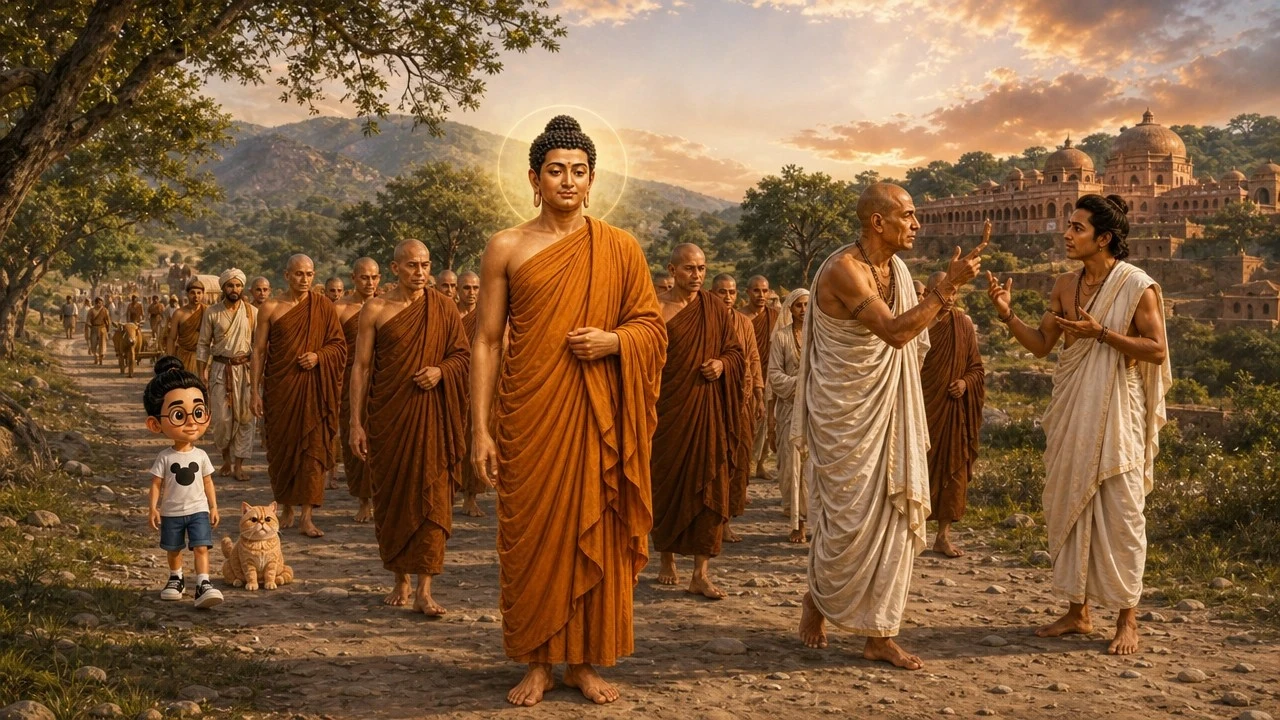
dn1:1.1.2 At one time the Buddha was traveling along the road between Rājagaha and Nāḷandā together with a large Saṅgha of five hundred mendicants.
dn1:1.1.3 The wanderer Suppiya was also traveling along the same road, together with his resident pupil, the student Brahmadatta.
dn1:1.1.4 Meanwhile, Suppiya criticized the Buddha, the teaching, and the Saṅgha in many ways,
dn1:1.1.5 but his pupil Brahmadatta praised them in many ways.
dn1:1.1.6 And so both tutor and pupil followed behind the Buddha and the Saṅgha of mendicants directly contradicting each other.
dn1:1.2.1 Then the Buddha took up residence for the night in the royal rest-house in Ambalaṭṭhikā together with the Saṅgha of mendicants.
dn1:1.2.2 And Suppiya and Brahmadatta did likewise.
dn1:1.2.3 There too, Suppiya criticized the Buddha, the teaching, and the Saṅgha in many ways,
dn1:1.2.4 but his pupil Brahmadatta praised them in many ways.
dn1:1.2.5 And so both tutor and pupil kept on directly contradicting each other.
dn1:1.3.1 Then several mendicants rose at the crack of dawn and sat together in the pavilion, where the topic of judgmentalism came up:
dn1:1.3.2 “It’s incredible, reverends, it’s amazing how the diverse convictions of sentient beings have been well deciphered by the Blessed One, who knows and sees, the perfected one, the fully awakened Buddha.
dn1:1.3.3 For this Suppiya criticizes the Buddha, the teaching, and the Saṅgha in many ways,
dn1:1.3.4 while his pupil Brahmadatta praises them in many ways.
dn1:1.3.5 And so both tutor and pupil followed behind the Buddha and the Saṅgha of mendicants directly contradicting each other.”
dn1:1.4.1 When the Buddha found out about this discussion on judgmentalism among the mendicants, he went to the pavilion, where he sat on the seat spread out and addressed the mendicants:
dn1:1.4.2 “Mendicants, what were you sitting talking about just now? What conversation was left unfinished?”
dn1:1.4.3 The mendicants told him what had happened, adding,
dn1:1.4.9 “This was our conversation that was unfinished when the Buddha arrived.”
dn1:1.5.1 “Mendicants, if others criticize me, the teaching, or the Saṅgha, don’t make yourselves resentful, bitter, and exasperated.
dn1:1.5.2 You’ll get angry and upset, which would be an obstacle for you alone.
dn1:1.5.3 If others were to criticize me, the teaching, or the Saṅgha, and you got angry and upset, would you be able to understand whether they spoke well or poorly?”
dn1:1.5.4 “No, sir.”
dn1:1.6.1 “If others criticize me, the teaching, or the Saṅgha, you should explain that what is untrue is in fact untrue:
dn1:1.6.2 ‘This is why that’s untrue, this is why that’s false. There’s no such thing in us, it’s not found among us.’
dn1:1.6.3 If others praise me, the teaching, or the Saṅgha, don’t make yourselves thrilled, elated, and excited.
dn1:1.6.4 You’ll get thrilled, elated, and excited, which would be an obstacle for you alone.
dn1:1.6.5 If others praise me, the teaching, or the Saṅgha, you should admit that what is true is in fact true:
dn1:1.6.6 ‘This is why that’s true, this is why that’s correct. There is such a thing in us, it is found among us.’
dn1:1.7.0.1 2. Ethics
dn1:1.7.0.2 2.1. The Shorter Section on Ethics
dn1:1.7.1 When an ordinary person speaks praise of the Realized One, they speak only of trivial, trifling details of mere ethics.
dn1:1.7.2 And what are the trivial, trifling details of mere ethics that an ordinary person speaks of?
dn1:1.8.1 ‘The ascetic Gotama has given up killing living creatures. He has renounced the rod and the sword. He’s scrupulous and kind, living full of sympathy for all living beings.’
dn1:1.8.2 Such is an ordinary person’s praise of the Realized One.
dn1:1.8.3 ‘The ascetic Gotama has given up stealing. He takes only what’s given, and expects only what’s given. He keeps himself clean by not thieving.’
dn1:1.8.4 Such is an ordinary person’s praise of the Realized One.
dn1:1.8.5 ‘The ascetic Gotama has given up unchastity. He is chaste, set apart, refraining from the vulgar act of sex.’
dn1:1.8.6 Such is an ordinary person’s praise of the Realized One.
dn1:1.9.1 ‘The ascetic Gotama has given up lying. He speaks the truth and sticks to the truth. He’s honest and dependable, and doesn’t trick the world with his words.’
dn1:1.9.2 Such is an ordinary person’s praise of the Realized One.
dn1:1.9.3 ‘The ascetic Gotama has given up backbiting. He doesn’t repeat in one place what he heard in another so as to divide people against each other. Instead, he reconciles those who are divided and support those who are united, delighting in harmony, loving harmony, speaking words that promote harmony.’
dn1:1.9.4 Such is an ordinary person’s praise of the Realized One.
dn1:1.9.5 ‘The ascetic Gotama has given up harsh speech. He speaks in a way that’s mellow, pleasing to the ear, endearing, going to the heart, polite, and likable and agreeable to the people.’
dn1:1.9.6 Such is an ordinary person’s praise of the Realized One.
dn1:1.9.7 ‘The ascetic Gotama has given up talking nonsense. His words are timely, true, and meaningful, in line with the teaching and training. He says things at the right time which are valuable, reasonable, succinct, and beneficial.’
dn1:1.9.8 Such is an ordinary person’s praise of the Realized One.
dn1:1.10.1 ‘The ascetic Gotama refrains from injuring plants and seeds.’
dn1:1.10.3 ‘He eats in one part of the day, abstaining from eating at night and food at the wrong time.’
dn1:1.10.4 ‘He refrains from seeing shows of dancing, singing, and music.’
dn1:1.10.5 ‘He refrains from attiring and adorning himself with garlands, fragrance, and makeup.’
dn1:1.10.6 ‘He refrains from high and luxurious beds.’
dn1:1.10.7 ‘He refrains from receiving gold and currency,
dn1:1.10.8 raw grains,
dn1:1.10.9 raw meat,
dn1:1.10.10 women and girls,
dn1:1.10.11 male and female bondservants,
dn1:1.10.12 goats and sheep,
dn1:1.10.13 chickens and pigs,
dn1:1.10.14 elephants, cows, horses, and mares,
dn1:1.10.15 and fields and land.’
dn1:1.10.16 ‘He refrains from running errands and messages;
dn1:1.10.17 buying and selling;
dn1:1.10.18 falsifying weights, metals, or measures;
dn1:1.10.19 bribery, fraud, cheating, and duplicity;
dn1:1.10.20 mutilation, murder, abduction, banditry, plunder, and violence.’
dn1:1.10.21 Such is an ordinary person’s praise of the Realized One.
dn1:1.10.22 The shorter section on ethics is complete.
dn1:1.11.0 2.2. The Middle Section on Ethics
dn1:1.11.1 ‘There are some ascetics and brahmins who, while enjoying food given in faith, still engage in injuring plants and seeds.
dn1:1.11.2 These include plants propagated from roots, trunks, cuttings, or joints; and those from regular seeds as the fifth.
dn1:1.11.3 The ascetic Gotama refrains from such injury to plants and seeds.’
dn1:1.11.4 Such is an ordinary person’s praise of the Realized One.
dn1:1.12.1 ‘There are some ascetics and brahmins who, while enjoying food given in faith, still engage in storing up goods for their own use.
dn1:1.12.2 This includes such things as food, drink, clothes, vehicles, bedding, fragrance, and things of the flesh.
dn1:1.12.3 The ascetic Gotama refrains from storing up such goods.’
dn1:1.12.4 Such is an ordinary person’s praise of the Realized One.
dn1:1.13.1 ‘There are some ascetics and brahmins who, while enjoying food given in faith, still engage in seeing shows.
dn1:1.13.2 This includes such things as dancing, singing, music, performances, and storytelling; clapping, gongs, and kettledrums; beauty pageants; pole-acrobatics and bone-washing displays of the corpse-workers; battles of elephants, horses, buffaloes, bulls, goats, rams, chickens, and quails; staff-fights, boxing, and wrestling; combat, roll calls of the armed forces, battle-formations, and regimental reviews.
dn1:1.13.3 The ascetic Gotama refrains from such shows.’
dn1:1.13.4 Such is an ordinary person’s praise of the Realized One.
dn1:1.14.1 ‘There are some ascetics and brahmins who, while enjoying food given in faith, still engage in gambling that causes negligence.
dn1:1.14.2 This includes such things as checkers with eight or ten rows, checkers in the air, hopscotch, spillikins, board-games, tip-cat, drawing straws, dice, leaf-flutes, toy plows, somersaults, pinwheels, toy measures, toy carts, toy bows, guessing words from syllables, guessing another’s thoughts, and imitating musical instruments.
dn1:1.14.3 The ascetic Gotama refrains from such gambling.’
dn1:1.14.4 Such is an ordinary person’s praise of the Realized One.
dn1:1.15.1 ‘There are some ascetics and brahmins who, while enjoying food given in faith, still make use of high and luxurious bedding.
dn1:1.15.2 This includes such things as sofas, couches, woolen covers—shag-piled, colorful, white, embroidered with flowers, quilted, embroidered with animals, double or single fringed—and silk covers studded with gems, as well as silken sheets, woollen carpets, rugs for elephants, horses, or chariots, black antelope hides and woven rugs, and spreads of fine deer hide, with a canopy above and red cushions at both ends.
dn1:1.15.3 The ascetic Gotama refrains from such bedding.’
dn1:1.15.4 Such is an ordinary person’s praise of the Realized One.
dn1:1.16.1 ‘There are some ascetics and brahmins who, while enjoying food given in faith, still engage in attiring and adorning themselves with garlands, fragrance, and makeup.
dn1:1.16.2 This includes such things as applying beauty products by anointing, massaging, bathing, and rubbing; mirrors, ointments, garlands, fragrances, and makeup; face-powder, foundation, bracelets, headbands, fancy walking-sticks or containers, rapiers, parasols, fancy sandals, turbans, jewelry, chowries, and long-fringed white robes.
dn1:1.16.3 The ascetic Gotama refrains from such beautification and adornment.’
dn1:1.16.4 Such is an ordinary person’s praise of the Realized One.
dn1:1.17.1 ‘There are some ascetics and brahmins who, while enjoying food given in faith, still engage in low talk. This includes such topics as
dn1:1.17.2 talk about kings, bandits, and chief ministers; talk about armies, threats, and wars; talk about food, drink, clothes, and beds; talk about garlands and fragrances; talk about family, vehicles, villages, towns, cities, and countries; talk about women and heroes; talk at the street market and the place for water pots; talk about the departed; motley talk; tales of land and sea; and talk about being reborn in this or that place.
dn1:1.17.3 The ascetic Gotama refrains from such low talk.’
dn1:1.17.4 Such is an ordinary person’s praise of the Realized One.
dn1:1.18.1 ‘There are some ascetics and brahmins who, while enjoying food given in faith, still engage in arguments.
dn1:1.18.2 They say such things as: “You don’t understand this teaching and training. I understand this teaching and training. What, you understand this teaching and training? You’re practicing wrong. I’m practicing right. I stay on topic, you don’t. You said last what you should have said first. You said first what you should have said last. What you’ve thought so much about has been disproved. Your doctrine is refuted. Go on, save your doctrine! You’re trapped; get yourself out of this—if you can!”
dn1:1.18.3 The ascetic Gotama refrains from such argumentative talk.’
dn1:1.18.4 Such is an ordinary person’s praise of the Realized One.
dn1:1.19.1 ‘There are some ascetics and brahmins who, while enjoying food given in faith, still engage in running errands and messages.
dn1:1.19.2 This includes running errands for rulers, ministers, aristocrats, brahmins, householders, or princes who say: “Go here, go there. Take this, bring that from there.”
dn1:1.19.3 The ascetic Gotama refrains from such errands.’
dn1:1.19.4 Such is an ordinary person’s praise of the Realized One.
dn1:1.20.1 ‘There are some ascetics and brahmins who, while enjoying food given in faith, still engage in deceit, flattery, hinting, and belittling, and using material things to chase after other material things.
dn1:1.20.2 The ascetic Gotama refrains from such fawning and flattery.’
dn1:1.20.3 Such is an ordinary person’s praise of the Realized One.
dn1:1.20.4 The middle section on ethics is complete.
dn1:1.21.0 2.3. The Large Section on Ethics
dn1:1.21.1 ‘There are some ascetics and brahmins who, while enjoying food given in faith, still earn a living by low lore, by wrong livelihood.
dn1:1.21.2 This includes such fields as augury, omenology, divining portents, interpreting dreams, divining features of men and women, divining holes in cloth gnawed by mice, fire offerings, ladle offerings, offerings of husks, rice powder, rice, ghee, or oil; offerings from the mouth, blood sacrifices, limb-reading; geomancy for building sites, fields, and cemeteries; exorcisms, earth magic, snake charming, poisons; the lore of the scorpion, the rat, the bird, and the crow; prophesying lifespan, chanting for protection, and divining omens from wild animals.
dn1:1.21.3 The ascetic Gotama refrains from such low lore, such wrong livelihood.’
dn1:1.21.4 Such is an ordinary person’s praise of the Realized One.
dn1:1.22.1 ‘There are some ascetics and brahmins who, while enjoying food given in faith, still earn a living by low lore, by wrong livelihood.
dn1:1.22.2 This includes reading the marks of gems, cloth, clubs, swords, spears, arrows, bows, weapons, women, men, boys, girls, male and female bondservants, elephants, horses, buffaloes, bulls, cows, goats, rams, chickens, quails, monitor lizards, rabbits, tortoises, or deer.
dn1:1.22.3 The ascetic Gotama refrains from such low lore, such wrong livelihood.’
dn1:1.22.4 Such is an ordinary person’s praise of the Realized One.
dn1:1.23.1 ‘There are some ascetics and brahmins who, while enjoying food given in faith, still earn a living by low lore, by wrong livelihood.
dn1:1.23.2 This includes making predictions that the king will march forth or march back; or that our king will attack and the enemy king will retreat, or vice versa; or that our king will triumph and the enemy king will be defeated, or vice versa; and so there will be victory for one and defeat for the other.
dn1:1.23.3 The ascetic Gotama refrains from such low lore, such wrong livelihood.’
dn1:1.23.4 Such is an ordinary person’s praise of the Realized One.
dn1:1.24.1 ‘There are some ascetics and brahmins who, while enjoying food given in faith, still earn a living by low lore, by wrong livelihood.
dn1:1.24.2 This includes making predictions that there will be an eclipse of the moon, or sun, or stars; that the sun, moon, and stars will be in conjunction or in opposition; that there will be a meteor shower, a fiery horizon, an earthquake, or thunder in the heavens; that there will be a rising, a setting, a darkening, a brightening of the moon, sun, and stars. And it also includes making predictions about the results of all such phenomena.
dn1:1.24.3 The ascetic Gotama refrains from such low lore, such wrong livelihood.’
dn1:1.24.4 Such is an ordinary person’s praise of the Realized One.
dn1:1.25.1 ‘There are some ascetics and brahmins who, while enjoying food given in faith, still earn a living by low lore, by wrong livelihood.
dn1:1.25.2 This includes predicting whether there will be plenty of rain or drought; plenty to eat or famine; an abundant harvest or a bad harvest; security or peril; sickness or health. It also includes such occupations as arithmetic, accounting, calculating, poetry, and cosmology.
dn1:1.25.3 The ascetic Gotama refrains from such low lore, such wrong livelihood.’
dn1:1.25.4 Such is an ordinary person’s praise of the Realized One.
dn1:1.26.1 ‘There are some ascetics and brahmins who, while enjoying food given in faith, still earn a living by low lore, by wrong livelihood.
dn1:1.26.2 This includes making arrangements for giving and taking in marriage; for engagement and divorce; and for scattering rice inwards or outwards at the wedding ceremony. It also includes casting spells for good or bad luck, treating impacted fetuses, binding the tongue, or locking the jaws; charms for the hands and ears; questioning a mirror, a girl, or a god as an oracle; worshiping the sun, worshiping the Great One, breathing fire, and invoking Siri, the goddess of luck.
dn1:1.26.3 The ascetic Gotama refrains from such low lore, such wrong livelihood.’
dn1:1.26.4 Such is an ordinary person’s praise of the Realized One.
dn1:1.27.1 ‘There are some ascetics and brahmins who, while enjoying food given in faith, still earn a living by low lore, by wrong livelihood.
dn1:1.27.2 This includes rites for propitiation, for granting wishes, for ghosts, for the earth, for rain, for property settlement, and for preparing and consecrating house sites, and rites involving sipping water and bathing, and oblations. It also includes administering emetics, purgatives, expectorants, and phlegmagogues; administering ear-oils, eye restoratives, nasal medicine, ointments, and counter-ointments; surgery with needle and scalpel, treating children, prescribing root medicines, and herbal bandages.
dn1:1.27.3 The ascetic Gotama refrains from such low lore, such wrong livelihood.’
dn1:1.27.4 Such is an ordinary person’s praise of the Realized One.
dn1:1.27.5 These are the trivial, trifling details of mere ethics that an ordinary person speaks of when they speak praise of the Realized One.
dn1:1.27.6 The longer section on ethics is complete.
dn1:1.28.0.1 3. Views
dn1:1.28.0.2 3.1. Theories About the First Beginning
dn1:1.28.1 There are other principles—deep, hard to see, hard to understand, peaceful, sublime, beyond the scope of logic, subtle, comprehensible to the astute—which the Realized One makes known after realizing them with his own insight. Those who genuinely praise the Realized One would rightly speak of these things.
dn1:1.28.2 And what are these principles?
dn1:1.29.1 There are some ascetics and brahmins who speculate and theorize about the first beginning, and propose various hypotheses concerning the first beginning on eighteen grounds.
dn1:1.29.2 And what are the eighteen grounds on which they rely?
dn1:1.30.0 3.1.1. Eternalism
dn1:1.30.1 There are some ascetics and brahmins who are eternalists, who assert that the self and the cosmos are eternal on four grounds.
dn1:1.30.2 And what are the four grounds on which they rely?
dn1:1.31.1 It’s when some ascetic or brahmin—by dint of keen, resolute, committed, and diligent effort, and right application of mind—experiences an immersion of the heart of such a kind that they recollect their many kinds of past lives.
dn1:1.31.2 That is: one, two, three, four, five, ten, twenty, thirty, forty, fifty, a hundred, a thousand, a hundred thousand rebirths. They remember: ‘There, I was named this, my clan was that, I looked like this, and that was my food. This was how I felt pleasure and pain, and that was how my life ended. When I passed away from that place I was reborn somewhere else. There, too, I was named this, my clan was that, I looked like this, and that was my food. This was how I felt pleasure and pain, and that was how my life ended. When I passed away from that place I was reborn here.’ And so they recollect their many kinds of past lives, with features and details.
dn1:1.31.3 They say:
dn1:1.31.4 ‘The self and the cosmos are eternal, barren, steady as a mountain peak, standing firm like a pillar.
dn1:1.31.5 They remain the same for all eternity, while these sentient beings wander and transmigrate and pass away and rearise.
dn1:1.31.6 Why is that?
dn1:1.31.7 Because by dint of keen, resolute, committed, and diligent effort, and right application of mind I experience an immersion of the heart of such a kind that I recollect my many kinds of past lives,
dn1:1.31.8 with features and details.
dn1:1.31.9 Because of this I know:
dn1:1.31.10 “The self and the cosmos are eternal, barren, steady as a mountain peak, standing firm like a pillar.
dn1:1.31.11 They remain the same for all eternity, while these sentient beings wander and transmigrate and pass away and rearise.”’
dn1:1.31.12 This is the first ground on which some ascetics and brahmins rely to assert that the self and the cosmos are eternal.
dn1:1.32.1 And what is the second ground on which they rely?
dn1:1.32.2 It’s when some ascetic or brahmin—by dint of keen, resolute, committed, and diligent effort, and right application of mind—experiences an immersion of the heart of such a kind that they recollect their many kinds of past lives.
dn1:1.32.3 That is: one eon of the cosmos contracting and expanding; two, three, four, five, or ten eons of the cosmos contracting and expanding. They remember: ‘There, I was named this, my clan was that, I looked like this, and that was my food. This was how I felt pleasure and pain, and that was how my life ended. When I passed away from that place I was reborn somewhere else. There, too, I was named this, my clan was that, I looked like this, and that was my food. This was how I felt pleasure and pain, and that was how my life ended. When I passed away from that place I was reborn here.’ And so they recollect their many kinds of past lives, with features and details.
dn1:1.32.4 They say:
dn1:1.32.5 ‘The self and the cosmos are eternal, barren, steady as a mountain peak, standing firm like a pillar.
dn1:1.32.6 They remain the same for all eternity, while these sentient beings wander and transmigrate and pass away and rearise.
dn1:1.32.7 Why is that?
dn1:1.32.8 Because by dint of keen, resolute, committed, and diligent effort, and right application of mind I experience an immersion of the heart of such a kind that I recollect my many kinds of past lives,
dn1:1.32.9 with features and details.
dn1:1.32.10 Because of this I know:
dn1:1.32.11 “The self and the cosmos are eternal, barren, steady as a mountain peak, standing firm like a pillar. They remain the same for all eternity, while these sentient beings wander and transmigrate and pass away and rearise.”’
dn1:1.32.12 This is the second ground on which some ascetics and brahmins rely to assert that the self and the cosmos are eternal.
dn1:1.33.1 And what is the third ground on which they rely?
dn1:1.33.2 It’s when some ascetic or brahmin—by dint of keen, resolute, committed, and diligent effort, and right application of mind—experiences an immersion of the heart of such a kind that they recollect their many kinds of past lives.
dn1:1.33.3 That is: ten eons of the cosmos contracting and expanding; twenty, thirty, or forty eons of the cosmos contracting and expanding. They remember: ‘There, I was named this, my clan was that, I looked like this, and that was my food. This was how I felt pleasure and pain, and that was how my life ended. When I passed away from that place I was reborn somewhere else. There, too, I was named this, my clan was that, I looked like this, and that was my food. This was how I felt pleasure and pain, and that was how my life ended. When I passed away from that place I was reborn here.’ And so they recollect their many kinds of past lives, with features and details.
dn1:1.33.4 They say:
dn1:1.33.5 ‘The self and the cosmos are eternal, barren, steady as a mountain peak, standing firm like a pillar.
dn1:1.33.6 They remain the same for all eternity, while these sentient beings wander and transmigrate and pass away and rearise.
dn1:1.33.7 Why is that?
dn1:1.33.8 Because by dint of keen, resolute, committed, and diligent effort, and right application of mind I experience an immersion of the heart of such a kind that I recollect my many kinds of past lives,
dn1:1.33.9 with features and details.
dn1:1.33.10 Because of this I know:
dn1:1.33.11 “The self and the cosmos are eternal, barren, steady as a mountain peak, standing firm like a pillar. They remain the same for all eternity, while these sentient beings wander and transmigrate and pass away and rearise.”’
dn1:1.33.12 This is the third ground on which some ascetics and brahmins rely to assert that the self and the cosmos are eternal.
dn1:1.34.1 And what is the fourth ground on which they rely?
dn1:1.34.2 It’s when some ascetic or brahmin relies on logic and inquiry. They speak of what they have worked out by logic, following a line of inquiry, expressing their own perspective:
dn1:1.34.3 ‘The self and the cosmos are eternal, barren, steady as a mountain peak, standing firm like a pillar.
dn1:1.34.4 They remain the same for all eternity, while these sentient beings wander and transmigrate and pass away and rearise.’
dn1:1.34.5 This is the fourth ground on which some ascetics and brahmins rely to assert that the self and the cosmos are eternal.
dn1:1.35.1 These are the four grounds on which those ascetics and brahmins assert that the self and the cosmos are eternal.
dn1:1.35.2 Any ascetics and brahmins who assert that the self and the cosmos are eternal do so on one or other of these four grounds. Outside of this there is none.
dn1:1.36.1 The Realized One understands this:
dn1:1.36.2 ‘If you hold on to and attach to these grounds for views it leads to such a destiny in the next life.’
dn1:1.36.3 He understands this, and what goes beyond this. And since he does not misapprehend that understanding, he has realized quenching within himself.
dn1:1.36.4 Having truly understood the origin, disappearance, gratification, drawback, and escape from feelings, the Realized One is freed by not grasping.
dn1:1.37.1 These are the principles—deep, hard to see, hard to understand, peaceful, sublime, beyond the scope of logic, subtle, comprehensible to the astute—which the Realized One makes known after realizing them with his own insight. And those who genuinely praise the Realized One would rightly speak of these things.
dn1:1.37.2 The first recitation section.