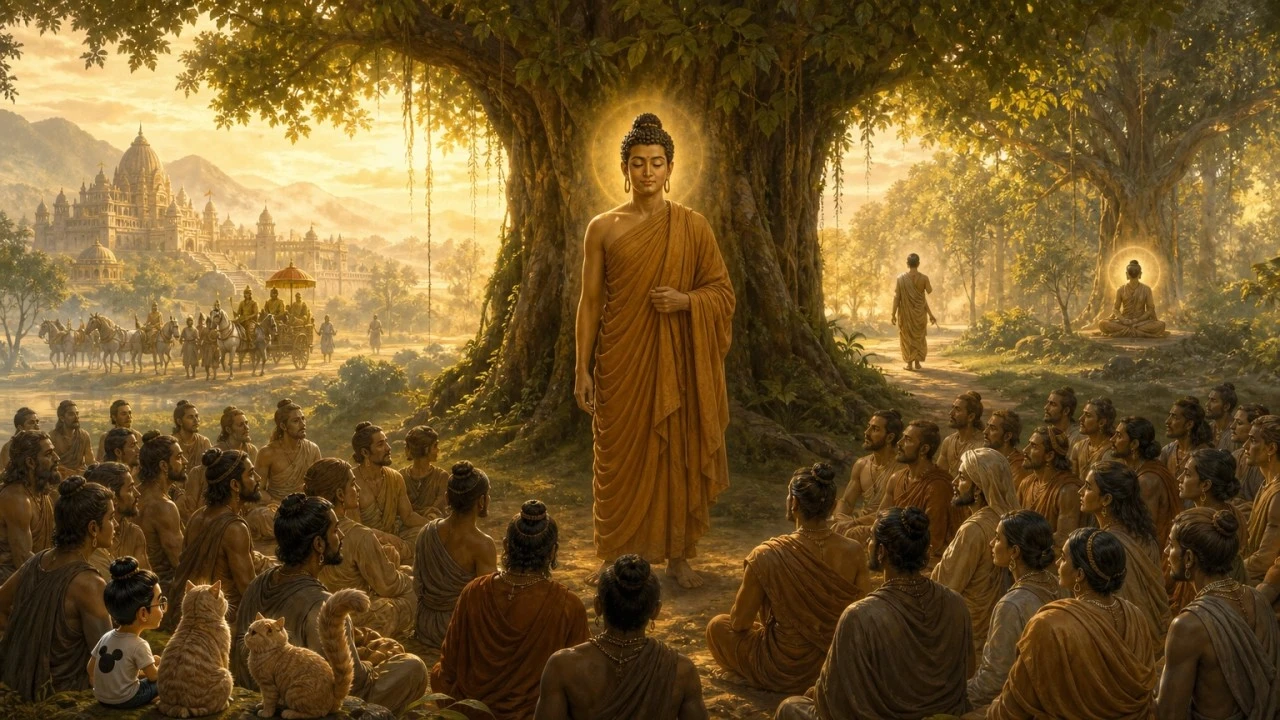

dn14:3.1.0 12. The Appeal of the Divinity
BAGIAN 3
dn14:3.1.1 Then it occurred to the Blessed One Vipassī, the perfected one, the fully awakened Buddha,
dn14:3.1.2 ‘Why don’t I teach the Dhamma?’
dn14:3.1.3 Then he thought,
dn14:3.1.4 ‘This principle I have discovered is deep, hard to see, hard to understand, peaceful, sublime, beyond the scope of logic, subtle, comprehensible to the astute.
dn14:3.1.5 But people like clinging, they love it and enjoy it.
dn14:3.1.6 It’s hard for them to see this topic; that is, specific conditionality, dependent origination.
dn14:3.1.7 It’s also hard for them to see this topic; that is, the stilling of all activities, the letting go of all attachments, the ending of craving, fading away, cessation, extinguishment.
dn14:3.1.8 And if I were to teach this principle, others might not understand me, which would be wearying and troublesome for me.’
dn14:3.2.1 And then these verses, which were neither supernaturally inspired, nor learned before in the past, occurred to him:
dn14:3.2.2 ‘I’ve struggled hard to realize this,
dn14:3.2.3 there’s no need to reveal it now!
dn14:3.2.4 Those mired in greed and hate
dn14:3.2.5 can’t really understand this teaching.
dn14:3.2.6 It goes against the stream, subtle,
dn14:3.2.7 deep, obscure, and very fine.
dn14:3.2.8 Those besotted by greed cannot see,
dn14:3.2.9 for they’re cloaked in a mass of darkness.’
dn14:3.2.10 So, as the Buddha Vipassī reflected like this, his mind inclined to remaining passive, not to teaching the Dhamma.
dn14:3.2.11 Then, knowing the Buddha Vipassī’s train of thought, it occurred to a certain Great Divinity,
dn14:3.2.12 ‘Oh lord! The world will be lost, the world will perish! For the mind of the Blessed One Vipassī, the perfected one, the fully awakened Buddha, inclines to remaining passive, not to teaching the Dhamma.’
dn14:3.2.13 Then, as easily as a strong person would extend or contract their arm, he vanished from the realm of divinity and reappeared in front of the Buddha Vipassī.
dn14:3.3.1 He arranged his robe over one shoulder, knelt on his right knee, raised his cupped palms toward the Buddha Vipassī, and said,
dn14:3.3.2 ‘Sir, let the Blessed One teach the Dhamma! Let the Holy One teach the Dhamma!
dn14:3.3.3 There are beings with little dust in their eyes. They’re in decline because they haven’t heard the teaching.
dn14:3.3.4 There will be those who understand the teaching!’
dn14:3.4.1 When he said this, the Buddha Vipassī said to him,
dn14:3.4.2 ‘I too thought this, Divinity,
dn14:3.4.3 “Why don’t I teach the Dhamma?”
dn14:3.4.4 Then it occurred to me,
dn14:3.4.9 “If I were to teach this principle, others might not understand me, which would be wearying and troublesome for me.”
dn14:3.4.19 So, as I reflected like this, my mind inclined to remaining passive, not to teaching the Dhamma.’
dn14:3.5.1 For a second time …
dn14:3.5.2 For a third time that Great Divinity begged the Buddha to teach.
dn14:3.6.1 Then, understanding the Divinity’s invitation, the Buddha Vipassī surveyed the world with the eye of a Buddha, out of his compassion for sentient beings.
dn14:3.6.2 And he saw sentient beings with little dust in their eyes, and some with much dust in their eyes; with keen faculties and with weak faculties, with good qualities and with bad qualities, easy to teach and hard to teach. And some of them lived seeing the danger in the fault to do with the next world, while others did not.
dn14:3.6.3 It’s like a pool with blue water lilies, or pink or white lotuses. Some of them sprout and grow in the water without rising above it, thriving underwater. Some of them sprout and grow in the water reaching the water’s surface. And some of them sprout and grow in the water but rise up above the water and stand with no water clinging to them.
dn14:3.6.4 In the same way, the Buddha Vipassī saw sentient beings with little dust in their eyes, and some with much dust in their eyes.
dn14:3.7.1 Then that Great Divinity, knowing the Buddha Vipassī’s train of thought, addressed him in verse:
dn14:3.7.2 ‘Standing high on a rocky mountain,
dn14:3.7.3 you can see the people all around.
dn14:3.7.4 In just the same way, All-seer, so intelligent,
dn14:3.7.5 having ascended the Temple of Truth,
dn14:3.7.6 rid of sorrow, look upon the people
dn14:3.7.7 swamped with sorrow, <j>overcome by rebirth and old age.
dn14:3.7.8 Rise, hero! Victor in battle, caravan leader,
dn14:3.7.9 wander the world free of debt.
dn14:3.7.10 Let the Blessed One teach the Dhamma!
dn14:3.7.11 There will be those who understand!’
dn14:3.7.12 Then the Buddha Vipassī addressed that Great Divinity in verse:
dn14:3.7.13 ‘Flung open are the doors to freedom from death!
dn14:3.7.14 Let those with ears to hear commit to faith.
dn14:3.7.15 Thinking it would be troublesome, Divinity, <j>I did not teach
dn14:3.7.16 the sophisticated, sublime Dhamma among mankind.’
dn14:3.7.17 Then the Great Divinity, knowing that his request for the Buddha Vipassī to teach the Dhamma had been granted, bowed and respectfully circled him, keeping him on his right, before vanishing right there.
dn14:3.8.0 13. The Chief Disciples
dn14:3.8.1 Then it occurred to the Blessed One Vipassī, the perfected one, the fully awakened Buddha,
dn14:3.8.2 ‘Who should I teach first of all?
dn14:3.8.3 Who will quickly understand this teaching?’
dn14:3.8.4 Then he thought,
dn14:3.8.5 ‘That Khaṇḍa, the king’s son, and Tissa, the high priest’s son, are astute, competent, intelligent, and have long had little dust in their eyes.
dn14:3.8.6 Why don’t I teach them first of all? They will quickly understand this teaching.’
dn14:3.9.1 Then, as easily as a strong person would extend or contract their arm, he vanished from the tree of awakening and reappeared near the capital city of Bandhumatī, in the deer park named Sanctuary.
dn14:3.9.2 Then the Buddha Vipassī addressed the park keeper,
dn14:3.9.3 ‘My dear park keeper, please enter the city and say this to the king’s son Khaṇḍa and the high priest’s son Tissa:
dn14:3.9.4 “Sirs, the Blessed One Vipassī, the perfected one, the fully awakened Buddha, has arrived at Bandhumatī and is staying in the deer park named Sanctuary. He wishes to see you.”’
dn14:3.9.5 ‘Yes, sir,’ replied the park keeper, and did as he was asked.
dn14:3.10.1 Then the king’s son Khaṇḍa and the high priest’s son Tissa had the finest carriages harnessed. Then they mounted a fine carriage and, along with other fine carriages, set out from Bandhumatī for the Sanctuary.
dn14:3.10.2 They went by carriage as far as the terrain allowed, then descended and approached the Buddha Vipassī on foot. They bowed and sat down to one side.
dn14:3.11.1 The Buddha Vipassī taught them step by step, with
dn14:3.11.2 a talk on giving, ethical conduct, and heaven. He revealed the drawbacks of sensual pleasures, so sordid and corrupt, and the benefit of renunciation.
dn14:3.11.3 And when he knew that their minds were ready, pliable, rid of hindrances, elated, and confident he revealed the special teaching of the Buddhas:
dn14:3.11.4 suffering, its origin, its cessation, and the path.
dn14:3.11.5 Just as a clean cloth rid of stains would properly absorb dye,
dn14:3.11.6 in that very seat the stainless, immaculate vision of the Dhamma arose in the king’s son Khaṇḍa and the high priest’s son Tissa:
dn14:3.11.7 ‘Everything that is liable to arise is liable to cease.’
dn14:3.12.1 They saw, attained, understood, and fathomed the Dhamma. They went beyond doubt, got rid of indecision, and became self-assured and independent of others regarding the Teacher’s instructions. They said to the Buddha Vipassī,
dn14:3.12.2 ‘Excellent, sir! Excellent!
dn14:3.12.3 As if he were righting the overturned, or revealing the hidden, or pointing out the path to the lost, or lighting a lamp in the dark so people with clear eyes can see what’s there, the Buddha has made the teaching clear in many ways.
dn14:3.12.4 We go for refuge to the Blessed One and to the teaching.
dn14:3.12.5 Sir, may we receive the going forth and ordination in the Buddha’s presence?’
dn14:3.13.1 And they received the going forth, the ordination in the Buddha Vipassī’s presence.
dn14:3.13.2 Then the Buddha Vipassī educated, encouraged, fired up, and inspired them with a Dhamma talk.
dn14:3.13.3 He revealed the drawbacks of conditioned phenomena, so sordid and corrupt, and the benefit of extinguishment.
dn14:3.13.4 Being taught like this their minds were soon freed from defilements by not grasping.
dn14:3.14.0 14. The Going Forth of the Large Crowd
dn14:3.14.1 A large crowd of 84,000 people in the capital of Bandhumatī heard
dn14:3.14.2 that the Blessed One Vipassī, the perfected one, the fully awakened Buddha, had arrived at Bandhumatī and was staying in the deer park named Sanctuary.
dn14:3.14.3 And they heard that the king’s son Khaṇḍa and the high priest’s son Tissa had shaved off their hair and beard, dressed in ocher robes, and gone forth from the lay life to homelessness in the Buddha’s presence.
dn14:3.14.4 It occurred to them,
dn14:3.14.5 ‘This must be no ordinary teaching and training, no ordinary going forth in which the king’s son Khaṇḍa and the high priest’s son Tissa have gone forth.
dn14:3.14.6 If even they go forth, why don’t we do the same?’
dn14:3.14.7 Then those 84,000 people left Bandhumatī for the deer park named Sanctuary, where they approached the Buddha Vipassī, bowed and sat down to one side.
dn14:3.15.1 The Buddha Vipassī taught them step by step, with
dn14:3.15.2 a talk on giving, ethical conduct, and heaven. He revealed the drawbacks of sensual pleasures, so sordid and corrupt, and the benefit of renunciation.
dn14:3.15.3 And when he knew that their minds were ready, pliable, rid of hindrances, elated, and confident he revealed the special teaching of the Buddhas:
dn14:3.15.4 suffering, its origin, its cessation, and the path.
dn14:3.15.5 Just as a clean cloth rid of stains would properly absorb dye,
dn14:3.15.6 in that very seat the stainless, immaculate vision of the Dhamma arose in those 84,000 people:
dn14:3.15.7 ‘Everything that is liable to arise is liable to cease.’
dn14:3.16.1 They saw, attained, understood, and fathomed the Dhamma. They went beyond doubt, got rid of indecision, and became self-assured and independent of others regarding the Teacher’s instructions. They said to the Buddha Vipassī,
dn14:3.16.2 ‘Excellent, sir! Excellent!’
dn14:3.16.3 And just like Khaṇḍa and Tissa they asked for and received ordination. Then the Buddha taught them further.
dn14:3.17.4 Being taught like this their minds were soon freed from defilements by not grasping.
dn14:3.18.0 15. The 84,000 Who Had Gone Forth Previously
dn14:3.18.1 The 84,000 people who had gone forth previously also heard:
dn14:3.18.2 ‘It seems the Blessed One Vipassī, the perfected one, the fully awakened Buddha, has arrived at Bandhumatī and is staying in the deer park named Sanctuary. And he is teaching the Dhamma!’
dn14:3.18.3 Then they too went to the Buddha Vipassī, realized the Dhamma, went forth, and became freed from defilements.
dn14:3.22.0 16. The Allowance to Wander
dn14:3.22.1 Now at that time a large Saṅgha of 6,800,000 mendicants were residing at Bandhumatī.
dn14:3.22.2 As the Buddha Vipassī was in private retreat this thought came to his mind,
dn14:3.22.3 ‘The Saṅgha residing at Bandhumatī now is large. What if I was to urge them:
dn14:3.22.4 “Wander forth, mendicants, for the welfare and happiness of the people, out of sympathy for the world, for the benefit, welfare, and happiness of gods and humans.
dn14:3.22.5 Let not two go by one road.
dn14:3.22.6 Teach the Dhamma that’s good in the beginning, good in the middle, and good in the end, meaningful and well-phrased. And reveal a spiritual practice that’s entirely full and pure.
dn14:3.22.7 There are beings with little dust in their eyes. They’re in decline because they haven’t heard the teaching.
dn14:3.22.8 There will be those who understand the teaching!
dn14:3.22.9 But when six years have passed, you must all come to Bandhumatī to recite the monastic code.”’
dn14:3.23.1 Then a certain Great Divinity, knowing the Buddha Vipassī’s train of thought, as easily as a strong person would extend or contract their arm, vanished from the realm of divinity and reappeared in front of the Buddha Vipassī.
dn14:3.23.2 He arranged his robe over one shoulder, raised his cupped palms toward the Buddha Vipassī, and said,
dn14:3.23.3 ‘That’s so true, Blessed One! That’s so true, Holy One!
dn14:3.23.4 The Saṅgha residing at Bandhumatī now is large. Please urge them to wander, as you thought.
dn14:3.23.9 And sir, I’ll make sure that when six years have passed the mendicants will return to Bandhumatī to recite the monastic code.’
dn14:3.23.10 That is what that Great Divinity said.
dn14:3.23.11 Then he bowed and respectfully circled the Buddha Vipassī, keeping him on his right, before vanishing right there.
dn14:3.24.1 Then in the late afternoon, the Buddha Vipassī came out of retreat and addressed the mendicants, telling them all that had happened. Then he said,
dn14:3.26.1 ‘Wander forth, mendicants, for the welfare and happiness of the people, out of sympathy for the world, for the benefit, welfare, and happiness of gods and humans.
dn14:3.26.2 Let not two go by one road.
dn14:3.26.3 Teach the Dhamma that’s good in the beginning, good in the middle, and good in the end, meaningful and well-phrased. And reveal a spiritual practice that’s entirely full and pure.
dn14:3.26.4 There are beings with little dust in their eyes. They’re in decline because they haven’t heard the teaching.
dn14:3.26.5 There will be those who understand the teaching!
dn14:3.26.6 But when six years have passed, you must all come to Bandhumatī to recite the monastic code.’
dn14:3.26.7 Then most of the mendicants left to wander the country that very day.
dn14:3.27.1 Now at that time there were 84,000 monasteries in the Black Plum Tree Land.
dn14:3.27.2 And when the first year came to an end the deities raised the cry:
dn14:3.27.3 ‘Good fellows, the first year has ended.
dn14:3.27.4 Now five years are left.
dn14:3.27.5 When five years have passed, you must all go to Bandhumatī to recite the monastic code.’
dn14:3.27.6 And when the second year …
dn14:3.27.7 the third year …
dn14:3.27.8 the fourth year …
dn14:3.27.9 the fifth year came to an end, the deities raised the cry:
dn14:3.27.10 ‘Good fellows, the fifth year has ended.
dn14:3.27.11 Now one year is left.
dn14:3.27.12 When one year has passed, you must all go to Bandhumatī to recite the monastic code.’
dn14:3.27.13 And when the sixth year came to an end the deities raised the cry:
dn14:3.27.14 ‘Good fellows, the sixth year has ended.
dn14:3.27.15 Now is the time that you must go to Bandhumatī to recite the monastic code.’
dn14:3.27.16 Then that very day the mendicants went to Bandhumatī to recite the monastic code. Some went by their own psychic power, and some by the psychic power of the deities.
dn14:3.28.1 And there the Blessed One Vipassī, the perfected one, the fully awakened Buddha, recited the monastic code thus:
dn14:3.28.2 ‘Patient acceptance is the ultimate fervor.
dn14:3.28.3 Extinguishment is the ultimate, say the Buddhas.
dn14:3.28.4 No true renunciate injures another,
dn14:3.28.5 nor does an ascetic hurt another.
dn14:3.28.6 Not to do any evil;
dn14:3.28.7 to embrace the good;
dn14:3.28.8 to purify one’s mind:
dn14:3.28.9 this is the instruction of the Buddhas.
dn14:3.28.10 Not speaking ill nor doing harm;
dn14:3.28.11 restraint in the monastic code;
dn14:3.28.12 moderation in eating;
dn14:3.28.13 staying in remote lodgings;
dn14:3.28.14 commitment to the higher mind—
dn14:3.28.15 this is the instruction of the Buddhas.’
dn14:3.29.0 17. Being Informed by Deities
dn14:3.29.1 This one time, mendicants, I was staying near Ukkaṭṭhā in the Subhaga Forest at the root of a magnificent sal tree.
dn14:3.29.2 As I was in private retreat this thought came to mind,
dn14:3.29.3 ‘It’s not easy to find an abode of sentient beings where I haven’t previously abided in all this long time, except the gods of the pure abodes.
dn14:3.29.4 Why don’t I go to see them?’
dn14:3.29.5 Then, as easily as a strong person would extend or contract their arm, I vanished from the Subhaga Forest and reappeared with the gods of Aviha.
dn14:3.29.6 In that order of gods, many thousands, many hundreds of thousands of deities approached me, bowed, stood to one side, and said to me,
dn14:3.29.7 ‘Ninety-one eons ago, good fellow, the Buddha Vipassī arose in the world, perfected and fully awakened.
dn14:3.29.8 He was born as an aristocrat into an aristocrat family.
dn14:3.29.9 Koṇḍañña was his clan.
dn14:3.29.10 He lived for 80,000 years.
dn14:3.29.11 He was awakened at the root of a patala tree.
dn14:3.29.12 He had a fine pair of chief disciples named Khaṇḍa and Tissa.
dn14:3.29.13 He had three gatherings of disciples—one of 6,800,000, one of 100,000, and one of 80,000—all of them mendicants who had ended their defilements.
dn14:3.29.14 He had as chief attendant a mendicant named Asoka.
dn14:3.29.15 His father was King Bandhumā,
dn14:3.29.16 his birth mother was Queen Bandhumatī,
dn14:3.29.17 and their capital city was named Bandhumatī.
dn14:3.29.18 And such was his renunciation, such his going forth, such his striving, such his awakening, and such his rolling forth of the Wheel of Dhamma.
dn14:3.29.19 And good fellow, after leading the spiritual life under that Buddha Vipassī we lost our desire for sensual pleasures and were reborn here.’
dn14:3.29.20 And other deities came and similarly recounted the details of the Buddhas Sikhī, Vessabhū, Kakusandha, Koṇāgamana, and Kassapa.
dn14:3.30.1 In that order of gods, many thousands, many hundreds of thousands of deities approached me, bowed, stood to one side, and said to me,
dn14:3.30.2 ‘In the present fortunate eon, good fellow, you have arisen in the world, perfected and fully awakened.
dn14:3.30.3 You were born as an aristocrat into an aristocrat family.
dn14:3.30.4 Gotama is your clan.
dn14:3.30.5 For you the lifespan is short, brief, and fleeting. A long life is a hundred years or a little more.
dn14:3.30.6 You were awakened at the root of a peepal tree.
dn14:3.30.7 You have a fine pair of chief disciples named Sāriputta and Moggallāna.
dn14:3.30.8 You have had one gathering of disciples—1,250 mendicants who had ended their defilements.
dn14:3.30.9 You have as chief attendant a mendicant named Ānanda.
dn14:3.30.10 Your father was King Suddhodana,
dn14:3.30.11 your birth mother was Queen Māyā,
dn14:3.30.12 and your capital city was Kapilavatthu.
dn14:3.30.13 And such was your renunciation, such your going forth, such your striving, such your awakening, and such your rolling forth of the Wheel of Dhamma.
dn14:3.30.14 And good fellow, after leading the spiritual life under you we lost our desire for sensual pleasures and were reborn here.’
dn14:3.31.1 Then together with the gods of Aviha I went to see the gods of Atappa …
dn14:3.31.2 the gods fair to see …
dn14:3.31.3 and the fair seeing gods. Then together with all these gods I went to see the gods of Akaniṭṭha, where we had a similar conversation.
dn14:3.33.1 And that is how the Realized One is able to recollect the birth, names, clans, lifespan, chief disciples, and gatherings of disciples of the Buddhas of the past who have become fully quenched, cut off proliferation, cut off the course, finished off the cycle, and passed beyond all suffering. It is both because I have clearly penetrated the principle of the teachings,
dn14:3.33.3 and also because the deities told me.”
dn14:3.33.5 That is what the Buddha said.
dn14:3.33.6 Satisfied, the mendicants approved what the Buddha said.